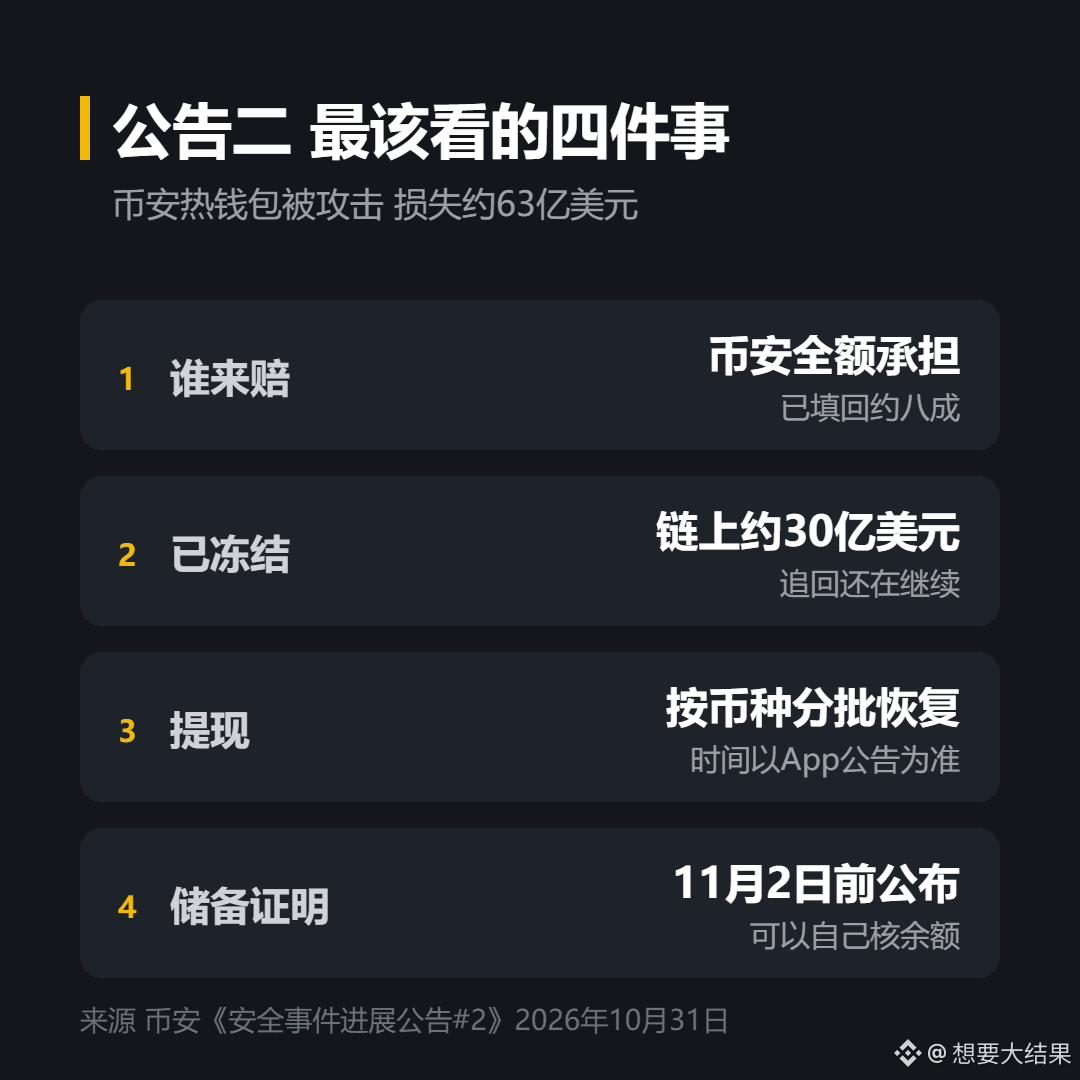
The four things that matter most in Binance’s second official announcement after $6.3 billion was stolen
In the early hours of October 31, Binance released its second security incident update, confirming that its hot wallet had been attacked at 4:05 a.m. Beijing time on October 30, resulting in the loss of about $6.3 billion worth of token assets.
First, Binance itself will cover the losses. SAFU and the company’s own funds will make up the full amount. More than $6.34 billion has been prepared; corresponding tokens worth over $5 billion are already in place, covering about 80% of the loss. The rest is being purchased on and off the market.
Second, about $3 billion has already been frozen on-chain, and efforts to recover more are ongoing. So far, no evidence has been found that wallet private keys were leaked. The breach may have started with a compromised laptop, and other points of intrusion were later discovered.
Third, withdrawals are suspended, while deposits and other services continue as usual. Withdrawals will resume in batches by token. The estimated timelines have changed from 48 hours to 34 hours and then 42 hours, so check the announcements in the app for the latest information.
Fourth, the first Proof of Reserves snapshot has been scheduled. The results will be announced before Monday, November 2. At that point, you can check the Proof of Reserves page on Binance using your account to see whether your balance has been included.
Be extra cautious in the days after withdrawals resume:
Only trust withdrawal resumption notices in the app. Any “priority withdrawal channel” or “verification to unfreeze your account” in private messages is fake.
Make a small test withdrawal first. Once you’ve confirmed the address and network are correct, withdraw larger amounts.
Queues may be slow—that’s normal. Don’t seek out so-called insiders to speed things up.
Update, November 18: Binance began restoring withdrawals in stages on November 1, and has also published its Proof of Reserves. Check the announcements in the app for the latest information.
#币安被盗