
Back in July, I said this downturn had the hallmarks of a long-term reversal.
Whether that would be confirmed depended on whether the subsequent rebound could break above the previous high.
Three months later, the rebound failed to break above the previous high. The reversal is essentially confirmed.
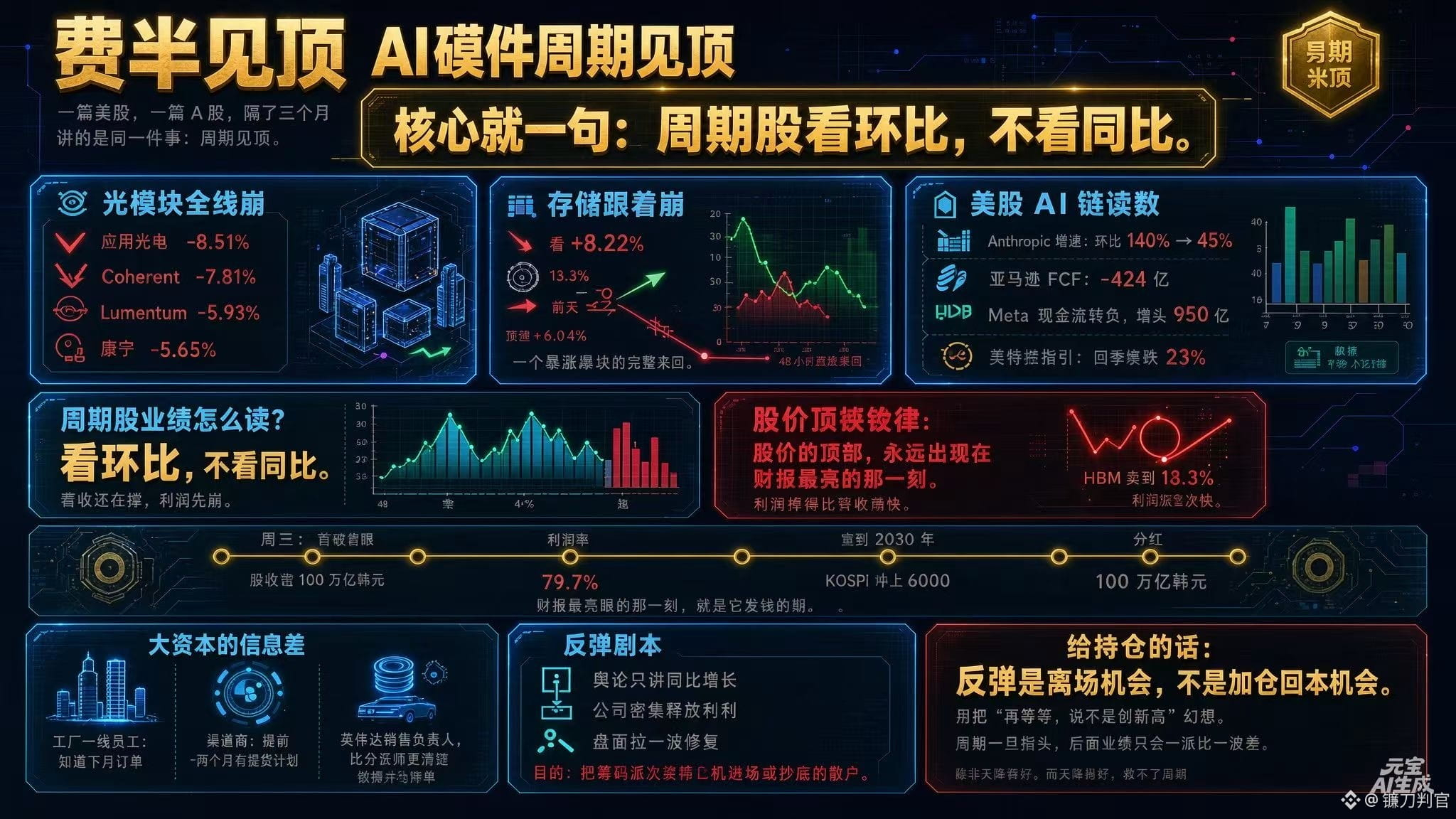
Today’s piece takes that analysis one step further: the cycle in optical modules and AI hardware has peaked.
The key point is simple: for cyclical stocks, look at quarter-over-quarter numbers, not year-over-year numbers.
Last week’s price action is the evidence.
Optical module stocks plunged across the board.
Optical communications stocks tumbled together in a single day: Coherent and Lumentum fell more than 7–8%, Applied Optoelectronics dropped more than 8%, and Corning followed suit.
Memory stocks plunged too. SK Hynix surged more than 13% intraday on its earnings day, then gave back over 6% in the following few trading sessions.
A complete boom-and-bust cycle in just a few trading days.
How should you read the results of cyclical companies?
Look at quarter-over-quarter numbers, not year-over-year numbers.
Leading companies hit record highs in the second quarter. In the third quarter, results fell quarter over quarter, with profits dropping faster than revenue.
Revenue is still holding up, but profits are already collapsing.
That’s the most typical signal of a cyclical peak.
The U.S. AI supply chain is showing the same pattern.
Anthropic’s growth rate fell from 140% to 45% quarter over quarter.
Amazon’s FCF was negative $42.4 billion. Meta’s cash flow turned negative, and it promptly announced a $95 billion share offering.
Intel’s third-quarter revenue beat expectations, but its fourth-quarter guidance fell far short, sending shares down more than 23% after hours.
There’s a pattern with cyclical stocks that’s been especially clear in this AI cycle:
Their share prices often peak right when their earnings look the best.
SK Hynix is a textbook example.
On earnings day, revenue topped 100 trillion won for the first time, its operating margin was around 80%, and HBM orders were booked through 2030. The stock surged more than 13% intraday, and the KOSPI climbed above 6,000.
That same day, it announced 100 trillion won in dividends.
The moment its earnings looked brightest was the moment it paid out.
The old rule at a cyclical peak: instead of investing in expansion, companies return cash to shareholders.
The information gap works the same way.
Factory-floor employees know whether next month’s orders are picking up; distributors have shipment plans one or two months in advance.
In the U.S., Nvidia’s sales executives know more about data center orders than any analyst.
Big money has never relied on earnings reports. Those reports are for retail investors.
Institutions had already worked out the full-year numbers by midyear.
(The rest is in the replies.)
$SKHY
#美股财报季来袭