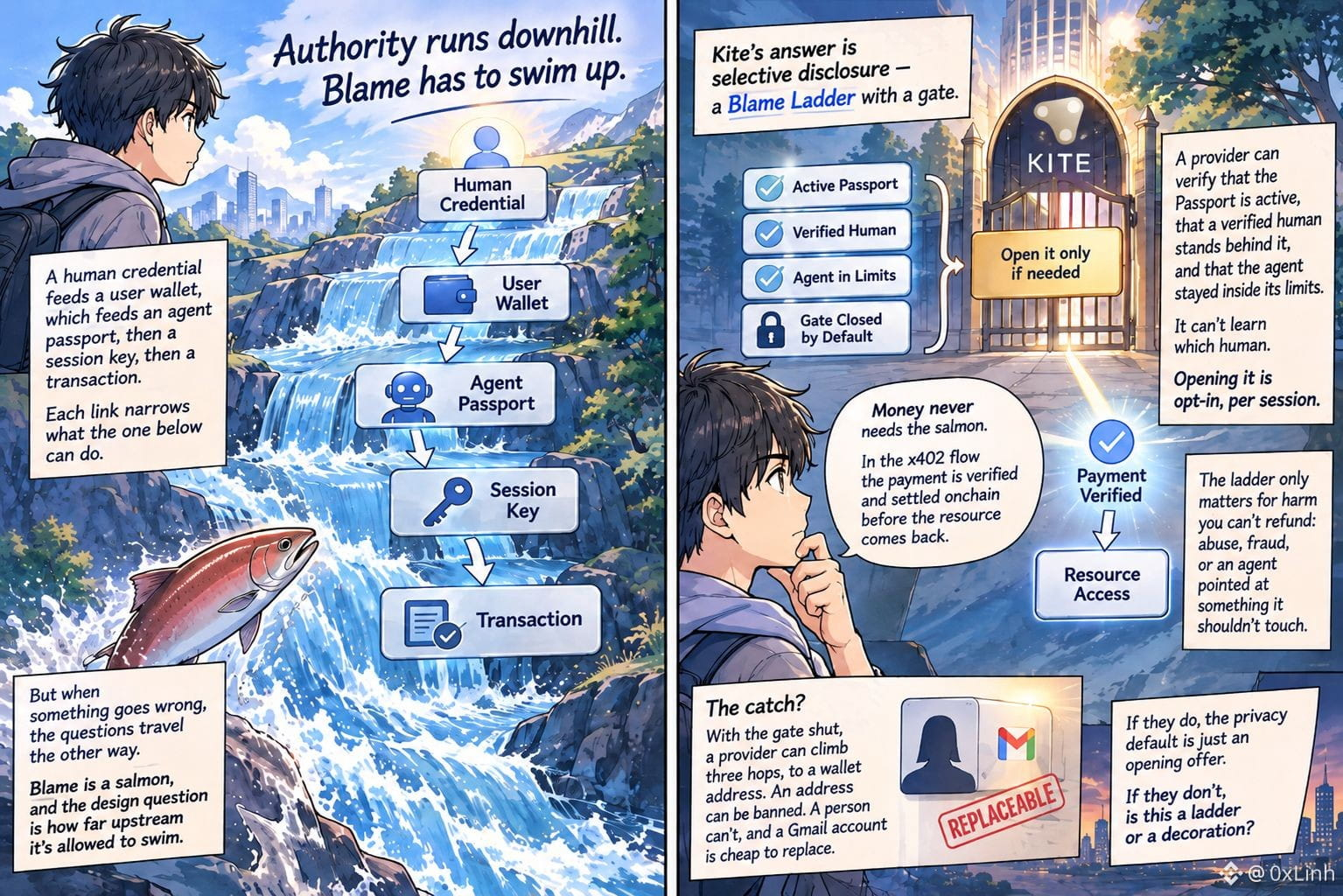
Authority runs downhill. Blame has to swim up.
That’s how I ended up reading Kite Passport. A human credential feeds a user wallet, which feeds an agent passport, then a session key, then a transaction. Each link narrows what the one below it can do, like a river splitting into streams until a session dries up the moment its scope is spent.
But when something goes wrong, the questions travel the other way. Who sent this? Who’s behind it? Blame is a salmon, and the design question is how far upstream it’s allowed to swim. Four hops separate a transaction from a human, and the last hop is the one that matters.
Kite’s answer is selective disclosure, and I think of it as a Blame Ladder with a gate. A provider can verify that the Passport is active, that a verified human stands behind it, and that the agent stayed inside its limits. It can’t learn which human. The gate is shut by default. Opening it is opt-in, per session.
Money never needs the salmon. In the x402 flow the payment is verified and settled onchain before the resource comes back. The ladder only matters for harm you can’t refund: abuse, fraud, an agent pointed at something it shouldn’t touch.
Here’s what stopped me. With the gate shut, a provider can climb three hops, to a wallet address. An address can be banned. A person can’t, and a Gmail account, the deep dive’s own example of a verified human, is cheap to replace. So the ladder ends at a pond, and a person can dig another one.
I won’t judge this by how many Passports exist. I’d watch who controls the gate, what forces it open, and whether providers in regulated categories refuse to serve a shut one.
If they do, the privacy default is just an opening offer. If they don’t, is this a ladder or a decoration?
$KITE
#KiteBBW ⭐️
That’s how I ended up reading Kite Passport. A human credential feeds a user wallet, which feeds an agent passport, then a session key, then a transaction. Each link narrows what the one below it can do, like a river splitting into streams until a session dries up the moment its scope is spent.
But when something goes wrong, the questions travel the other way. Who sent this? Who’s behind it? Blame is a salmon, and the design question is how far upstream it’s allowed to swim. Four hops separate a transaction from a human, and the last hop is the one that matters.
Kite’s answer is selective disclosure, and I think of it as a Blame Ladder with a gate. A provider can verify that the Passport is active, that a verified human stands behind it, and that the agent stayed inside its limits. It can’t learn which human. The gate is shut by default. Opening it is opt-in, per session.
Money never needs the salmon. In the x402 flow the payment is verified and settled onchain before the resource comes back. The ladder only matters for harm you can’t refund: abuse, fraud, an agent pointed at something it shouldn’t touch.
Here’s what stopped me. With the gate shut, a provider can climb three hops, to a wallet address. An address can be banned. A person can’t, and a Gmail account, the deep dive’s own example of a verified human, is cheap to replace. So the ladder ends at a pond, and a person can dig another one.
I won’t judge this by how many Passports exist. I’d watch who controls the gate, what forces it open, and whether providers in regulated categories refuse to serve a shut one.
If they do, the privacy default is just an opening offer. If they don’t, is this a ladder or a decoration?
$KITE
#KiteBBW ⭐️