
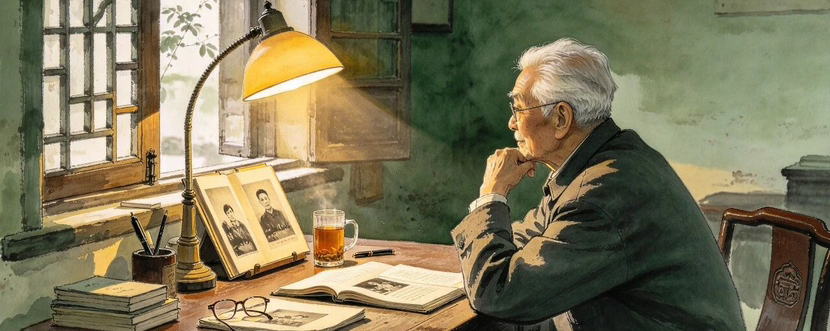


THE ELDER GENERATION’S MEMOIRS
Turn a lifetime into a book
Have you ever tried asking your parents this question—“Dad, what were you like when you were young?”
“There’s nothing much to say.” “It was all pretty ordinary.” “Same as everyone else.”
Then the conversation would veer off—to dinner, watching TV, or asking you instead whether work was going well or the kids were doing okay. It’s as if there’s a quiet wall between us and our parents—not built through arguments, but brick by brick, through silence.
01
Why We Don’t Like Telling Our Own Stories
Look deeper, and you’ll see this isn’t about personality. It’s etched into the bones of our culture.
Our old traditions value “the middle way” and modesty, and discourage standing out. Confucianism says, “Let feelings arise, but keep them within the bounds of propriety”—keep emotions in check, and let actions speak louder than words. Passed down from one generation to the next, “speak less, don’t show your flaws, don’t stick your neck out” became a way of life—and a virtue.
A psychology study
A Cornell University psychologist asked Asian American and European American college students to keep a diary for a week, then gave them a surprise test. When the prompts were about “their own lives,” the high-achieving Asian American students actually ranked near the bottom of their class. They were so focused on others that writing about themselves was a real struggle.
Where we come from
When we wrote essays titled “My…,” teachers taught us to elevate the message, focus on the collective, and avoid individual heroism. “The nail that sticks out gets hammered down.” “Don’t air your dirty laundry.” “Don’t flaunt your wealth.” We heard these sayings far more often than “I like…”
Western children
are encouraged from an early age to discover what makes “me” unique. They can tell long stories about themselves and don’t hold back from praising themselves.
So it’s not that we have no stories. We were trained from childhood to quietly hide the “me” inside us. Hide it long enough, and even we forget that we, too, have stories to tell.
02
Becoming parents deepens the silence
Once they become parents, that silence grows even heavier.
I once knew a family with an old, faded wooden chest that had sat in their storage room for years. The father had made it by hand when he was young, and its latch was rusted. His son never knew what was inside until his father’s seventieth birthday, when they opened the lid for the first time and he slowly began to tell the stories of those years.
There was nothing valuable in the old wooden chest, just—
A bundle of ration coupons, a worn work ID, a few black-and-white photos, letters home to his mother
He left home young to earn a living, doing heavy labor and living in a dormitory. After he married, he worked overtime and traveled constantly to support his family. He never once complained to his children about those hardships. In their memories, he was always silent and strong, as if he could never be vulnerable.
So many Chinese families are like this. Parents swallow their hardships and leave us the comfort and security. What they don’t talk about is their hurt; what they don’t show off is their pride; what they bear alone is the hardship.
That generation lived through material scarcity and turbulent times. But when you really ask them to reminisce, their first words are often still, “There’s nothing much to tell.”
The cost is that we know what dishes our father likes and the familiar refrain of our mother’s nagging, yet we never knew—
Before they became “Dad” and “Mom,”
they were young once, too.
When older family members say, “There’s nothing worth talking about,”
they’re often describing a whole life we’ve overlooked
03
What tightens the heart most is time
We always think our parents’ memories will stay right there forever, like old furniture at home that can’t be moved. But as people grow old, their memories can be stolen away. Stories they can still recount in detail today grow hazy in a couple of years; later, so much sinks completely into time, beyond anyone’s reach.
A news report
The Paper once published a report about young people trying to use AI to help older adults write their memoirs. What they encountered was “a generation’s silence.” Many older people started out enthusiastically, but stopped partway through, thinking, “My life isn’t worth writing about.” One elderly woman praised the writing to their face, but her daughter talked her out of it afterward: “Why spend money on this? She’s not famous. Who would read it?”
You see, even the idea of “recording your own life” is, in the minds of so many older people, the same as “showing off” or “making a name for yourself.” The experiences of ordinary people, they think, belong only in a diary at home—not in a book.
But Grandma Yang Benfen didn’t see it that way. She wrote Qiuyuan about her mother, an ordinary working-class woman with no accolades or extraordinary story. She simply recorded the traces her mother left in this world, so they wouldn’t be swept away by time. The book moved countless ordinary people who were not famous.
Because the joys and sorrows of ordinary people are the most real, and the most moving.
04
So, what is this really about?
What are we really doing when we help an older family member write their memoir? It’s not about publishing a book, writing someone’s biography, or making anyone famous. It’s about helping those who never learned to express themselves find, piece by piece, the “me” they’ve kept hidden all their lives.
I
Keeping them company
Brew a cup of tea and start with an old photo or a “Back in those days…” Let the conversation unfold, little by little.
II
Putting it together
Turn the fragments scattered across decades of memories into a story with a beginning and an end.
III
Making it a book
Make a book they can open and leaf through, filled not with grand words, but with the details of everyday life.
You don’t need to know how to write. Many older people didn’t have much schooling, their hands tire when they hold a pen, and decades of memories are scattered in their minds, impossible to sort out. That’s perfectly normal. What we do is sit down and talk with them.
Then we gather those fragments and shape them into a book they can open and leaf through. There are no grand words in it, just the details of everyday life: a mouthful of food saved for later, a garment stitched late at night, a letter sent that never got a reply.
A book can’t bring anyone back, and it won’t give your father ten more years to live. But decades from now, a child might turn to one of its pages and learn that their grandfather was once stubborn and poor, and secretly slipped money to his son; they’ll learn which land, and which hard years, their roots grew from.
The parents we hear about from other people are always only one-sided versions of them. A memoir can finally let them be fully themselves, just once.
Turn a lifetime into a book.
Not to last forever, but to leave a trace.
Want help writing? Send me a DM or leave a comment