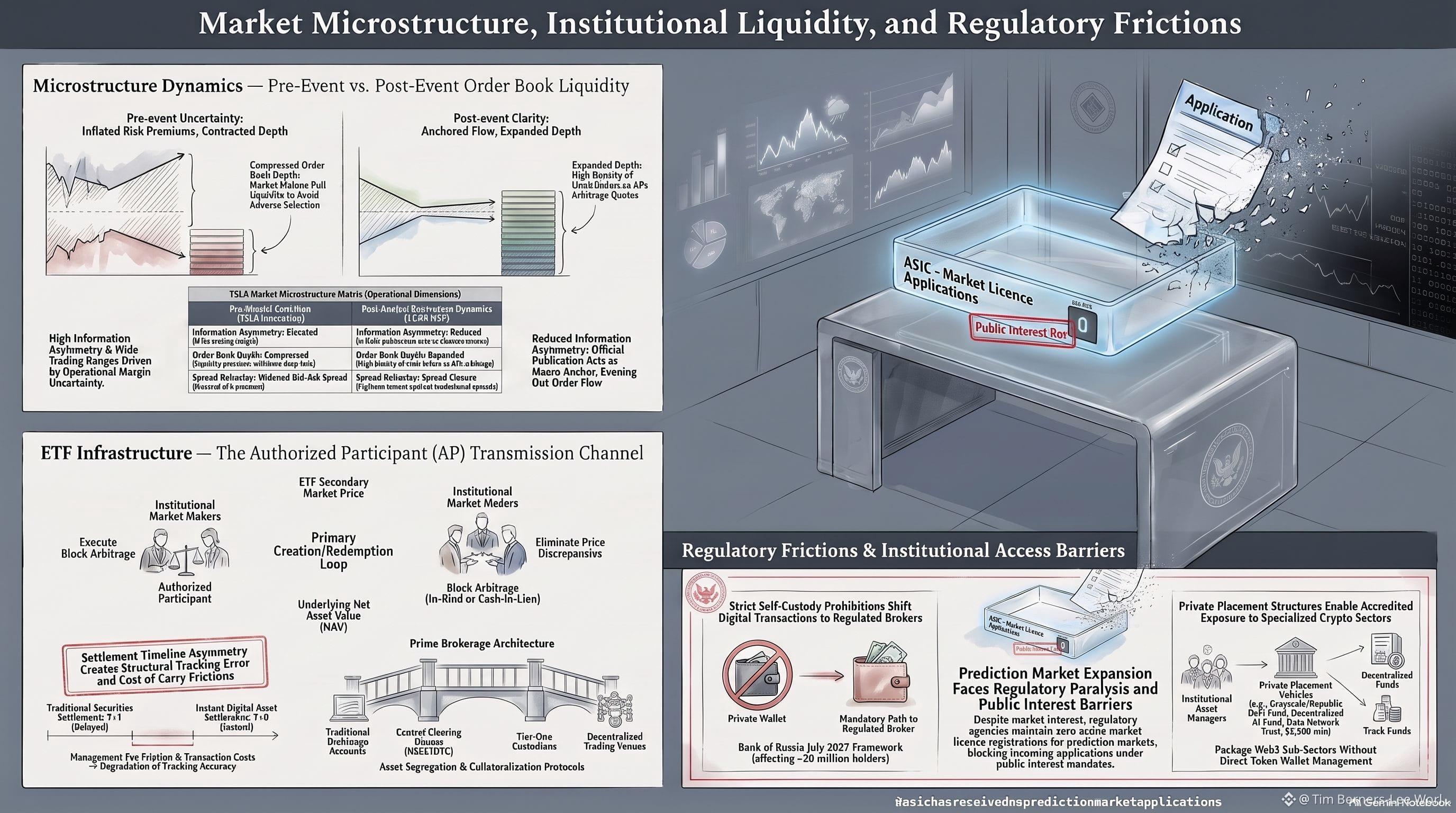
#asichasreceivednopredictionmarketapplications
Australia’s licensing void and ASIC’s strict threshold
The revelation that the Australian Securities and Investments Commission $ASIC.US has no record of formal applications from prediction market platforms exposes a deep divide between the global boom in event contracts and the region’s rigid Asia-Pacific legal frameworks. With no locally authorized operators, the regulator has made clear that any participation by Australian residents in offshore giants takes place at their own corporate risk, without dispute resolution schemes or safeguards to segregate client funds. This lack of applications is not due to a lack of market interest, but to the extremely high legal standard imposed under section 798A of the Corporations Act 2001, which requires an assessment of whether these financial structures truly serve the “public interest.” The main barrier to entry for competitors is that ASIC has operationally classified prediction markets in the same restrictive category as binary options, a derivative product banned for retail clients in the country until 2031. From a regulatory perspective, contracts based on the outcome of non-financial events—such as the weather or sports scores—are structured as “all-or-nothing” settlements, sharing the same speculative and inherent nature as traditional betting. In addition, alerts published on its Moneysmart portal emphasize the systemic risks of market manipulation and information asymmetry, where average users compete directly against participants with confidential or privileged information. Consequently, the outlook for derivatives finance in Australia remains tightly sealed, demonstrating that regulators prioritize mitigating harm to retail consumers over easing restrictions