
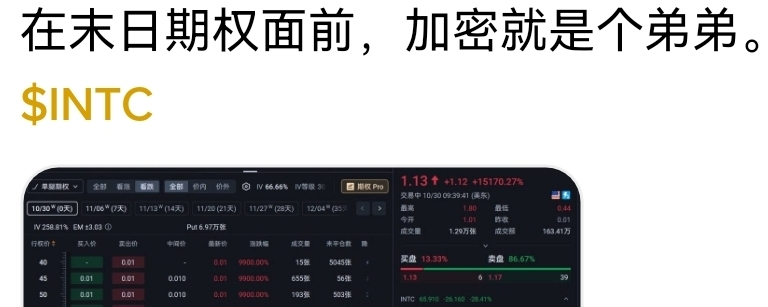

On October 30, Intel plunged nearly 30% in a single day. Before its earnings report, someone spent $13,000 on $68 puts expiring that day, paying just 3 cents per contract. The next day, the stock was cut in half, and those options shot up to over $4— a 135-fold return, turning $13,000 into $1.8 million.
A lot of people think crypto is volatile enough—that a 20% gain or loss in a day is exciting. But anyone who truly understands leverage knows that 0DTE options are a magnifying glass. The stock fell just 30%, yet cheap out-of-the-money puts went from worthless to money printers. Behind it all lies the most fundamental secret of options: the Gamma effect.
1. Let’s break down Gamma
The sensitivity of an option’s price to the stock price is called Delta.
Gamma, meanwhile, measures how quickly Delta changes.
As expiration approaches, Gamma for at-the-money options can rise sharply. A small move in the stock price can cause Delta to swing dramatically. An out-of-the-money option can instantly become deep in the money, and its price no longer rises gently—it can skyrocket in leaps. Conversely, if the move goes the wrong way, it can become worthless in a very short time.
That’s why options expiring that day can deliver astonishing returns of a hundredfold or more. They amplify a “small move in the stock price” into a “dramatic jump in the option price.” No matter how volatile crypto gets, it rarely reaches such extreme multiples overnight at the contract level.
II. A deeper look: How do professional traders make money with Gamma?
Ordinary investors see stories of hundredfold returns and get envious. The real pros, however, are doing something else—Gamma scalping.
They deliberately buy options to establish a Long Gamma position, while continually buying and selling shares to keep the overall position’s Delta as close to zero as possible.
When the stock price rises, Delta increases, so they sell shares;
When the stock price falls, Delta decreases, so they buy shares.
The result: they sell as the stock rises and buy as it falls. As long as the market moves back and forth, they can continually “scalp” profits from the underlying asset.
The essence of this strategy is betting that realized volatility will exceed implied volatility.
On the options side, you pay a premium and continue to bear time decay. On the stock side, you profit by selling high and buying low. When the latter’s gains exceed the former’s losses, the strategy is profitable overall.
As expiration approaches, Gamma rises and hedging needs to happen more frequently, significantly increasing both the frequency and size of scalping gains. That’s why professional traders pay such close attention to Gamma management around 0DTE expiration—high Gamma amplifies both profits and risk.
III. How does it work in practice? Three typical examples
Example 1: The classic straddle with dynamic hedging
Suppose a stock is currently trading at $100. You expect it to move significantly over the next few days, but you’re unsure of the direction.
Buy one at-the-money Call and one at-the-money Put to form a straddle, with an initial Delta close to zero. Then adjust as soon as the stock price moves: if it rises to $103, the overall Delta becomes positive, so you sell the corresponding number of shares; if it falls back to $98, Delta becomes negative, so you buy shares back.
As the stock price moves back and forth, you keep selling high and buying low in the stock. As long as the actual price swings are large enough, your gains from the stock can cover the options’ time decay.
Example 2: High-Gamma scalping near expiration
With only 1–2 days left until expiration, Gamma for at-the-money options is already very high. Buy an appropriate number of at-the-money or slightly out-of-the-money options while maintaining Delta neutrality. Even a 1–2% move in the stock price calls for an immediate adjustment in the opposite direction on the stock side.
Profits can grow faster, but the risks are higher too. A gap or one-way market move can leave you with significant exposure if you don’t hedge in time. This approach is suitable for people with a clear volatility outlook who can monitor the market in real time.
Example 3: Turning an existing options position from “passive” to “active”
Suppose you already own some Calls and their combined Delta is currently +0.6. Immediately sell the corresponding number of shares to bring your total Delta close to zero. Then manage the position dynamically: if the stock keeps rising, keep selling shares; if it pulls back, buy shares back.
This turns an options position that originally had directional exposure into a neutral strategy focused on profiting from volatility. Many professional traders continuously hedge this way after taking an options position.
A few final thoughts
Options expiring that day can make you rich overnight—or wipe you out in an instant.
Gamma is a double-edged sword, and scalping it is like dancing on the edge of a blade.
Those who truly make money aren’t the ones who dare to gamble more, but the ones who understand volatility more deeply and execute their hedges more consistently.
This is where the market is fairest: it rewards those who know how to manage risk and leaves the risk to those who only focus on returns.
Once you understand all this, you’ll see that in the world of finance, the most exciting thing has never been the direction of the move, but volatility itself.