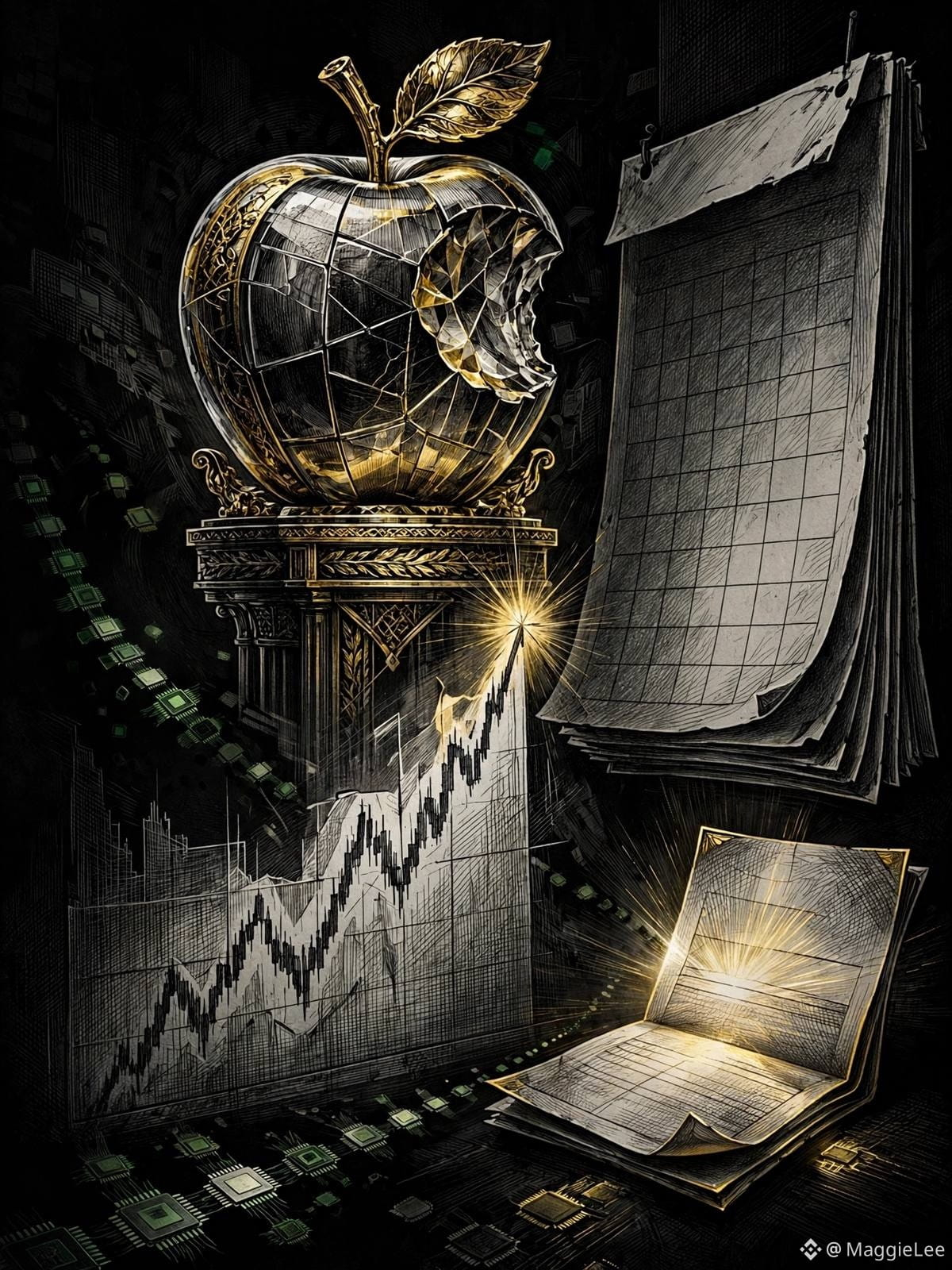
Apple reclaims the $5 trillion market-cap crown—but this time, by “falling less than Nvidia.” Monday’s post-market earnings report is the real test.
First, the numbers (U.S. market close on 10-30; premarket in Beijing on 10-31):
• $AAPL closed at $344.63 (-1.23%, down $4.28); Nvidia fell 4.22% to close at $204.64—a world of difference in their declines.
• Apple’s market cap is about $5.03 trillion, versus Nvidia’s roughly $4.94 trillion. After a long time, Apple is back in the global No. 1 spot, with a gap of less than $90 billion between them.
• Up 26.8% year to date; its 52-week high is $351.73 (reached on 10-23), and it’s now just 2% below that peak.
What’s Monday’s test? After the market closes on 11-2 in the U.S. (early morning on 11-3 in Beijing), Apple reports its fiscal Q4 2026 results:
• Expectations: revenue of about $113.6 billion (+10.2%) and EPS of about $1.98 (versus $1.85 in the same quarter last year). The company’s own guidance calls for revenue growth of 9–11% and a gross margin of 47–48%—market expectations are already at the top end of that range.
• This will be the first earnings call hosted by new CEO John Ternus.
• The product lineup has just heated up: the first foldable iPhone Duo went on sale globally on 10-23; the first touchscreen MacBook Pro (M5 Pro/Max) was announced on 10-28, with deliveries starting 11-6. There’s plenty of ammunition for the holiday season.
The thesis: Apple won this crown through “relative strength,” not fundamentals—it got it back because Nvidia fell 3 percentage points more. The stock is now up 27% year to date, near its all-time high, and trading at nearly 40 times earnings. Buyers are betting on Monday’s report. Apple has beaten earnings expectations in each of the past four quarters, but after beating in July, the stock still fell 7.35%. In this market, where “AI spending is on trial,” a beat is no longer enough: it has to be a big beat, with stronger guidance.
Here are the risks you can’t leave out:
• Rising memory prices are a real threat: Intel plunged 23% after hours because of PC memory costs, and Apple itself flagged memory cost pressures for iPhone and Mac in its guidance.
• The 47–48% gross margin includes a one-time benefit of about 1 percentage point from tariff refunds—headline numbers look good, but margins are lower without it.
• Up 27% year to date, near an all-time high, and priced for perfection: if guidance is even a little soft, Apple could suffer Intel’s fate.
Bottom line: Don’t bet on the direction; watch two things—the underlying gross margin excluding one-time benefits, and how strong the holiday-quarter guidance is. If the beat isn’t convincing, Apple could be the next Intel.
$AAPL $NVDA
#苹果 #财报季 #科技股 #市值王座 #RisingMemoryPrices
(Personal research, not investment advice.)