

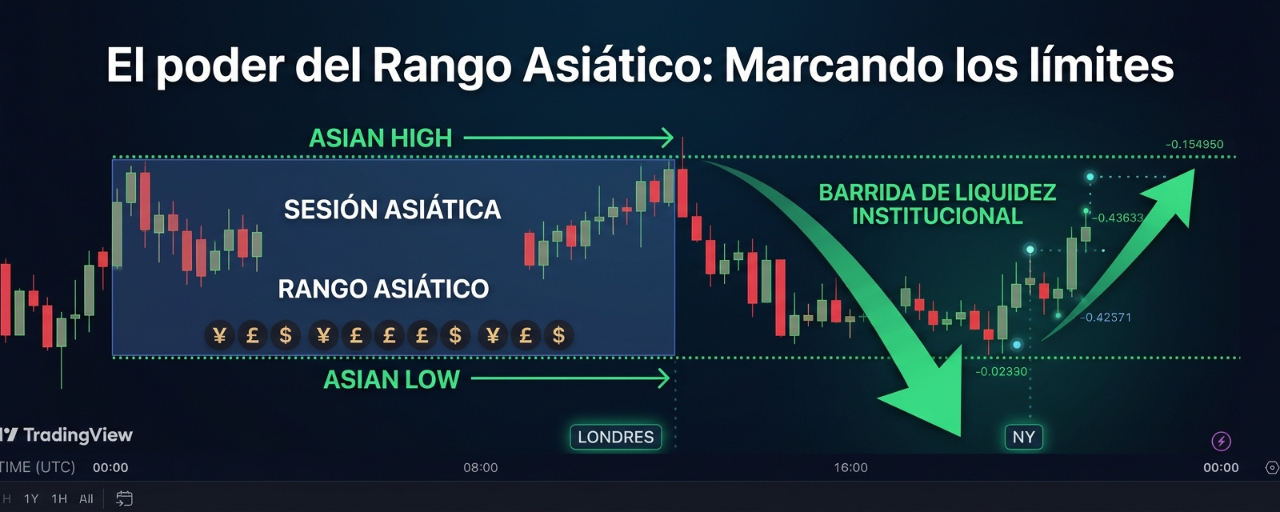

If you open your charts and trade blindly from the very first minute of the London or New York session, you're playing the lottery. The daily market doesn't move at random; it leaves clues and liquidity trails that take shape from the day's first breath.
As armored warriors learning to read the market step by step, today we're going to uncover the secret behind the Asian Range and how to use it to anticipate institutional moves.
What Is the Asian Range, and Why Does It Matter?
The Asian session (generally the time block that includes the start of Tokyo trading) is usually characterized by lower trading volume compared with the liquidity giants of London and New York.
During these hours, prices tend to consolidate, moving within a relatively narrow range. For Smart Money, this period of apparent calm is the perfect setting: they create a visible range (Asian highs and lows) that acts as a massive liquidity trap.
Institutions use these levels formed during the early hours to accumulate positions or let retail traders place their orders and stop-losses in predictable locations.
Anatomy of the Range: Highs and Lows
To trade this concept cleanly on your platform, follow these steps:
Define the Time Window: Mark the price range the asset (for example, Bitcoin) forms during the first hours of the Asian session.
Identify the Extremes: Draw a clear line at the Asian High and the Asian Low.
Understand the Trap: Most of the time, the price will leave this range before or right at the start of the London session. This false breakout goes straight for the liquidity accumulated at the extremes, providing the counterparties institutions need.
How to Use It to Your Advantage During the Trading Session
Don't trade the initial breakout: If the price breaks the Asian high at the London open, don't rush to buy. It's most likely a manipulation to sweep stops before the real move in the opposite direction.
Look for a Reentry or Judas Swing: Wait for the price to sweep one of the Asian Range extremes and show a change of character (ChoCh) as it moves back inside the range. That's the true institutional entry signal.
The market leaves clear clues before making its big moves. Stop chasing candles when you open your screen. Tomorrow morning, open your chart, mark the Asian Range boundaries, and watch how the price reliably goes hunting for that liquidity before starting its true trend. Train your mind and follow the trail of real money!
#BinanceSquare #SmartMoneyConcepts #CryptocurrencyTrading #TechnicalAnalysis $BTC $ETH