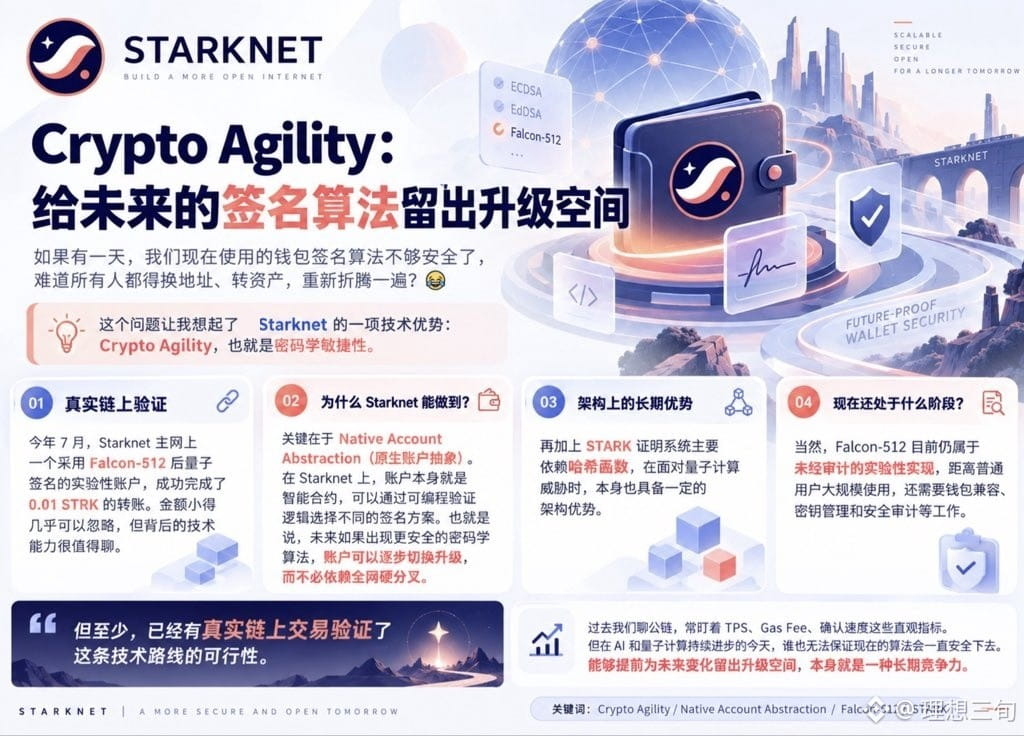

If one day the wallet signature algorithm we use today is no longer secure enough, would everyone really have to switch addresses, transfer their assets, and go through the whole process all over again?
This question brings to mind one of Starknet’s technical strengths: Crypto Agility.
In fact, something quite interesting happened on Starknet mainnet this past July.
An experimental account using post-quantum Falcon-512 signatures successfully completed a transfer of 0.01 STRK.
The amount was negligible, but the technical capabilities behind it are worth discussing.
/
This brings us to Starknet’s Native Account Abstraction.
Unlike traditional externally owned accounts, Starknet accounts are smart contracts themselves. They can use programmable verification logic to choose different signature schemes.
This means that if a more secure cryptographic algorithm emerges in the future, accounts can adopt a new signature verification method without requiring a hard fork of the entire network.
Additionally, because the STARK proving system relies primarily on hash functions, it already has certain architectural advantages in the face of quantum computing threats.
Of course, the Falcon-512 implementation mentioned above is still experimental and unaudited. Before it can be used at scale by everyday users, work remains to be done on wallet compatibility, key management, and security audits.
But at least a real on-chain transaction has already demonstrated the feasibility of this technical approach.
/
As I looked into this, I found the concept of Crypto Agility quite interesting.
When discussing a blockchain’s technical advantages, we’ve often focused on more tangible metrics such as TPS, gas fees, and transaction confirmation speed.
But cryptography itself is constantly evolving. Especially now, with both AI and quantum computing advancing rapidly, no one can guarantee that the algorithms we use today will remain secure forever.
I think leaving room in advance to upgrade as technology evolves is also a form of long-term competitiveness.
Starknet already has the architectural foundations for this. What’s worth watching next is whether these experimental capabilities can gradually become features that everyday users can easily use.
$STRK
Not investment advice. DYOR.