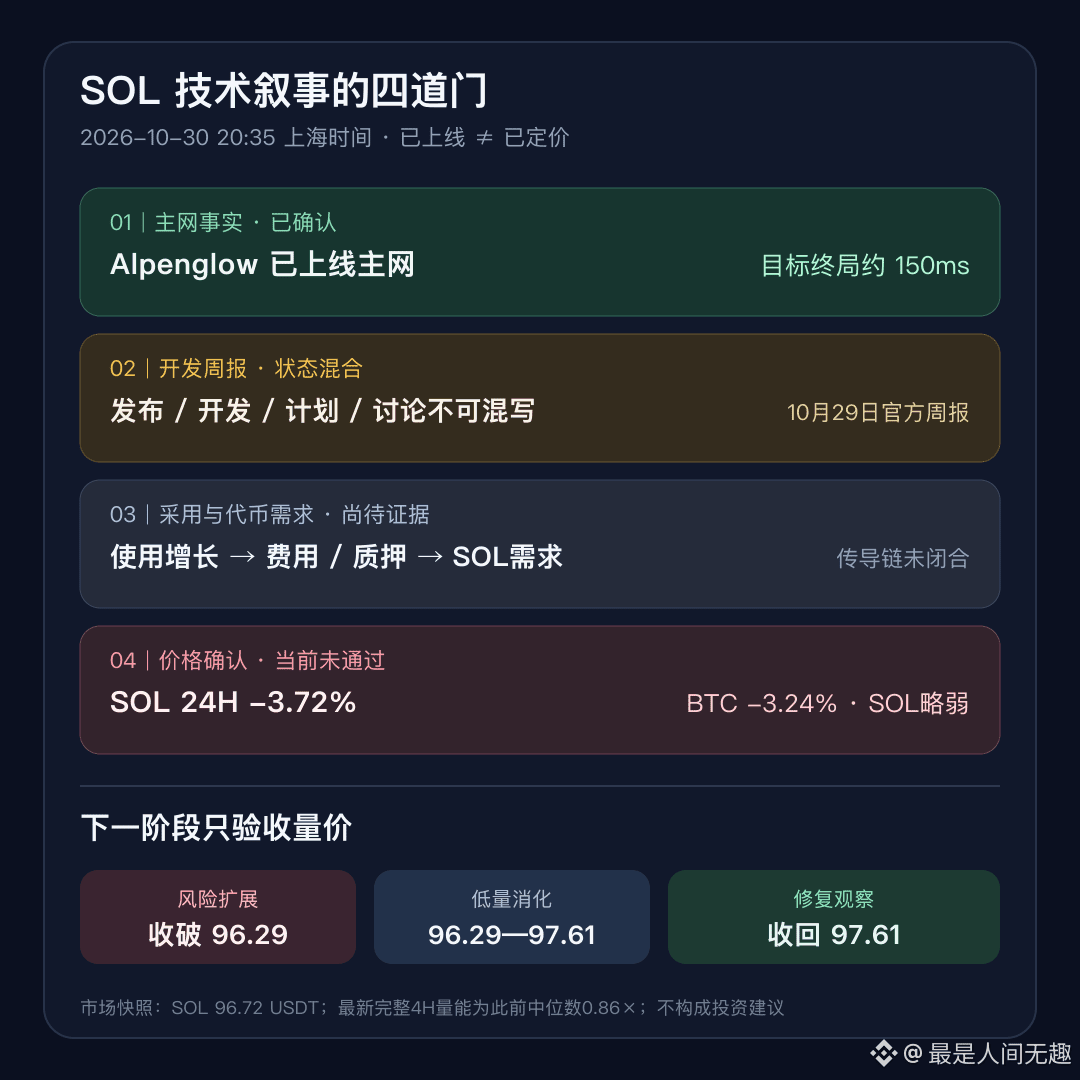
Alpenglow is live, so why is $SOL still down 3.72%? Don’t treat the entire developer weekly report as a new mainnet catalyst
At 20:35 on October 30 (Shanghai time), SOL was trading at 96.72 USDT over the rolling 24 hours, down 3.72%, while BTC fell 3.24% over the same period. This relative performance offers an unwelcome but important takeaway: network technology is making real progress, but the price has yet to show independent strength. The question now isn’t “Is the upgrade good?” but whether it has passed through three gates: adoption, capital, and price.
Only some of the mainnet facts have been confirmed. Solana’s official upgrades page lists Agave 4.3 as delivered in October 2026 and explicitly states that Alpenglow is live on mainnet, with a target finality time of about 150 milliseconds—roughly 99% faster than TowerBFT’s 12.8 seconds. This is protocol-level progress, not a rumor.
But the official developer weekly report from October 29 should not be read wholesale as “another batch of features is live.” The new system call for optimized arithmetic is still under discussion; default CLI builds for V1 transactions, the Loader V3 upgrade process, some validator configurations, and network support are still in development, planned, or slated for future releases. The report also lists software versions that have been released, but “version release,” “feature development,” “mainnet activation,” and “real-world adoption” are four distinct stages.
So far, the market has passed the “there is trading” test, but not the “sustained acceptance” test. Over the full 4-hour period from 04:00 to 08:00, SOL fell from 99.83 to 95.64, with about 197 million USDT in trading volume—6.27 times the median of the previous 12 complete 4-hour periods. From 08:00 to 12:00, it rebounded from 95.65 to 97.25, with volume still at 3.37 times the median, but it did not recover the starting point of the previous period. The latest full 4-hour period, from 16:00 to 20:00, closed lower at 96.57 from 97.35, with trading volume of about 31.99 million, just 0.86 times the previous median. The counterevidence is that there was clear buying support after the intraday low of 92.34; the negative evidence is that rebound volume is fading and SOL remains slightly weaker than BTC.
Next, assess the situation across three layers rather than betting on the words “technology upgrade” alone:
Capital acceptance returns: A full 1-hour candle closes back above 97.61 on increased volume, with hourly trading volume above about 11.94 million USDT.
Structure repairs: The subsequent full 4-hour candle closes above 98.59, with trading volume above about 37.22 million USDT, and SOL is no longer underperforming BTC over the same period. If all these conditions are met, the view that “technical progress has yet to receive sustained price acceptance” is no longer valid.
Risk continues: A full 1-hour candle closes below 96.29 on increased volume, extending the weakness; a further break below 92.34 would invalidate the intraday support structure. If price merely moves sideways on low volume between 96.29 and 97.61, call it consolidation—not a breakout or a crash.
Key risks include misreading the target finality time as a guaranteed result for every transaction, mistaking development progress for mainnet activation, overlooking the gap between real-world usage and token demand, and false signals caused by broader market volatility. First, open the core asset page and check the latest complete hourly trading volume and whether the close confirms a break above 97.61 or below 96.29. Then check whether the 4-hour chart holds above 98.59 and regains relative strength. A technical narrative only becomes part of a trading decision when price and volume respond.