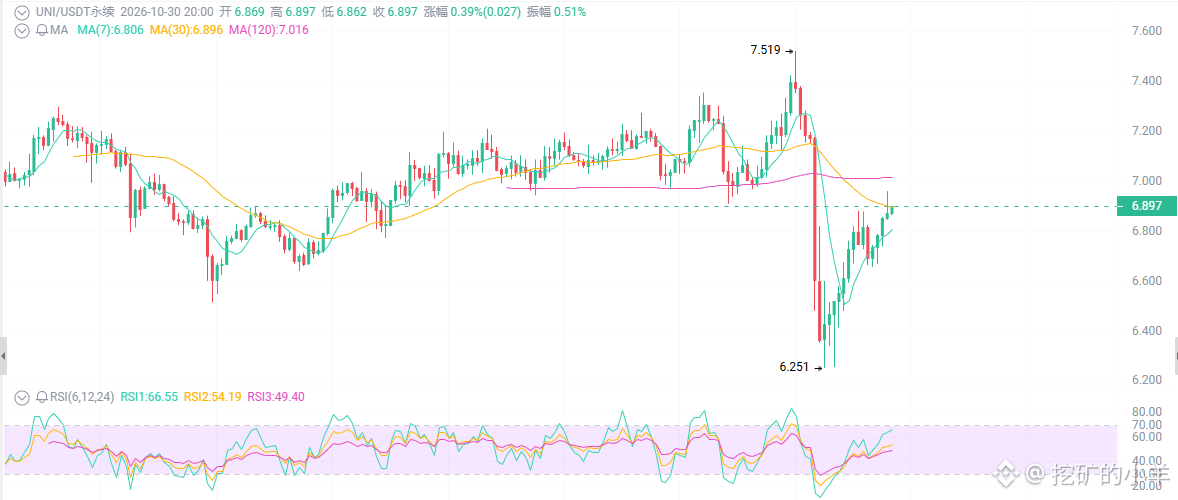
UNI at $6.9—did you cut your losses?
A Binance hacker address dumped 7.02 million UNI, worth nearly $40 million, sending the price straight from $7.5 to $6.27. Meanwhile, daily active addresses on-chain hit a new high for 2026, and new addresses posted their biggest single-day increase since September 2020. Prices are falling, but users are growing. Is this a shakeout by manipulative whales using bad news as cover, or is UNI really in trouble?
First, the surface picture: bad news is piling on, but someone is quietly buying.
UNI is down 22% over the past 30 days, 6% over the past 7 days, and another 3–5% in the past 24 hours. The candlestick chart shows strong support at $6.25–$6.50: today, the price was pushed down to $6.27 before bouncing back. RSI is in the neutral-to-weak 35–45 range—not extremely oversold yet—but trading volume has surged to around $1 billion.
First point: the hacker’s sell-off is real, but have you ever considered this?
7.02 million UNI, sold at an average price of $6.65, worth $39.6 million.
UNI’s daily trading volume is $1 billion. That sell-off accounted for just 4%. Selling pressure of 4% drove the price down 15%, showing just how fragile market sentiment is—one little scare is enough to trigger a stampede.
Daily active addresses: 14,600, a one-year high.
New addresses: 13,100, the biggest single-day increase since September 2020.
Prices are falling, while the number of users is surging.
Second point: Uniswap is no longer what you think it is.
Is UNI just a “governance token”?
The Fee Switch is active: protocol revenue is around $7.95 million, with some flowing toward UNI burn mechanisms.
Aggregator Hooks have launched: they tap into external liquidity, bringing protocol fees and potential UNI burns.
The Unichain OP Enterprise upgrade: accelerating multichain expansion.
Dynamic fee Hooks in v4: turning external traffic into protocol value.
Uniswap is transforming from a “free tool” into a “toll highway.” Every trade and every aggregated order creates real monetary value for UNI holders.
The more CEX blowups there are, the more capital flows to DEXs—and Uniswap stands to benefit the most.
Third point: macro conditions are weighing on UNI, but they can’t kill it.
The FOMC held rates at 3.75%–4% on October 28, taking a cautious, hawkish stance. BTC retreated from its highs to $77,000, and altcoins followed it down.
Macro conditions are cyclical; fundamentals are structural.
Tightening can crush valuations, but it can’t kill a DeFi leader with record daily active users, real protocol revenue, and products that keep evolving.
During the 2018 bear market, Uniswap had only a few hundred daily active users. What happened after that?
During the 2022 bear market, UNI fell to $4. What happened after that?
Every time a good asset gets hammered into a hole, it’s a chance to pick up tokens.