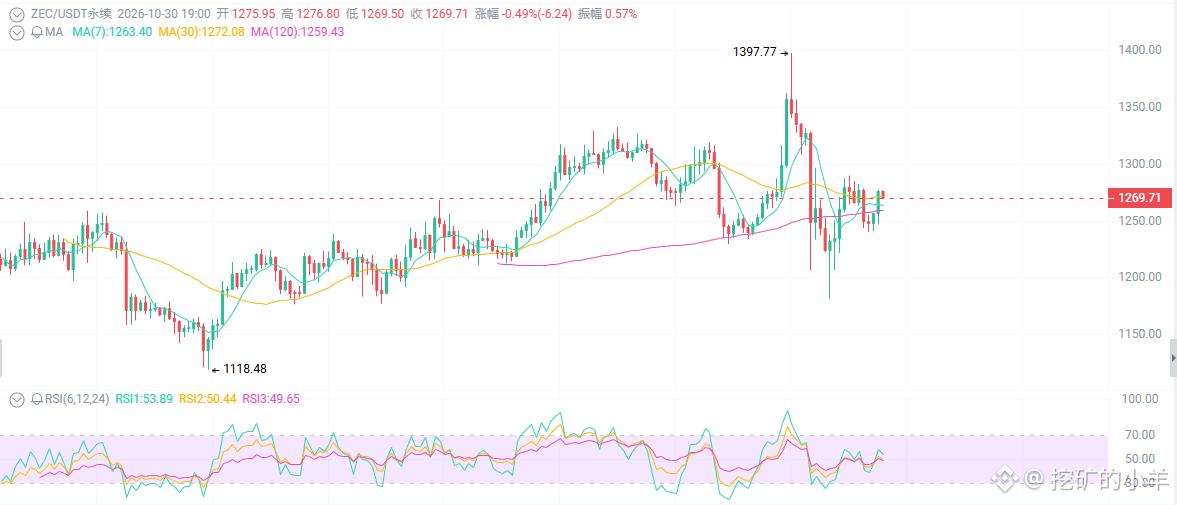
ZEC at $1,270: Are you getting in, or just watching?
ETF inflows for 7 straight days, the NU7 upgrade activating in 5 days, and its 10th anniversary just behind it—but the price plunged from $1,700 back to $1,270. Retail traders are yelling, “Privacy coins are finished,” while institutions keep buying day after day. Is this the last chance to escape, or the fiercest shakeout before the main rally?
First, the big picture: bad news is piling up, but ZEC just won’t fall any further.
BTC is hovering between $77,000 and $81,000, the Fed is holding rates at 3.75%–4% with no cuts, PCE inflation is at 3.6%, and the odds of a December rate hike are still on the table—the whole market is in risk-off mode. Normally, a high-beta altcoin like ZEC should be crashing along with it. But it isn’t.
After pulling back from $1,700 to around $1,200, it bounced all the way back to $1,270. 24-hour trading volume is over $1.5 billion, RSI is neutral, and early signs of a bullish MACD crossover are emerging. When an asset refuses to fall, a big rally may be coming.
First: ETFs are buying, and they’re buying with conviction.
Spot ZEC ETFs, including Grayscale’s, have seen net inflows for 7 consecutive days, with AUM at one point approaching the $1 billion mark.
ZEC’s total market cap is only $21–22 billion. ETF inflows of $1 billion mean institutions have locked up the equivalent of 5% of the circulating supply. And this is sustained buying, not a one-off allocation.
Second: the NU7 upgrade is no minor tweak.
It’s expected to activate on mainnet around November 5, cutting block time from 75 seconds to 25 seconds—a 3x speed improvement. It also introduces the Network Sustainability Mechanism, making the network’s long-term economic model healthier.
ZEC transfers go from “wait a minute” to “almost instant”
Miner incentives are being restructured; daily issuance stays the same, but becomes more sustainable
It paves the way for broader adoption down the line
This isn’t one of those upgrades where “good news turns into bad news once it’s priced in.” It’s a genuine leap in performance.
Before Ethereum’s EIP-1559 went live in 2021, the price also moved sideways. After launch, it took off. Does the NU7 story sound familiar?
Third: the governance dispute around the 10th anniversary—you’re only seeing the argument.
Co-founder Sean Bowe proposed stopping the allocation of 8% of block rewards to community grants, arguing that the treasury already holds $125 million, which is enough. Winklevoss also called for a “focus on privacy at the core.”
A project can openly debate how to spend a $125 million treasury—that means it has real money, and its governance is evolving.
Compared with those zombie projects whose treasuries have long been drained, ZEC’s “arguments” are a nice problem to have. There’s no immediate selling pressure, and capital will be used more efficiently over the long term.