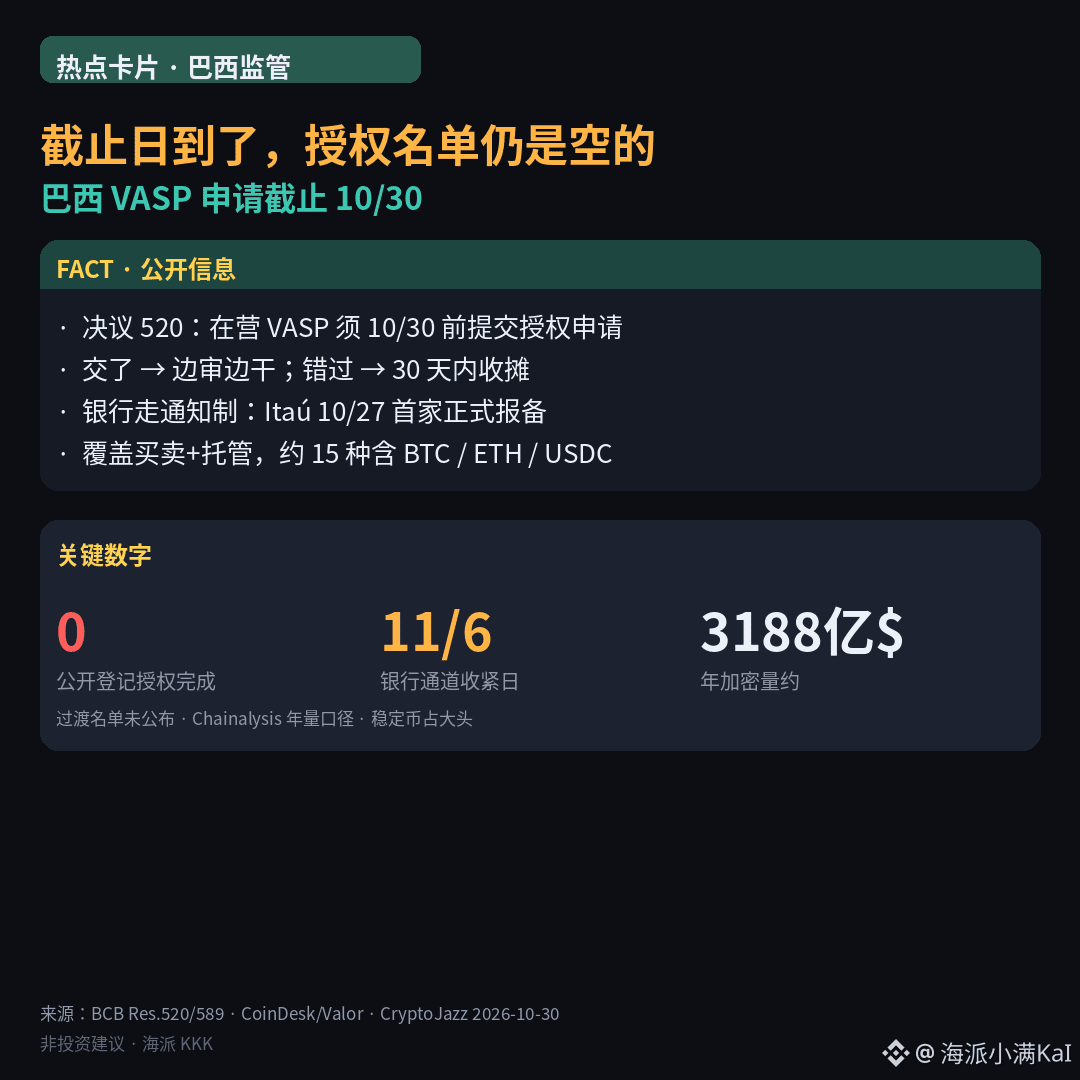
Brazil’s crypto exchanges turn in their applications today. In the central bank’s public data, the number of completed authorizations is still zero.
Under Resolution 520, virtual asset service providers already operating in Brazil must submit an authorization application by today (10/30). Once they apply, they can continue operating while their applications are reviewed; those that miss the deadline have 30 days to wind down. Banks take a different route: those already regulated only need to submit a formal “notification.” The largest private bank, Itaú Unibanco, filed first on 10/27, covering trading and custody of around 15 assets, including BTC, ETH, and USDC. CoinDesk described it as the country’s first bank to move its crypto business under the new framework.
The next cut comes on 11/6: in principle, banks and payment institutions may no longer connect with “unauthorized” crypto service providers. The transition list hasn’t been published yet. Whether platforms that have applied can keep their banking access depends on that list.
Brazil sees around $318.8 billion in crypto volume annually (according to Chainalysis, with stablecoins making up the bulk). The rules taking effect aren’t a switch for a sudden surge, but banks’ formal entry and how access channels change could alter where money flows in from. Binance $BTC perpetual price is currently around 77,700, down about 3.1% over 24 hours.
#巴西加密监管 #BTC $BTC