

Many people investing in AI focus only on GPUs, overlooking a more sobering fact: the biggest incremental demand is coming from storage, driven by large-model inference, KV cache, and long-context multimodal workloads.
$SNDK This earnings report put the “AI storage supercycle” front and center.
In the latest fiscal quarter, data center revenue surged 1,682% year over year—nearly 17-fold—and non-GAAP gross margin climbed to 85.1%, far surpassing the industry's historical norm. Revenue and EPS both beat guidance across the board, while free cash flow came in at a staggering level.
NAND used to be a classic cyclical business, with its ups and downs driven entirely by supply, demand, and pricing dynamics. Gross margins were kept low for years. This cycle is completely different.
The key shift isn’t in consumer USB drives or SSDs, but in the long-term NBM model, where hyperscale cloud providers and AI compute clusters lock in orders well in advance. Multi-year minimum-purchase contracts secure demand and significantly smooth out the boom-and-bust cycles of the past. Management has explicitly said that orders are locked in beyond 2030, covering everything from high-performance TLC enterprise SSDs to high-capacity QLC platforms, purpose-built for AI data lakes and inference clusters.
The reversal in the business mix is plain to see: a year ago, data centers accounted for only about 12% of shipments; now that figure has climbed to nearly 44%. The company is actively scaling back its consumer business, directing all its capacity and resources toward the high-margin AI data-center market. It’s pursuing higher-value revenue instead of fighting it out in the red ocean of consumer markets.
But I have to flag a key risk for traders—this is also the biggest tension in the market right now:
Earnings were explosive, yet the stock came under pressure after hours.
The reason is simple: memory stocks have already surged enormously, and the market has priced in extremely high expectations. Investors aren’t asking whether results are good, but whether the company can keep exceeding expectations. Add in Intel’s earnings miss and weakness in the PC market, and sentiment across the memory sector is under pressure. Investors are divided, and some are taking profits.
On one side, the long-term fundamentals behind AI demand are solid. On the other, the sector is crowded and expectations are sky-high, so even a slight disappointment could trigger a sharp valuation correction. That’s the real tug-of-war playing out in memory stocks right now.
From a cross-market perspective, investor appetite for U.S. memory stocks can also spill over into crypto markets. When risk appetite rises and the AI infrastructure thesis gains traction, risk assets are more likely to attract incremental liquidity. But if good news is priced in at elevated levels and institutions start seeking safety by rotating back into the U.S. dollar and Treasuries, all high-volatility assets will come under pressure together. This is a correlation signal we need to watch closely when looking across markets.
For me personally, this isn’t a signal to blindly turn bullish. It’s a high-quality report confirming where we are in the cycle:
My bullish thesis: AI inference is driving structural growth in memory demand; long-term orders stabilize cash flow; and limited new capacity on the supply side supports prices. Pricing power is gradually shifting into the hands of leading manufacturers.
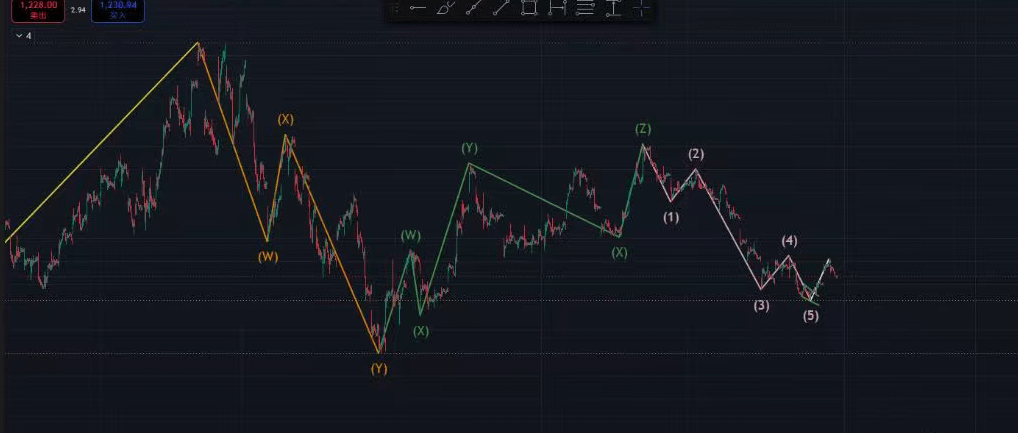
⭐ My stop-loss level (a subjective technical level, not a recommendation)
The conservative stop-loss zone is 949. A break below that would breach the recent high-volume trading area. The earlier support at 1200 remains intact, so if the fundamentals haven’t deteriorated, the price is unlikely to reach the conservative stop-loss level anytime soon.
☕ Risks to watch: The stock’s huge prior gains, stretched expectations, and crowded positioning in the sector all pose risks. Changes in macro liquidity—especially shifts in expectations for Fed rate cuts—could rewrite the valuation baseline at any time. At elevated levels, good news turning into bad news is commonplace.
Cycles don’t stay bullish forever, but the story of AI reshaping memory demand is only halfway through. GPUs are the stars on stage; memory is the underlying infrastructure, quietly being consumed and continuously replenished.
Going forward, I’ll be watching two key signals:
NAND spot price trends
New NBM orders from major manufacturers and whether they come through
I believe these two indicators are what will determine whether the memory rally has further to run.#股票财报季
Risk disclaimer: The above is solely my personal, subjective review of market action and a sharing of my analysis. It does not constitute any trading or buying or selling recommendation. U.S. equities and crypto markets are highly volatile, so be sure to manage risk carefully.
SNDKUSDTPerp1,151.94-1.40%