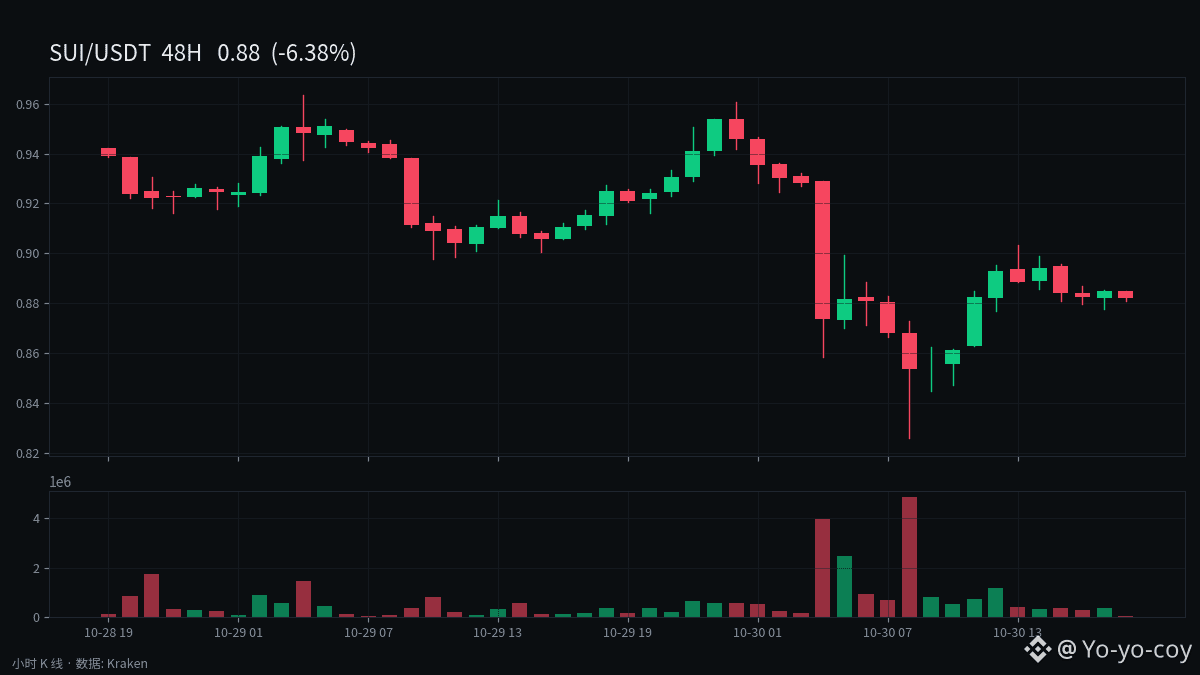
Even on a broadly declining day, some coins chart their own course. SUI’s price action on October 30 was one example: it fell and then rose over a four-hour period, with moves of more than 7% in both directions, yet still closed the day down.
Data showed that at 08:20 Beijing time on October 30, SUI was trading at around $0.8492, down about 7.75% over four hours and 10.19% over 24 hours (TokenPost spot price records). Four hours later, at 12:23 Beijing time, the price had recovered to around $0.8891, up about 7.02% over four hours, while its 24-hour decline had narrowed to about 1.93% (EconoTimes). CoinGecko data for the same day put the price at around $0.8793, down about 2.6% over 24 hours, with a market cap of approximately $3.621 billion, ranking 30th (CoinGabbar, October 30).
Notably, the intraday volatility did not change SUI’s medium-term position. A snapshot at 03:27 UTC on October 30 put the price at around $0.872, down about 65% from a year earlier and roughly 84% below its January 2025 peak of about $5.35 (The Bit Journal). There was no shortage of fundamental developments in October: the U.S. Sui ETF had accumulated about 14 million SUI over five weeks (reported by CoinMarketCap on October 19); there was news of a partnership involving Samsung Wallet; and on October 8, the Sui Foundation announced Hashi, a Bitcoin-collateralized protocol, saying that it had secured over $500 million in committed funding and was planning to launch on mainnet within October.
What we can observe is that the wide swings on event-driven days reflect pricing fluctuations amid thin liquidity more than a clear directional shift. The question going forward is whether October’s developments can translate into sustained demand once prices stabilize, rather than leaving behind just a candle with long wicks in both directions.
These are personal views only and do not constitute investment advice.
#SUI $SUI