

SUPREME SIAM | Markets, Business and Tokenomics | 30 October 2026
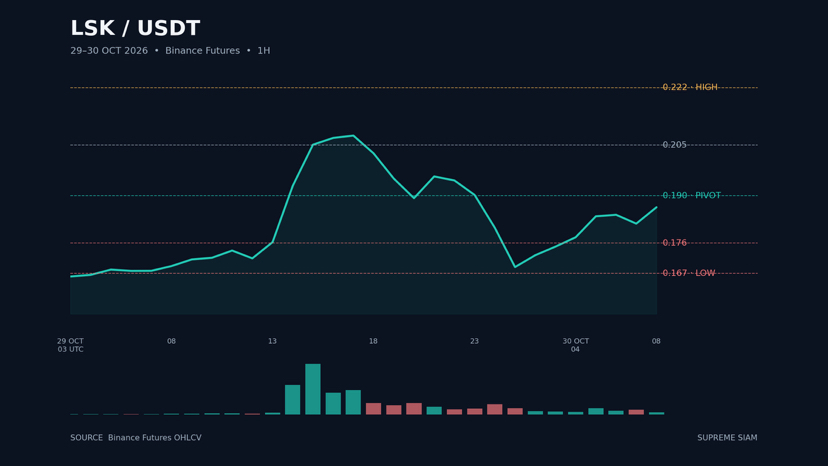
Yesterday $LSK rose from $0.16277 to $0.22189 on Binance Futures — about 36% from its intraday low. This morning, the price fell back toward $0.16713. At the 30 October checkpoint, 08:11 UTC, the futures price was $0.18976: 14.5% below its peak, although the rolling 24-hour figure was still +12.54%.
The paradox lies elsewhere. Lisk's own blockchain network is scheduled to shut down on October 31. But the project isn't disappearing: instead of a blockchain, it's launching financial software for companies. What exactly is the market buying—a functioning business or hope for its future? And which levels will show whether the rise or the sell-off will continue?
WHAT THE MARKET IS TRADING
Over 24 hours on Binance, $143.93 million flowed through the LSKUSDT futures contract, compared with $15.85 million through the LSK/USDT spot pair. Futures turnover was about 9.1 times higher than spot turnover on Binance. This indicates high speculative activity, but it does not mean that $144 million in new money was invested in LSK: the same capital can be used in trades many times over.
Open interest—the number of outstanding contracts—increased over the day from 28.61 million to 37.47 million LSK (+31.0%). This means more futures positions remain in the market after the sharp moves than yesterday. However, rising OI does not show which side is stronger—buyers or sellers: every futures contract has both sides.
By account count, 62.4% were long and 37.6% were short, but these are not shares of capital. The last completed funding rate was −0.0506% for the settlement interval: shorts paid longs. At the time of the snapshot, the next rate was estimated at around −0.2577%, but it could change before settlement. Negative funding signals an imbalance in the perpetual contract's price; it does not guarantee a rise.
THREE TRADING SCENARIOS
At the time of the snapshot, the price is near the transition zone at $0.190. The direction cannot yet be considered confirmed. We need hourly candle closes, the reaction after a retest of the level, and spot market behavior. Below are conditions, not instructions to open trades.
GROWTH — only after confirmation
If the hourly candle closes above $0.190, and the next pullback holds the $0.190–0.193 area with spot buying support, the likelihood of a move to $0.198–0.205 increases, followed by $0.216–0.222. The scenario weakens if the price falls back below $0.180: that would mean the breakout did not hold.
Example of risk scale: with a hypothetical entry at $0.192 and a protective level at $0.180, the risk per unit is $0.012 (6.25%). The potential move to $0.216 is $0.024, or 2R before fees, funding, and slippage. The first area, $0.198–0.205, may offer an insufficient risk/reward ratio.
DECLINE — if the recovery fails
If, after rising to $0.193–0.198, the price starts closing hourly candles below this zone again, while spot selling intensifies, a scenario emerges for a return to $0.176, followed by $0.167. Below $0.167, the next target is the $0.159–0.160 area—the previous lows of October 26–28. A close above $0.205 invalidates the recovery-failure thesis.
Hypothetical example: a short from $0.195 with protection above $0.205 carries $0.010 of risk. The potential move to $0.176 is $0.019, or about 1.9R before costs. But in a market this volatile, actual execution may be worse than the calculation suggests.
WAITING — a valid scenario in its own right
If LSK stays between $0.176 and $0.198 without sustained hourly closes outside the range, neither side has a confirmed advantage. In this zone, it makes more sense to wait for a clear breakout and retest: high volatility can stop out both longs and shorts. Until confirmation appears, my preliminary stance is WAIT, not chasing a candle.
For risk management: with $1,000 in capital, a maximum loss of 1% is $10. With an entry at $0.192 and protection at $0.180, the calculated position size is about 833 LSK, or $160 notional, excluding fees and slippage. Leverage does not increase the allowable cash loss; liquidation on futures may occur before the protective level is triggered.
HOW LISK MAKES MONEY NOW
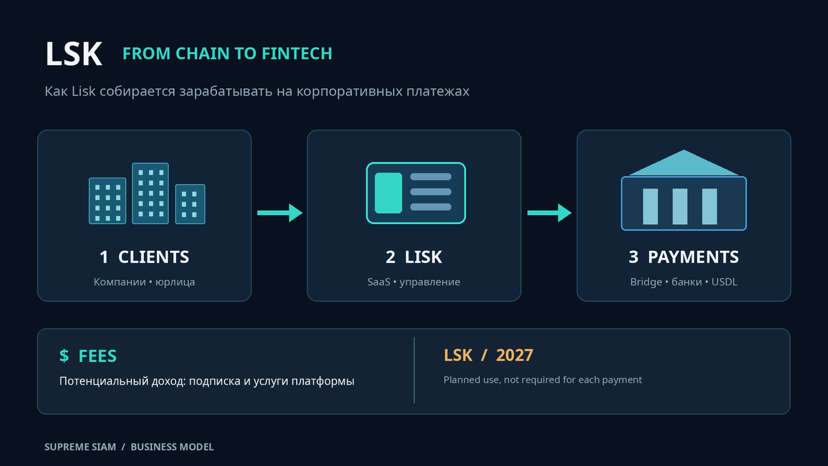
Imagine a company with three legal entities: it receives dollars, pays employees in euros, and settles with contractors in stablecoins. Its money is scattered across banks and wallets, while approvals are buried in email threads. Lisk aims to bring accounts, payments, employees, access permissions, and transaction history together in one working interface.
This is a B2B fintech service model: clients pay to save time and maintain control over their money. Lisk provides the software platform, while regulated payment services are carried out by partners, including Bridge. The company does not have to build a banking network itself, but it depends on partner fees, country availability, and the quality of their infrastructure.
Where does the revenue come from? The model includes software service fees and separate provider fees. But some features are offered for free during Early Access. Officially confirmed figures for recurring revenue and the number of independent paying corporate clients have not been published. So the product exists, but the business's sustainable economics have yet to be proven.
THE BUSINESS AND THE TOKEN ARE NOT THE SAME THING
Lisk uses USDL, a Bridge dollar stablecoin, for payments. LSK is a separate asset. According to the plan, starting in 2027 it will be used for rewards, a loyalty program, and payment for platform services. There is currently no confirmed mechanism by which every dollar of corporate payments automatically turns into a purchase of LSK.
Therefore, even if the platform grows its transaction volume, that would not prove increased demand for the exchange-traded token. A fundamental revaluation requires three things: independent paying companies, actual revenue, and a functioning mechanism that channels some of the economic value into LSK.
WHY THE SUPPLY WAS REDUCED
The team acknowledged that the previous blockchain ecosystem model did not generate sufficient economic returns, while funding programs with tokens created selling pressure. As a result, 100 million LSK were burned—25% of the previous total supply of 400 million. The newly stated supply is 300 million, with no future minting.
But there's an important detail: the 100 million were mostly a reserve for future DAO distributions from 2027 to 2033. This is a reduction in potential future supply, not the removal of 25% of coins from today's circulating supply.
Lisk's official table showed 219.28 million LSK in circulation on October 26—73.1% of the new supply. A real-time estimate in Binance data on October 30 was about 220.15 million, or 73.4%. This is not the same as the exact number of coins available for immediate sale.
Lisk reported completing a buyback of 9.8544 million LSK for $913,700—about 3.28% of the new total supply. The announced budget for the new program, from October 26 to December 31, is $4.388 million. A budget is not the same as tokens already purchased; a buyback is not a burn, and a permanent buyback funded by revenue is still only being explored.
MY CONCLUSION
LSK is currently a bet on a major business model shift. The project has a product, a team, foundation funding, and an idea for a commercial platform. But independently verified profits and mandatory demand for LSK from every payment are not yet in place. In the short term, the price is driven more by expectations, liquidity, and futures mechanics than by money earned by the company.
At this point, I choose to watch the reaction at $0.190. A sustained close above it and spot demand support the bullish case; a failed recovery and a move below $0.176 support the bearish case. Until then, WAIT is also a meaningful decision. These levels stop being relevant if the market forms a new price structure after the stated snapshot time.
Separately, it is the old Lisk Chain that is shutting down on October 31. LSK on Ethereum and on supported exchanges will continue to exist. According to the official warning, assets left directly on the network being shut down may become inaccessible; a standard withdrawal takes about eight days.
SUPREME SIAM | Research as of 30.10.2026, 08:11 UTC. Not individualized investment advice. Market conditions and funding rates change.

My public SUPREME SIAM lead portfolio is on my profile, under “Copy Trading.”
#LSK #Lisk #BinanceFutures #Tokenomics #SUPREMESIAM