BNB at $707—would you dare to buy the dip?
Binance’s hot wallet suddenly made unusual transfers. The amount is unclear, with estimates ranging from $270 million to $5.8 billion. BNB plunged 9% in a single day, underperforming all major coins. Withdrawals were paused and stablecoins frozen—is this an overreaction driven by panic, or is Binance really facing a major crisis?
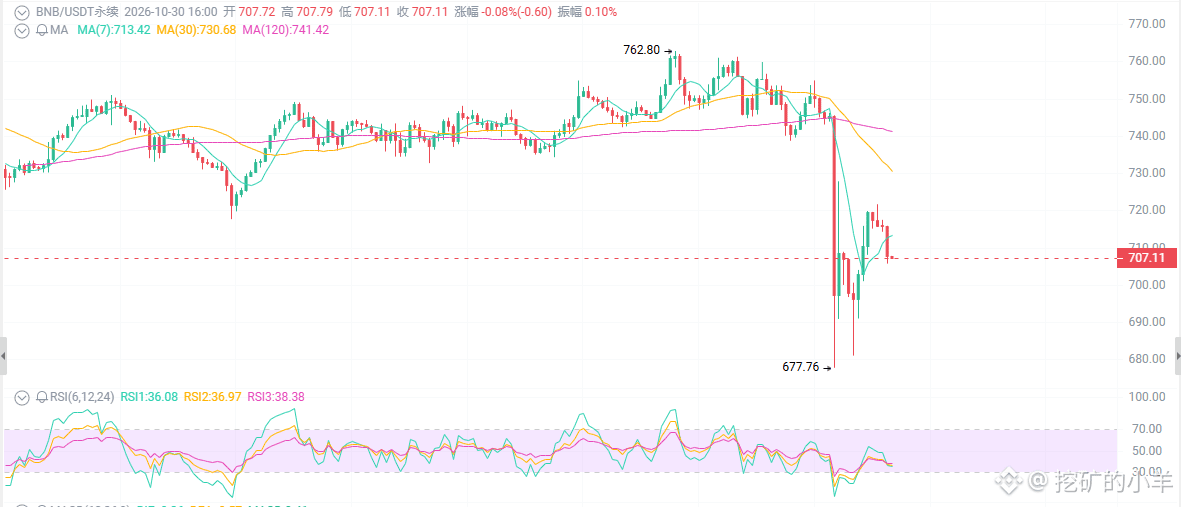
It briefly dipped to $678–690 over 24 hours before rebounding
Down 7–9% in a single day, significantly underperforming BTC—this is event-driven, not due to a market-wide downturn
The 37th quarterly burn has just been completed, destroying 1.646 million BNB (about $1.2 billion), bringing the circulating supply down to 131.5 million
Market cap remains among the largest, at about $94 billion
The chart tells you: $700–704 is the lifeline. Hold it, and it’s a golden buying opportunity; lose it, and the drop could be steep.
First: Is the security incident a real threat or a false alarm?
Around October 29, on-chain monitors detected large-scale unusual transfers from Binance-related hot wallets, with estimates of the amount ranging widely up to $5.8 billion.
Binance paused withdrawals, and stablecoin issuers froze related assets. CZ emphasized that user funds were safe, but the company has yet to fully confirm the details of any losses.
If losses are contained and withdrawals resume → panic will quickly subside, and $707 will be the floor
If more negative news emerges → trust will collapse, and $650 or even $600 could be possible
Second: The burn and ecosystem are BNB’s real trump cards
Don’t focus only on the negative news. Look at the fundamentals:
The 37th quarterly burn destroyed 1.646 million BNB, worth about $1.2 billion. The circulating supply has fallen to 131.5 million, with a long-term target of 100 million.
Ecosystem: BSC’s DeFi TVL is growing, contract deployments are increasing, and it leads in tokenized assets. The Jenner hard fork has launched on the testnet, with payment channels optimized. Brazil’s license application was submitted before the deadline. BNB Standard (a Nasdaq-related entity) holds a large amount of BNB.
Third: The technicals are at a “make-or-break” test
The daily and 4-hour charts show a short-term break below the ascending trendline, weakening the structure.
Strong support: $700–704 (the starting point for multiple rebounds; a demand zone)
Secondary support: $650–680 (a break below this could accelerate the decline)
Deeper support: $600–640
Resistance: $730–740 (the EMA and rebound highs)
Strong resistance: $750–760 (a dense area of previous highs)
Higher target: $810 (requires a strong recovery)
Indicators: A rebound followed short-term oversold conditions, but momentum remains weak. The moving averages show signs of a bearish alignment, and the RSI has rebounded from lows but has yet to confirm strength. Volume suggests there was buying support after panic selling, but it remains to be seen whether the price has stabilized sustainably. $700–704 is BNB’s make-or-break level.