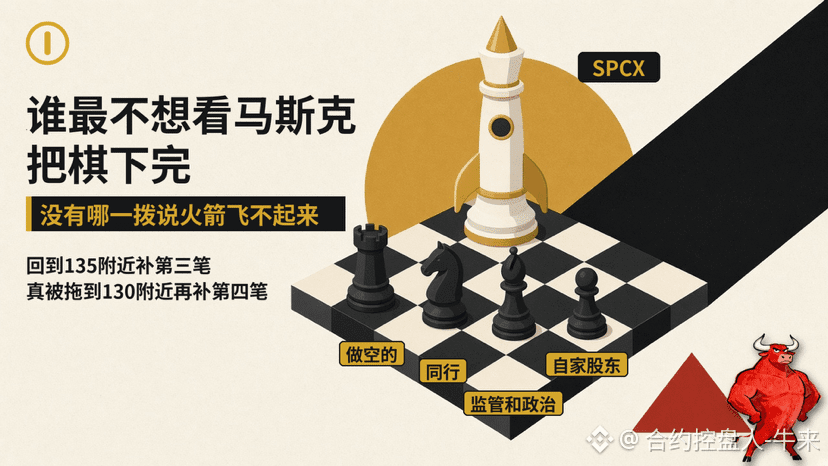
Picking up where we left off: who least wants to see Musk finish this chess game? Old Niu will only list what can be verified.
Old Niu is still bullish. First, a look at the market: $SPCX 140.24, down 2.85% over 24 hours. It hit a low of 138.57 this morning, didn’t revisit it in the afternoon, and spent the day hovering around 140. At the same time, $TSLAB was at 395.86, down 1.47%. Both funds have been dragged down by the tech sector.
I owed you all an answer from the last episode, so here it is. After going through the public information, Old Niu sees roughly four groups standing in the way of this chess game, and there’s a source for each. The first is the short sellers. Veteran short seller Chanos said publicly before the June listing that no matter how you work out the numbers, SpaceX couldn’t justify a $1.75 trillion valuation five years from now. According to the public short-interest data for the period ending October 15, 167 million shares of SPCX were shorted, 7.57% fewer than in the report for late September. The second group is the competitors. In March this year, Amazon’s satellite division formally asked the U.S. communications regulator to reject SpaceX’s application for orbital data centers using one million satellites, calling it no more than a speculative attempt to reserve space.
The third group is on the regulatory and political side. On October 22, Democratic U.S. Senator Booker said that if the merger really moves forward, antitrust authorities around the world will scrutinize it closely, and he intends to keep an eye on it too. Analysts at major banks have also cautioned in reports that getting past China could be especially difficult. The fourth group is actually the company’s own shareholders, and the dispute is over the price. One analyst argues that Tesla shareholders should receive a premium of 20% to 35%. But Gerber, a fund manager who holds shares in both companies, says that too large a premium would dilute SpaceX shareholders. On Tesla’s side, the deal needs more than half of all outstanding shares to pass. Musk himself has admitted that the bar is quite high, and the December 3 shareholder meeting agenda doesn’t include a merger proposal. Put simply, for now, it’s just the special committees on both sides negotiating.
After laying out these four groups, Old Niu actually feels more reassured. Short sellers were already trimming their positions last time; competitors are busy filing papers with regulators; shareholders are busy arguing over how to split the money. But not one of these groups is saying the rockets can’t fly. I already explained the two buys at 142 and 140 in the previous post. This episode is only about adding to the position: add a third tranche if it returns to around 135, and a fourth if it gets dragged down to around 130. For those of you still waiting on the sidelines, don’t just sit around waiting for Old Niu’s two price levels. This is Old Niu’s own thinking, not investment advice. #美国中期选举倒计时,美股博弈窗口已开启?