Gold on a blockchain is old news. Gold on a blockchain that decides who is allowed to hold it — that is the actual story.
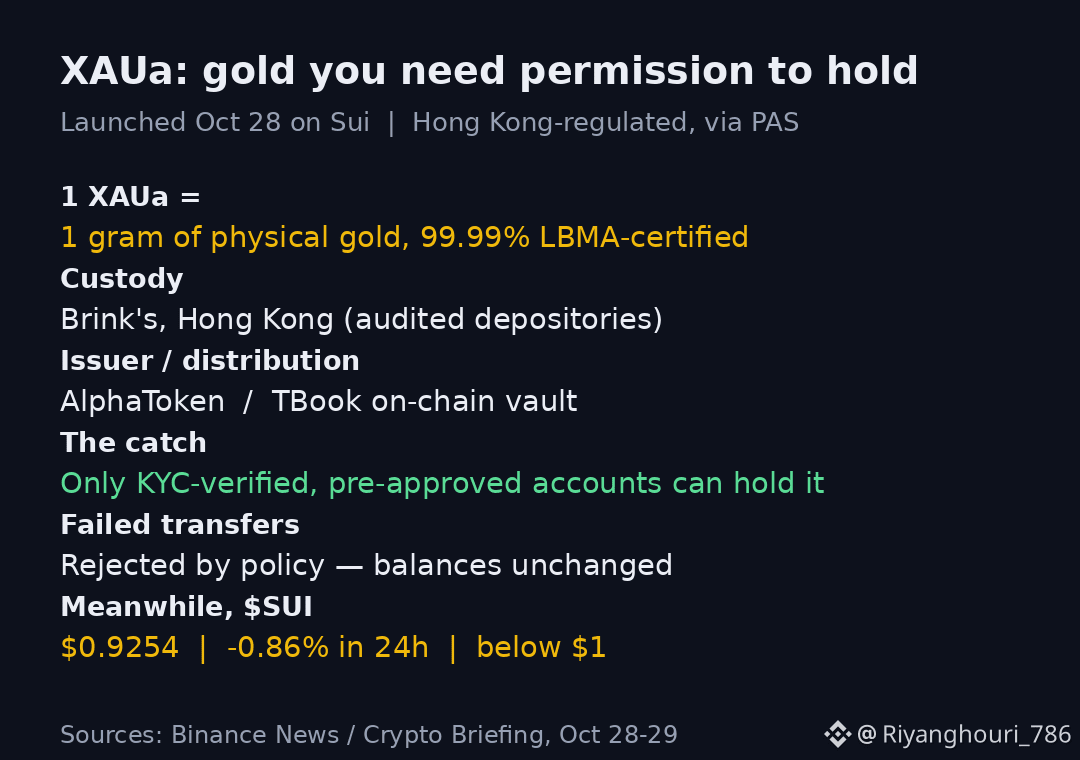
On October 28, AlphaToken launched XAUa on Sui, reported by Binance News and Crypto Briefing. Each token is one gram of LBMA-certified physical gold at 99.99% purity, held with Brink's in Hong Kong and distributed on-chain by TBook. It is Hong Kong-regulated, minted under Sui's Permissioned Asset Standard — and that is where I start to argue with myself.
Under PAS, compliance is written into the token itself. Only KYC-verified, pre-approved accounts can mint or trade it, every transfer must pass a policy check before settling, and a failed transfer is rejected with balances unchanged. TBook has rebuilt its whole vault platform on the same standard, so other regulated issuers can follow the template.
I can see both sides. For an institution, this is exactly the ask: gold exposure on-chain without the compliance team having a heart attack. For a crypto native, it is the opposite of the point — a bearer asset that is not really bearer at all, gated by a whitelist. Open gold tokens already exist, and Sui already hosts Matrixdock's XAUm, so XAUa is not competing on "gold on-chain." It is competing on "gold on-chain, with the paperwork built in."
The market, so far, has shrugged. SUI was around 0.9254, down about 0.86% in 24 hours and below a dollar, after a September rally above 1.20 and close to 1.30 in early October. Traders are pricing Sui on its own token dynamics, not on each new RWA headline.
What I am watching is a usage number, not another launch: does any named institution actually trade meaningful volume through this rail, or does PAS become a very compliant walled garden nobody trades in? That decides whether this is Sui's RWA moat or a press release with a vault attached.
Would you hold tokenized gold if you needed permission first, or does that defeat the whole point for you? $SUI