


Market analysis · October 30, 2026 · Figures as of October 29–30
The oil shock that began with the Iran war in February is now in its third stage. It first pushed crude higher, then began draining the world’s emergency stockpiles, and it is now pushing central banks toward tightening. Brent is trading around $115, the US Strategic Petroleum Reserve is at its lowest level since 1982, US inflation on the Fed’s preferred gauge is running at 3.6%, and the Federal Reserve, the Bank of Japan and the Bank of England are all signalling more tightening.
This article takes each piece in turn, shows how they connect, and sets out what to watch next.
The short version
Stockpiles: governments are mostly spending reserves, not building them. Refilling is a plan, and a future source of demand.
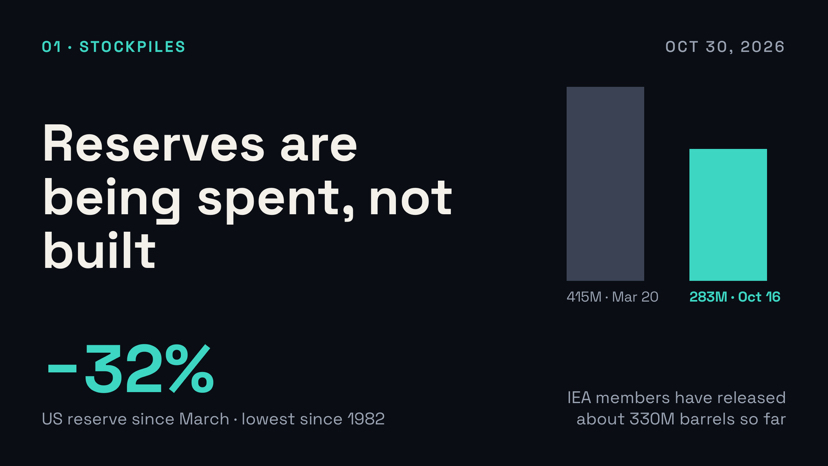
Crude: Brent is near four-year highs and up about 14% in October, with WTI back above $100 for the first time since April.
United States: September PCE inflation rose to 3.6% (core 3.1%). The Fed held on October 28 with two votes for a hike, and a December increase is widely expected.
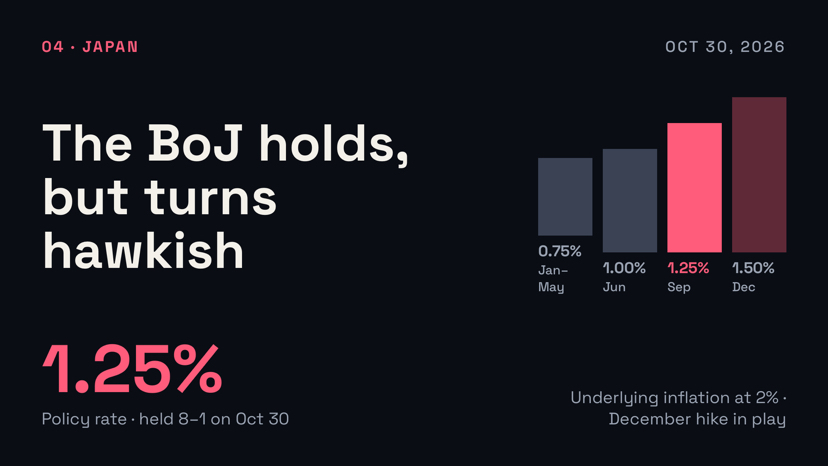
Japan: the Bank of Japan held at 1.25% but said underlying inflation has reached its 2% target, keeping a December hike in play.
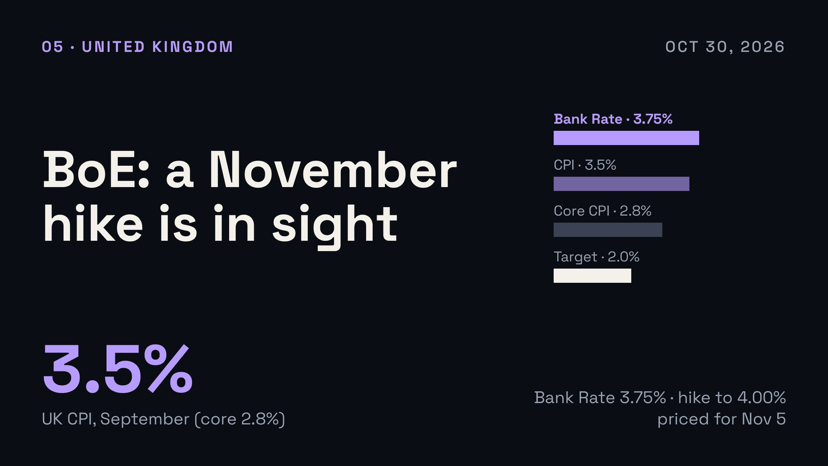
United Kingdom: inflation is 3.5%, and the Bank of England is widely expected to raise Bank Rate to 4.00% on November 5.
Market snapshot
Crude: Brent about $115–116; WTI about $102–103.
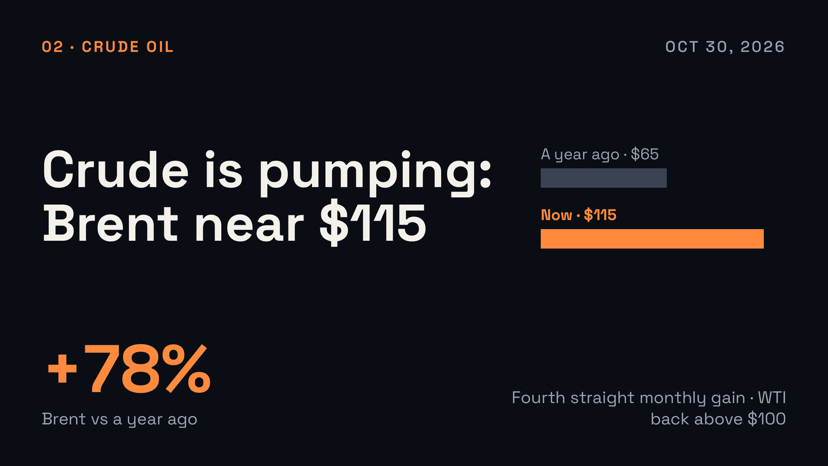
US Strategic Petroleum Reserve: 282.7 million barrels (week to October 16), the lowest since October 1982.
Policy rates: Fed 3.75%–4.00%; Bank of Japan 1.25%; Bank of England 3.75%; ECB deposit rate 2.50%.
Inflation: US PCE 3.6% (core 3.1%); UK CPI 3.5%; euro area 3.8%.
1. Stockpiles: reserves are being spent, not built
A common shorthand says governments are stockpiling. The data point the other way for now: most of the activity is drawdown, with refilling still on the drawing board.
The international release. In March the International Energy Agency’s 32 members agreed to make 400 million barrels of emergency stocks available. Roughly 330 million barrels have been released so far, and on October 16 the agency agreed to accelerate about another 100 million barrels, including more than 20 million of diesel. Even so, the IEA estimates that observed global oil stocks at the end of September were 509 million barrels below their pre-war level, leaving much less cushion against a new shock.
The United States. The Strategic Petroleum Reserve held 282.7 million barrels in the week to October 16, down about 133 million barrels (32%) from its March peak of 415.4 million and the lowest since 1982. The Energy Department is working through a 172-million-barrel release commitment using crude exchanges, with its latest solicitation for up to 40 million barrels. Washington has also complained that several European members released only a fraction of what they pledged.
Europe. Europe now plans to release 42 million barrels over three months, half of it diesel. France is releasing 10 million barrels of diesel at cost price, which the government expects to cut pump prices by 12 to 18 cents a litre.
The refill. The stockpiling part of the story is the rebuild. The administration says exchange terms will return about 200 million barrels to the SPR within a year, roughly 20% more than was drawn and at no taxpayer cost, and Trump said on October 2 that refilling would start very soon, though no source of barrels has been confirmed. Japan, which holds the world’s third-largest strategic stock at about 263 million barrels (US EIA estimate), is urging Asian governments to build larger inventories and coordinate releases. China holds the largest stockpile, estimated at about 1.4 billion barrels, and has leaned mainly on commercial stocks while leaving its official reserve largely intact.
Why it matters. Spent buffers make every new disruption more costly. A global rebuild, once prices ease, would also add demand just as supply recovers, which could put a floor under crude. The IEA expects constrained diesel and other middle-distillate supplies to persist well into 2027.
2. Crude oil: pumping toward four-year highs
Brent was near $115.7 early on Friday and on course for a gain of nearly 14% in October, its fourth straight monthly rise. WTI was around $102.7, heading for a 15% monthly jump and a close above $100 for the first time since April. A year ago Brent was near $65. For context, it peaked near $118 in the spring, fell to about $72 in early July, and has since climbed back.
What is driving it. The Strait of Hormuz remains the centre of gravity. IEA data show flows averaged only 7.6 million barrels a day in August, against roughly a fifth of world oil before the war. Attacks on shipping intensified in October, including the sinking of a containership in the strait, and Iran’s Revolutionary Guards said three tankers hit mines while using an unauthorised route south of Hormuz. On Thursday the Houthis said they had attacked Saudi sites including Ras Tanura, Rabigh and Abqaiq. Diplomacy has stalled, and the Wall Street Journal reported that Washington has told Gulf allies to prepare for a short, intense campaign after the November 3 midterms.
The demand side is cracking. The IEA’s October report sees global oil demand falling by 2.6 million barrels a day in 2026, including a 2.5 million barrel-a-day drop in the fourth quarter, as high prices and weaker activity bite. It still sees the market in deficit through year-end, and about 1.3 million barrels a day of diesel and gasoil exports were lost in September compared with a year earlier. Diesel is the pinch point: UK diesel has reached 192.5p a litre, its highest since July 2022.
3. United States: PCE confirms the energy pass-through
The Commerce Department’s September report landed the morning after the Fed meeting. The PCE price index rose 0.5% on the month and 3.6% on the year, up from 3.4% in August. Core PCE, which excludes food and energy, rose 0.3% on the month and 3.1% on the year, up from 3.0%. Goods prices were up 3.9% on the year and services 3.5%.
Energy was the spark. Gasoline and other energy goods jumped 9.2% in September, and energy goods and services together rose 5.4%. The worry is spillover: services prices excluding energy and housing rose 0.4% on the month, and core services excluding housing ran at 3.6% on the year, the highest since 2024, according to reporter Nick Timiraos. The Fed’s preferred core gauge (3.1%) is also running about half a point above core CPI (2.6%).
Growth complicates the picture. Third-quarter GDP grew at a 3.4% annual rate, faster than expected and up from 2.2% in the second quarter, helped by an AI-driven surge in business investment. September was softer: income rose only 0.2%, real disposable income fell 0.3%, the saving rate slipped to 3.8%, and real consumer spending was roughly flat. On a quarterly basis, PCE inflation actually cooled (2.1% annualized, from 5.0% in the second quarter), so September marks a re-acceleration rather than a steady climb.
The Fed. The central bank, led by Chair Kevin Warsh, hiked by a quarter point in September to 3.75%–4.00% and held on October 28 on a 10–2 vote, with governor Lisa Cook and Cleveland Fed president Beth Hammack preferring a hike. Warsh does not offer forward guidance, but the data strengthen the case for a December move, which investors widely expect. The 10-year Treasury yield is sitting near 5%.
4. Japan: a hawkish hold
The Bank of Japan kept its policy rate at 1.25% on Friday by an 8–1 vote, with board member Hajime Takata dissenting in favor of a hike to 1.5%. It raised its inflation forecast and said for the first time that underlying inflation has reached its 2% target, a milestone that opens the door to a hike as soon as December. The rate, up from 1.00% before September’s hike, is the highest in 31 years.
Two forces are behind the hawkish turn: stubborn energy costs and import prices lifted by a weak yen. A Bloomberg survey of economists published October 22 found 83% expect the next hike in December. Analysts polled by Reuters see 1.5% by December and a peak between 1.75% and 2%, while some strategists argue that tighter global financial conditions could push the move to January. Bank of Japan staff put the neutral rate between 1.1% and 2.5%, so there is room to run.
Japan is also on the stockpile front line. It released 80 million barrels from its reserves in March and now urges Asia to build bigger shared inventories.
5. United Kingdom: a November hike in sight
UK inflation rose to 3.5% in September from 3.1% in August, the highest since October 2025 and above forecasts. Motor fuel prices were up 29.8% on the year, with petrol at 169.5p a litre and diesel at 192.5p. Core inflation rose to 2.8% and services inflation to 3.7%.
The Bank of England held Bank Rate at 3.75% in September by a 6–3 vote, with three members voting for an immediate hike to 4%, and the committee projected inflation slightly above 4% in the first quarter of 2027. Goldman Sachs and Rabobank both forecast a quarter-point hike on November 5, and prediction markets price it above 90%. Some forecasters see October inflation near 3.8% and a move close to 4.5% after January’s energy price cap reset.
6. The wider chorus: the ECB
The European Central Bank held its deposit rate at 2.50% on Thursday after hiking twice this year, but it discussed a hike, warned that risks to inflation are tilted to the upside, and left a December increase in play. Euro-area inflation is 3.8%, the highest since September 2023, with energy up about 19%. Private-sector growth in the euro zone slowed to a four-month low in October, the stagflation squeeze that all of these central banks are trying to navigate. Christine Lagarde also announced that she will leave in February.
7. How the pieces connect
The chain is straightforward. The war restricts supply, supply losses push crude and diesel up, energy lifts headline inflation and starts to leak into services, and central banks respond with tighter policy. Meanwhile the emergency reserves that would normally cushion the shock have been drawn down, so there is less room for error. The risk is stagflation: the IEA sees oil demand shrinking, euro-area activity is slowing and US real spending has stalled, even as inflation climbs.
The next few weeks offer three broad paths, none of which can be given reliable odds.
De-escalation or a reopening of Hormuz. Crude retreats, rate-hike bets fade, and refill programmes could cushion prices on the way down.
Escalation after the midterms. Brent could spike further, December hikes become hard to avoid, and growth fears rise. Reserves are thinner than they were in March.
Stalemate. Brent stays near $100–$120, hikes arrive in sequence (the Bank of England in November, others in December), and demand destruction slowly does the work that supply cannot.
What it means for markets. The transmission to risk assets, including crypto, runs mainly through yields and liquidity. A US 10-year near 5% and four major central banks leaning toward hikes raise the bar for speculative assets, while any de-escalation would likely ease the pressure fastest.
8. Dates to watch
October 30: Tokyo October CPI and Governor Ueda’s press conference.
November 3: US midterm elections, after which the question of renewed US strikes on Iran becomes live.
November 5: Bank of England decision and Monetary Policy Report; a hike to 4.00% is the market’s base case.
Mid-November: US and UK October CPI, and the IEA’s next oil market report.
December: the Fed (decision December 9), plus the ECB, Bank of Japan and Bank of England meetings.
Ongoing: Hormuz traffic, SPR levels and refill announcements, Brent near $115, and the US 10-year near 5%.
Bottom line
Governments are not so much stockpiling as spending their stockpiles, and that is part of why crude is pumping: buffers are thinner while supply is still restricted. Central banks in the US, Japan, the UK and Europe have noticed. The Fed has already hiked, the Bank of England is expected to follow on November 5, and the Bank of Japan and ECB are signalling December. The next test is whether energy-led inflation keeps leaking into services, which would keep policy tighter for longer, or whether demand destruction and de-escalation cool oil first.
This article is for information only and is not financial advice. Markets are volatile and you can lose money. Do your own research.
Sources and data notes
Figures are as of October 29–30, 2026 and change quickly; oil quotes differ by contract and time of day. Reserve data draws on the IEA’s October Oil Market Report as reported by gCaptain, the US Energy Department, EIA weekly data as compiled by Energy Factbook and 24/7 Wall St., The National, EnergyNow and Oilprice.com. Oil prices draw on CNBC and Reuters, Fortune and Wikipedia’s price chronology. US inflation and growth draw on the Commerce Department release as reported by CNBC, Morningstar and ActionForex, and the Fed decision on CNBC, CNN and NPR. Japan draws on Reuters, Bloomberg and Investing.com; the UK on the ONS release as reported by Trading Economics, ITV and the House of Commons Library, with forecasts from Goldman Sachs and Rabobank and market odds from Polymarket; the ECB on CNBC, Reuters and the Irish Times. Analyst views are the analysts’ own opinions.
#EarningsSeason #USMidtermElections #SwitzerlandFirstSpotBitcoinETFExpectedToTradeInNovember #StrategyReports$21BQ3OperatingProfit #TwoAddressesHoldingAbout1.28BUSDTFrozen