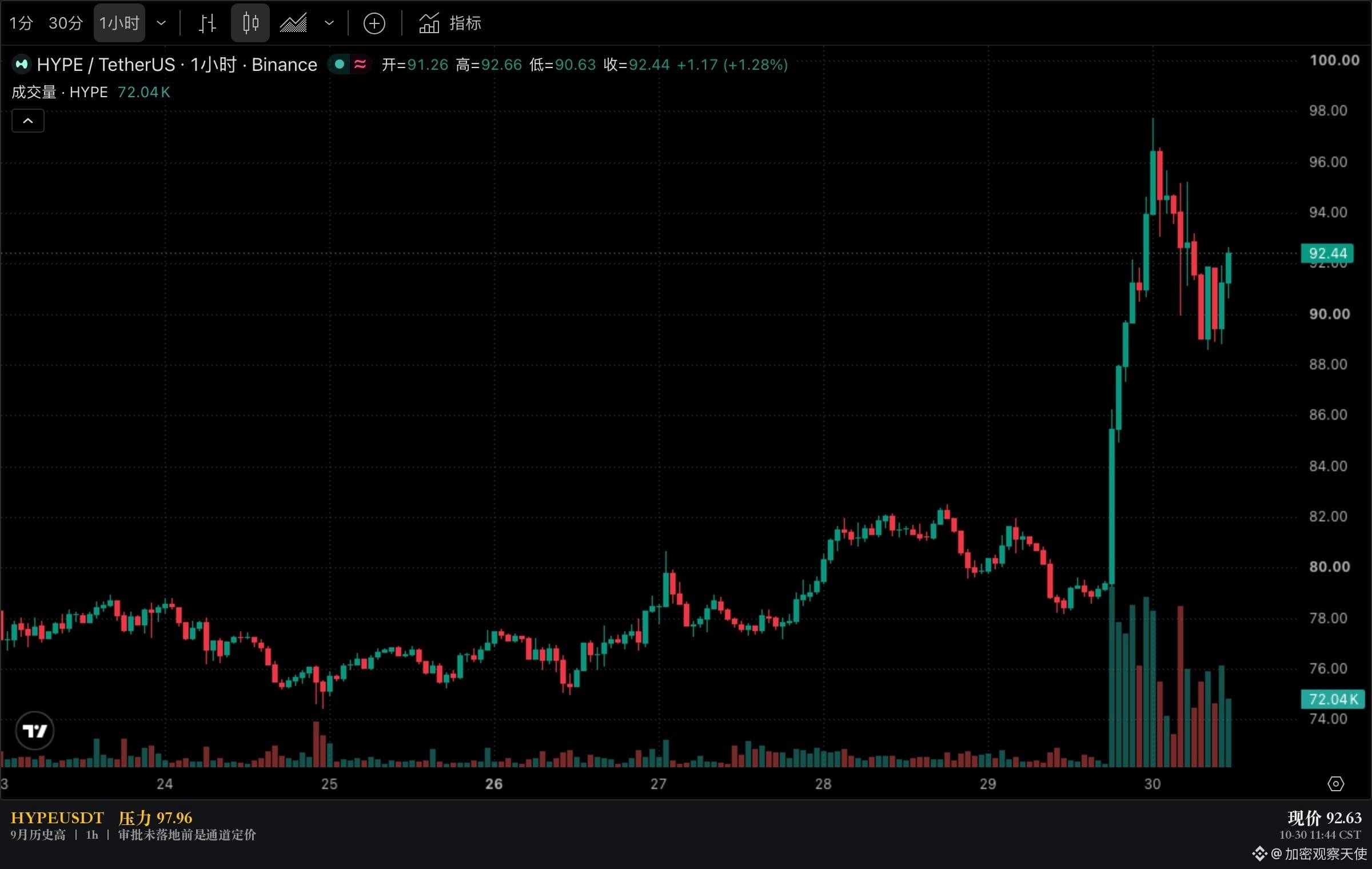
HYPE rose nearly 20% in a day, with close to $200 million in trading volume. Not a word in ICE’s announcement mentioned revenue.
It was all about conditions.
This rally was about a channel, not a business.
On 10-29, NYSE parent ICE and Trade[XYZ] announced a definitive agreement to bring Trade[XYZ]’s Hyperliquid-based #永续合约 to the United States. ICE will be the exclusive operator of these regulated markets and has made a strategic investment in it.
Why this one? By DefiLlama’s reckoning, Hyperliquid is one of the world’s largest decentralized derivatives platforms. ICE isn’t after the company; it wants the engine that’s already up and running.
The caveats are the key. “Subject to regulatory approvals” appears in almost every paragraph. The plan requires building a standalone retail market and clearing structure, with customers completing KYC/AML and accessing the market through a futures commission merchant that has become a member. Leverage would require separate approval as well.
The announcement gave no launch date, investment amount, or filing timeline.
Now consider the other track. The joint venture between ICE and OKX is working on tokenized stocks. The 10-28 disclosure added Walmart, Eli Lilly, Carnival, and others as objectors, bringing the total to 38, five more than the day before.
Issuers are voting while the exchange is still laying the groundwork. The two things aren’t in conflict: tokenized stocks affect the shareholder register, while perpetual futures affect price exposure.
The two tracks depend on different parties. Tokenized stocks are held up by issuers; perpetuals by the CFTC. In May, it approved Kalshi’s Bitcoin perpetuals, while saying other asset classes would be considered case by case. How quickly things move isn’t up to ICE.
The price action is more straightforward. At $HYPE 12, it was just over $92, a little more than $5 below the September 23 all-time high of $97.96.
The 24-hour range was $78 to $97.74. It climbed from $78 to $97 during the day, then retreated to $92.
The range was nearly 25%, and sellers were waiting above $97.
What I can’t determine is the revenue split: how much Trade[XYZ] gets, how much ICE charges for exclusive operating rights, and how much the Hyperliquid protocol takes. The announcement said nothing about it. All three arrangements seem plausible, but there’s no way to verify them.
Taking a broader view, this isn’t just about HYPE. A protocol has already built the product, but to enter the US it has to fill out someone else’s forms all over again.
Any premium built on “approval is coming” will eventually have to be settled against a fee schedule.
An approval can be stamped. That fee schedule can’t be.
Which document would you rather see first: the CFTC approval, or the revenue-sharing schedule?
At the time of writing, $HYPE was trading at $92.10, up 17.55% in 24 hours, with $195 million in trading volume.
Data from Binance spot markets and ICE’s investor relations page, 10-30 12:05. The above is a compilation of public data and personal analysis, and does not constitute investment advice.