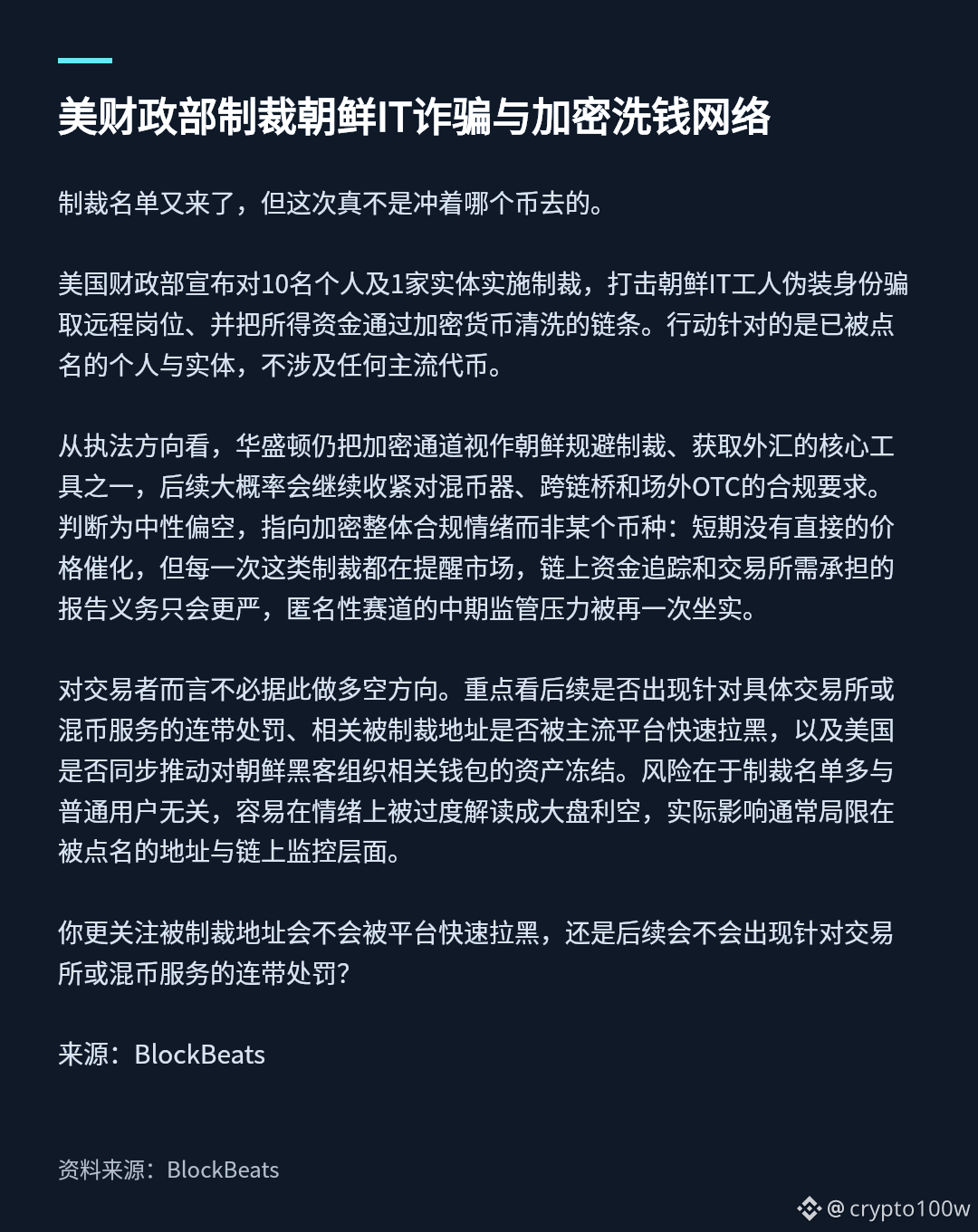
The sanctions list is back, but this time it really isn’t targeting any particular coin.
The U.S. Treasury Department announced sanctions against 10 individuals and one entity, targeting a scheme in which North Korean IT workers use fake identities to land remote jobs and launder their earnings through cryptocurrency. The action targets the named individuals and entity and does not involve any major tokens.
From an enforcement perspective, Washington still views crypto channels as one of North Korea’s key tools for evading sanctions and obtaining foreign currency. Compliance requirements for mixers, cross-chain bridges, and over-the-counter (OTC) trading are likely to tighten further. The outlook is neutral to slightly bearish, reflecting sentiment around crypto compliance as a whole rather than any specific coin: there is no direct short-term price catalyst, but each round of sanctions reminds the market that on-chain fund tracing and exchanges’ reporting obligations will only become stricter. Medium-term regulatory pressure on the privacy sector has been reinforced once again.
Traders need not use this as a basis for taking a bullish or bearish position. The key things to watch are whether follow-up penalties target specific exchanges or mixing services, whether major platforms quickly blacklist the sanctioned addresses, and whether the U.S. moves in parallel to freeze assets in wallets linked to North Korean hacking groups. The risk is that sanctions lists often have little to do with ordinary users, yet can easily be overinterpreted as bearish for the broader market. In practice, the impact is usually limited to the named addresses and on-chain monitoring.
Are you more focused on whether platforms will quickly blacklist the sanctioned addresses, or on whether follow-up penalties will target exchanges or mixing services?
Source: BlockBeats
Image 1: U.S. Treasury sanctions North Korean IT fraud and crypto money-laundering network · Key News
Image source: https://www.theblockbeats.info/flash/374211