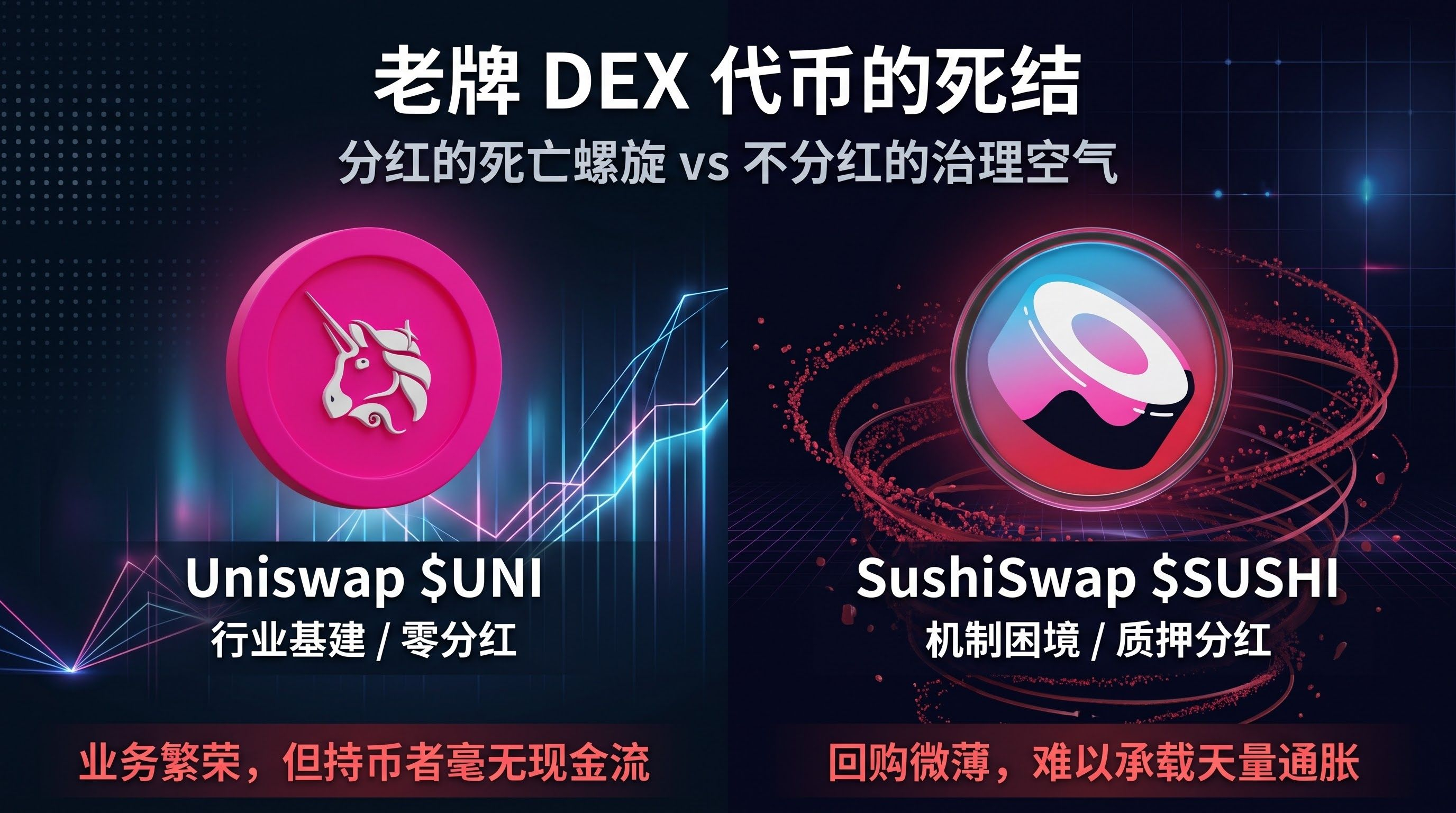
Dividend-paying tokens spiral toward death, while non-dividend tokens become governance theater: discussing the dead end facing legacy DEX tokens
Across DeFi’s financial building blocks, decentralized exchanges (DEXs) have long been regarded as core liquidity infrastructure. But when we turn our attention to their tokens on the secondary market, legacy DEXs represented by #UNI and #sushi have yet to make their token models work. One appears to have become an unshakable spot-market leader, while the other has long since been sidelined. Set aside their underlying businesses and look only at token value, and their fates are essentially the same.
Back in the day, SUSHI tried the “share the rewards fairly” route, launching xSUSHI to use 0.05% of trading fees to buy back tokens. But this mechanism had a fatal mathematical flaw at its core: to maintain liquidity-pool depth, the protocol had to massively inflate its token supply to subsidize miners. The meager buy pressure from fee-funded repurchases could never absorb the sell pressure from liquidity-mining rewards dumped on the market every day. As competition intensified and real trading volume fell, rewards shrank, triggering even more aggressive withdrawals and sell-offs. Rather than helping, the rewards mechanism became a catalyst for an accelerating collapse.
So did UNI, which took the opposite extreme and firmly refused to distribute rewards, find a way out? Reality is just as bleak. Uniswap’s technological moat has given it a monopoly over on-chain spot order routing, making it as indispensable to Ethereum as water, electricity, and gas. But the protocol’s success has no mathematical connection to secondary-market token holders. To avoid regulatory risk, the fee switch has remained locked for years. All underlying trading fees go to market makers, while fees collected through the front end go to the company. Token holders are left with a zero-interest ticket that offers neither cash flow nor a right to rewards, and its valuation keeps sliding in a bear market all the same.
Those who rely on rewards to put a floor under their token are devoured by their own high inflation; those who survive through monopoly power see their tokens completely detached from commercial profits. On-chain swaps are indeed a core necessity, but until tokens can legally capture the protocol’s net profits in a meaningful way, blindly believing in the long-term value of these assets is mostly wishful thinking.