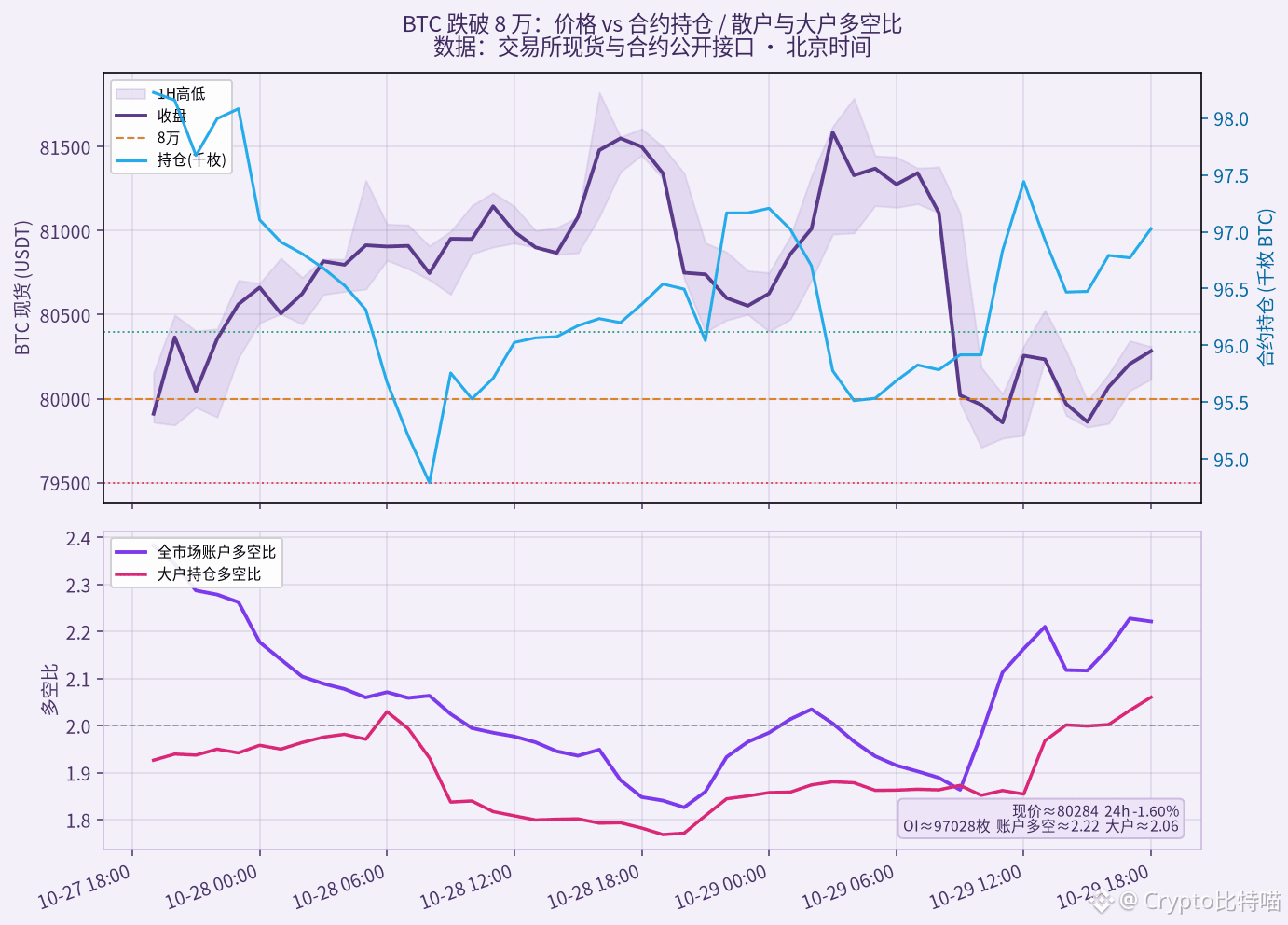
Spot ETFs have seen money pour in for three straight days, yet $BTC still plunged below 80,000—this is worth watching more closely than a simple price drop.
Publicly available figures show that U.S. spot Bitcoin ETFs recorded net inflows of approximately $110 million, $176 million, and $137 million on October 26–28, respectively, for a three-day total of about $424 million. But during the Asian session, the price gave back its post-rate-decision spike from 81,788 all the way down to a low of 79,710. It’s currently around 80,280, down about 1.6% in 24 hours. Across the futures market, liquidations totaled about $356 million over the past 24 hours. Long positions accounted for about $205 million of that, including roughly $94 million in $BTC contracts—the leveraged longs got swept out first. The odd thing is that after the sweep, the account long/short ratio climbed back from around 1.84 in the morning to 2.22, while large traders’ long/short ratio rose to about 2.06. Open interest is around 97,000 BTC, and retail traders are building up long positions again near 80,000. The Fear and Greed Index is at 51, still neutral. $ETH is around 2,324, with a similar decline.
So this isn’t “ETF failure” so much as institutions gradually buying spot while leveraged derivatives traders rush to bet on a direction—the two pools of money aren’t moving in sync. At 8:30 p.m. Beijing time tonight, we’ll also get the advance estimate for third-quarter GDP and September PCE. After the data, Amazon and Intel will report after the market close—the macro and tech picture is still unresolved.
I’m not catching the falling knife at the 80,000 round-number level, nor am I going long just because ETFs are seeing inflows: no new futures positions for now, and I’m leaving my spot holdings untouched. If the price recovers to 80,400 on declining volume, then I’ll consider 80,800–81,000; below 79,500, I’ll reduce leverage, with 79,220 as the hard level to watch. Until the data is out, doing less is cheaper than getting it wrong. The charts compare price with open interest over the past two days, as well as account and large-trader long/short ratios, based on public spot and futures exchange APIs.