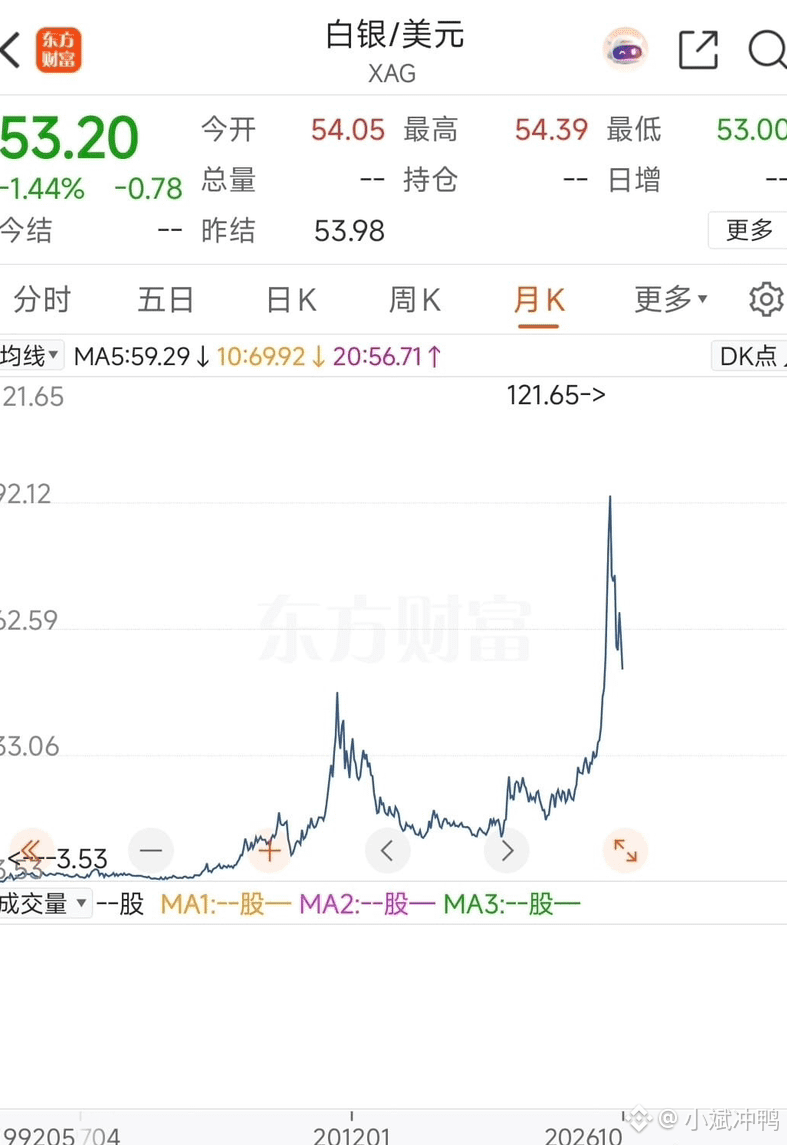
Those who chased silver at $50 in 1980 were stuck for 45 years.
Those who chased it at $49 in 2011 were stuck for 14 years.
So what about those who chased it at $121 in January 2026? Don’t worry, this isn’t about “how many years you’ll be stuck”—it’s already been cut in half.
In 1980, the Hunt brothers tried to corner the silver market, buying it all the way up to $50.35 from under $10. Then came “Silver Thursday,” March 27, 1980: silver was cut in half in a single day, crashing below $11. Even people who hadn’t used leverage lost 90% of their money. It took a full 45 years for silver to reclaim that $50 peak, finally rising above it on October 9, 2025.
The $49 peak from April 2011 was also only recovered on that same day—14 years later.
A lot of people think the story ends when they “break even.” It doesn’t.
After breaking above $50, silver went completely crazy: $50, $80, $100. It broke $100 on January 23, 2026, and touched $121 on January 29. But nine months later, today it’s down to just over $52. That’s a 56% drop from $121—more than half. Anyone who jumped in at $121 is now stranded at a new peak.
Every time silver surges to a peak, there’s a story that sounds impossible to argue with.
1980: Hyperinflation is coming, the dollar is doomed, and silver is real money.
2011: The Fed is printing money like crazy, currencies are losing value, and Chinese industrial demand is booming.
This time: Solar panels, electric vehicles, and AI data centers are devouring silver; supply is falling short; it’s a supercycle for an industrial-revolution metal.
The people telling these stories believed them. The first two have already been disproven.
This time really is different in some ways. Industrial uses now account for 60% of silver demand. Solar panels, electronics, and electric vehicles actually consume it—it’s not like a silver bar that’s still a silver bar after sitting around for a hundred years. According to the Silver Institute, the market has had a structural deficit for five years in a row. In 2025, supply was 32,100 tonnes against demand of 35,700 tonnes. And 70% of silver is a byproduct of copper, lead, and zinc mining, so mining companies can’t simply ramp up production, even if they want to.
The fundamentals are real. But are they new? “Chinese industrial demand” was real in 2011, too, and it still didn’t stop silver from falling from $49 to $12 in 2020.
Industrial demand determines the long-term floor; it doesn’t determine whether your entry price is safe. Demand can be real, while the price is far higher than that demand justifies. A good asset at a bad price.
The most painful part is this: People who were stuck at $50 for 45 years finally broke even in October 2025. Then they watched silver climb to $80, $100, and $121, believed “this time is different” all over again, and found themselves stranded at an even higher peak.
How many more years do you think it’ll take for people to break even at this $121 peak?
$XAG #Silver #PreciousMetals