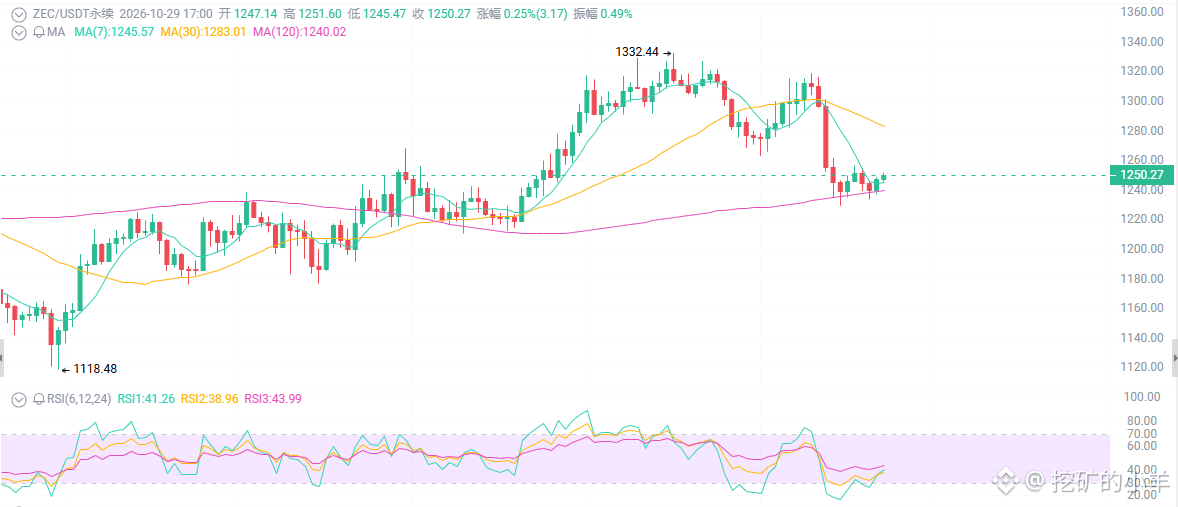
ZEC at $1,250—would you dare to bet on it?
On its 10th anniversary, ZEC fell from $1,690 to $1,250. Retail traders are complaining that nobody uses privacy coins, but 4.9 million ZEC are locked in the shielded pool—is this the final shakeout, or the funeral for the privacy narrative?
First, the surface story: 10th anniversary, and down it went.
Down 4%–5.5% in 24 hours, with a market cap of $20–21 billion, ranked No. 10, and trading volume of $700–900 million. It has pulled back 26% from its September high of $1,690. “Nobody uses privacy coins.” “That’s it for the 10th anniversary?”
But while it has fallen, it’s still showing resilience against BTC. The shielded pool accounts for about 29%, with roughly 4.9 million ZEC locked in it, and the share of shielded transactions is still rising.
The price is falling, but more people are using privacy.
First: On its 10th anniversary, institutions haven’t left—but retail traders are running.
October 28 marked 10 years since the mainnet launch. Grayscale’s research specifically highlighted its development fund model—about 20% of block rewards support the ecosystem. Although ZCSH-related products have seen redemption volatility recently, CoinShares’ Zcash ETP resumed trading after a brief suspension in Paris.
Retail traders are selling at a loss on the 10th anniversary, while institutions are watching the upgrade calendar around $1,250.
Second: The NU7 upgrade on November 5 isn’t just a minor tune-up.
NU7 is expected to activate on November 5, at around block height 3,543,405. The key changes:
Block time drops from 75 seconds to 25 seconds, making payment confirmations about 3x faster;
Block rewards are reduced proportionally, while daily issuance remains basically unchanged—not an inflation explosion;
The NSM network sustainability mechanism is introduced, locking some fees until around 2031, when they’ll be released;
Legacy Sprout v4 transactions are deprecated, and Zebra 7.0.0 already supports the upgrade.
In plain English: ZEC payments get faster, and fees are locked in a “time capsule,” which actually means less short-term selling pressure.
Third: Privacy isn’t just a concept—it’s a necessity in the age of regulation and AI.
ZEC isn’t a meme. It’s an optional privacy asset powered by zero-knowledge proofs: you can make transparent transactions or shielded ones. Its maximum supply is 21 million, with about 16.9–17 million in circulation. The ecosystem is still moving: Zcash Labs launched a JS toolkit, Shield launched a private ZEC/USDCx market, and the Zillions wallet added Ledger support.
Think about it—when AI is watching every transfer, is privacy a crime? No. Privacy is a necessity.
There are certainly regulatory risks; privacy coins have always been under scrutiny. But that’s exactly why usage of the shielded pool is a vote for real demand: 4.9 million ZEC locked in there didn’t get there because KOLs shouted about it.