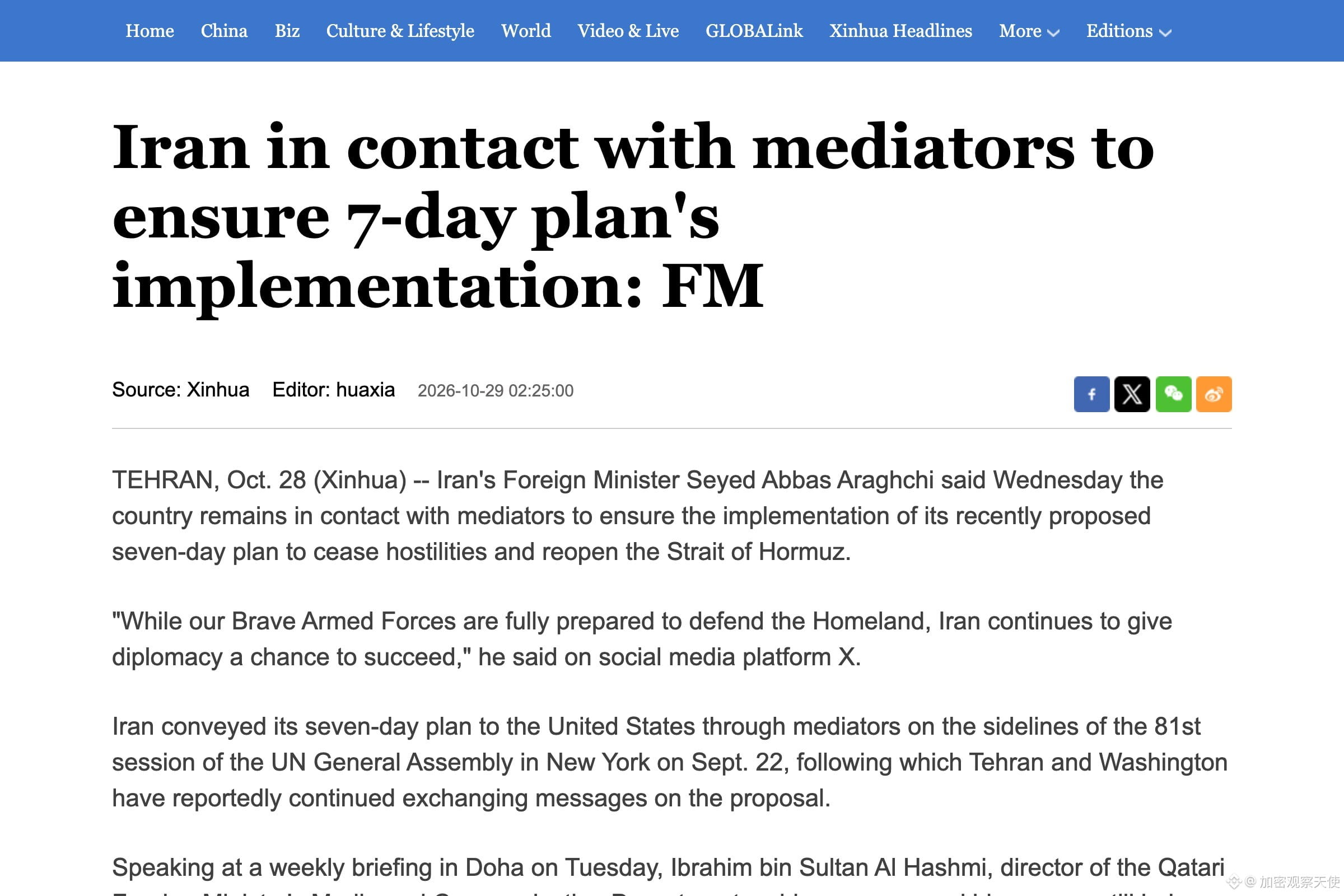
Iran says its seven-day plan calls for a ceasefire and reopening the strait; Ukraine’s trilateral talks are scheduled for early November; Gulf states have reportedly been told to prepare for action after the midterm elections.
Three tracks are lined up behind the same date.
The market is pricing not a war premium into oil, but a waiting premium.
A deadline that keeps getting postponed is itself losing value.
On 10-28, Iran’s foreign minister wrote on X that he was still in contact with mediators, seeking to put the seven-day plan into effect.
The proposal was conveyed by mediators on September 22 during the UN General Assembly and called for a ceasefire and the reopening of the strait.
On Ukraine, Zelenskyy said trilateral talks are scheduled for November 6 to 10, pending a response from the U.S. around November 4.
The third track comes from the media.
The Wall Street Journal reported that Washington has told several Gulf states to prepare for brief action after the midterm elections.
The White House has not made a final decision, and this report has not been officially confirmed.
Three tracks, one date.
History offers two cleaner precedents.
On October 26, 1972, Kissinger said in Paris that peace was at hand, 12 days before Election Day.
The Paris Peace Accords were actually signed on January 27, 1973—93 days later.
In the 2015 nuclear negotiations, the deadline was pushed from June 30 to July 7.
A third deadline was set for midnight on the 13th; the agreement was not signed until July 14.
What the two episodes had in common was that the dates kept moving, while the conditions did not.
So the number of postponements is a measure of how far apart the sides are on the terms.
Markets are moving in tandem. #油价 At the same time, front-month WTI was at $101.46, down 1.28%.
Brent was at $110.27, down 1.23%, while New York gold was nearly flat.
Oil retreats a notch, one marginal source of inflation expectations retreats a notch, and the long end eases in turn.
The 10-year yield edged lower today, after the official close at 5.05% in the previous session.
This chain affects the discount rate for long-duration assets like $BTC , not the narrative.
Oil is falling, and AI stocks are also being repriced lower; with both drivers moving in the same direction, it’s hard to tell which matters more.
The part I’m unsure about is this seven-day deadline.
The proposal put forward in September also came with a seven-day timeline. Five weeks have passed, and the same deadline has been mentioned again.
The new deadline sounds plausible, but there’s no way to verify it.
What’s really moving here is the coordinates, not the positions.
In any negotiation where a deadline is used as leverage, it depreciates each time it is invoked.
Because a date can be pushed back; credibility cannot.
After November 3, the question is not whether there will be another seven days, but which comes first: a ceasefire or the reopening of the strait.
Would you treat November 3 as a date, or as a variable?
Market data is intraday as of 10-29 12:05 CST; Treasury yields are from the Treasury Department’s daily curve.
The above is a compilation of public information and personal analysis, and does not constitute investment advice.