#微软财报能否兑现ai红利
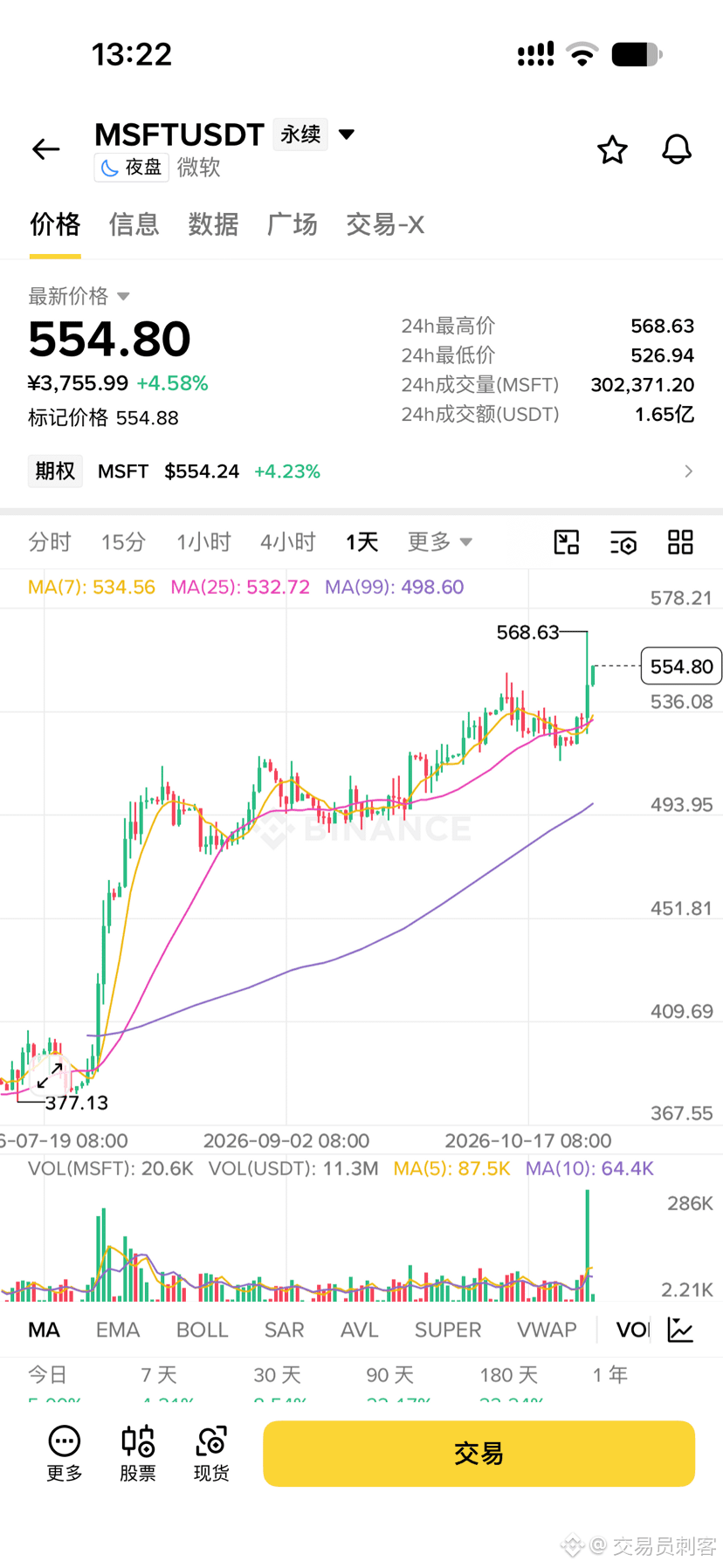
At 554, Microsoft is a classic case of “strong fundamentals, awkward positioning.” Its earnings were undeniably stellar, but the stock has already rallied in the short term. Chasing it higher now risks a pullback, while shorting it risks going against the trend. Here’s a breakdown of the bull and bear strategies for this setup.
Bullish case: Strong earnings, but don’t rush to chase
The standout feature of Microsoft’s latest earnings is its cash flow. Azure grew 48%, and the company generated a whopping $18.6 billion in free cash flow in a single quarter—that’s real cash-generating power. The stock surged at one point after hours, showing that investors are buying into Microsoft’s “spend and earn at the same time” model. As long as Microsoft continues to deliver on the commercialization of AI, it remains the strongest defensive play among the Magnificent Seven tech stocks. However, 554 is no longer where the stock was before earnings were announced, and some of the good news has already been priced in. On top of that, the Fed held rates steady, but two officials called for a hike, while rising long-term Treasury yields are weighing on stocks. Chasing the stock here offers an unattractive risk-reward.
Bearish case: Macro headwinds put short-term pressure on the stock
The bear case is not about fundamentals; it’s about macroeconomic conditions and flows. The Fed remains concerned about inflation, and expectations for a rate hike in December haven’t disappeared. That is capping valuations for tech stocks. As a mega-cap stock, Microsoft won’t be immune if the Nasdaq pulls back on disappointing after-hours earnings from companies like Amazon and Coinbase. Also, the 555–560 range above 554 is a dense area of overhead supply from previous buyers who are underwater. Without sustained high volume, it will be difficult to break through in one move.
Specific strategies
Strategy 1: Buy the pullback (primary strategy)
Don’t chase the price higher; wait for a pullback. If the stock retraces to the 545–548 range and stabilizes on lower volume, consider opening a small long position. Set a stop-loss below 540, with an initial target of 560 and a potential target of 570 if it breaks through. Strong earnings provide a fundamental backstop, making a pullback a buying opportunity.
Strategy 2: Try a small short at resistance (secondary strategy)
If the stock bounces back to 558–560 and shows heavy volume without further gains or forms a long upper wick, consider a small short position. Set a stop-loss above 565, with an initial target of 548 and a second target of 540. This is a short-term trade against trapped buyers and macro pressure, not a bet against the fundamentals.
Strategy 3: Follow a breakout (right-side entry)
If the stock breaks above 560 on strong volume and holds there, it would suggest the market has fully absorbed the earnings news and is positioning for further upside. Consider entering a small long position, with a stop-loss at 555 and a target of 575.