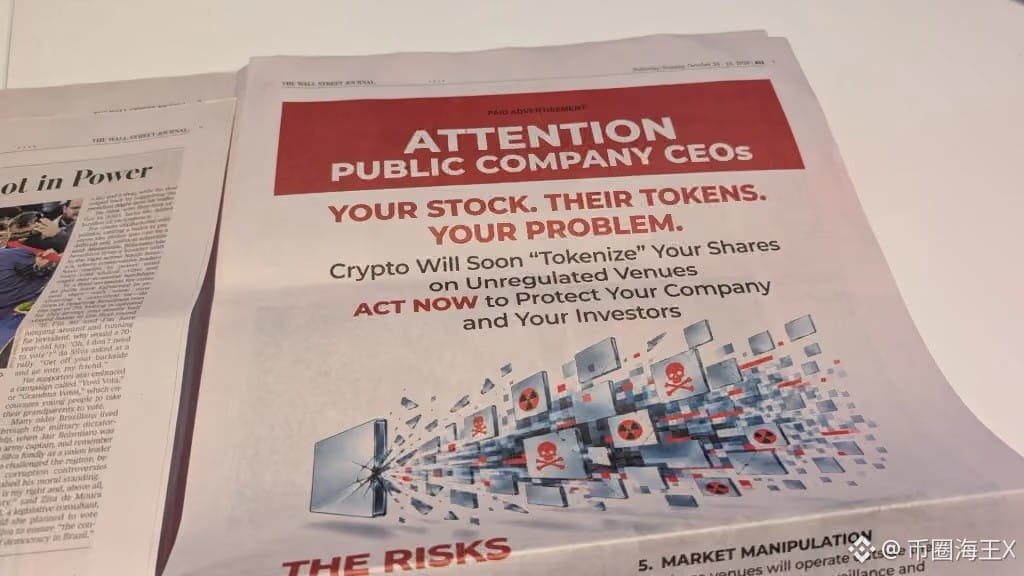
【Wall Street Publicly Opposes Stock Tokenization! Why Is the Crypto Industry Getting Nervous? ⚔️】
💬 加入X先生的粉丝群聊跟进
Putting stocks on-chain was once seen as an important way to bring traditional finance and blockchain together. Now, however, it has sparked a debate on Wall Street.
📢 Recently, The Wall Street Journal ran a full-page ad warning executives at publicly traded companies that third-party platforms tokenizing stocks could pose risks, including pricing discrepancies, opaque shareholder identities, cyberattacks, and market manipulation. The ad urged companies to exercise their right to object in a timely manner.
The dispute comes against the backdrop of a conditional, temporary exemption framework recently introduced by the U.S. Securities and Exchange Commission (SEC), allowing eligible platforms to trade certain tokenized stock products. Under the framework, platforms must notify issuing companies in writing in advance, and those companies have 30 days from receiving the notice to object.
⚠️ But soon after the ad appeared, tokenization company Securitize hit back with a full-page ad in the same newspaper, emphasizing that compliant stock tokens can be backed one-to-one by actual shares and traded on regulated platforms. Holders can also enjoy corresponding voting and dividend rights.
Here’s a key distinction: not all tokenized stock products are the same. Some tokens represent actual shares, while other products merely track a stock’s price and do not represent ownership of the underlying shares. The rights and risks can be completely different.
In addition, the original opposition ad was paid for by the Common Sense Leadership Fund, but the ultimate source of the funding remains unclear. Nasdaq also said it had no connection to the ad.
📌 What this debate really shows is that putting stocks on-chain may be possible, but who is allowed to issue them, where they can be traded, and what rights investors have must all be made clear.
The future of tokenization depends not only on whether the technology works, but also on whether regulation, market liquidity, and investor protections can keep pace. Understanding the changing rules is essential to seeing the real opportunities in the convergence of traditional finance and the crypto industry.
#股票的代幣化