Top-ranked at +24.78%, but only 4 eligible tokens are up: Is $INIT pricing in a recovery, or moving independently?
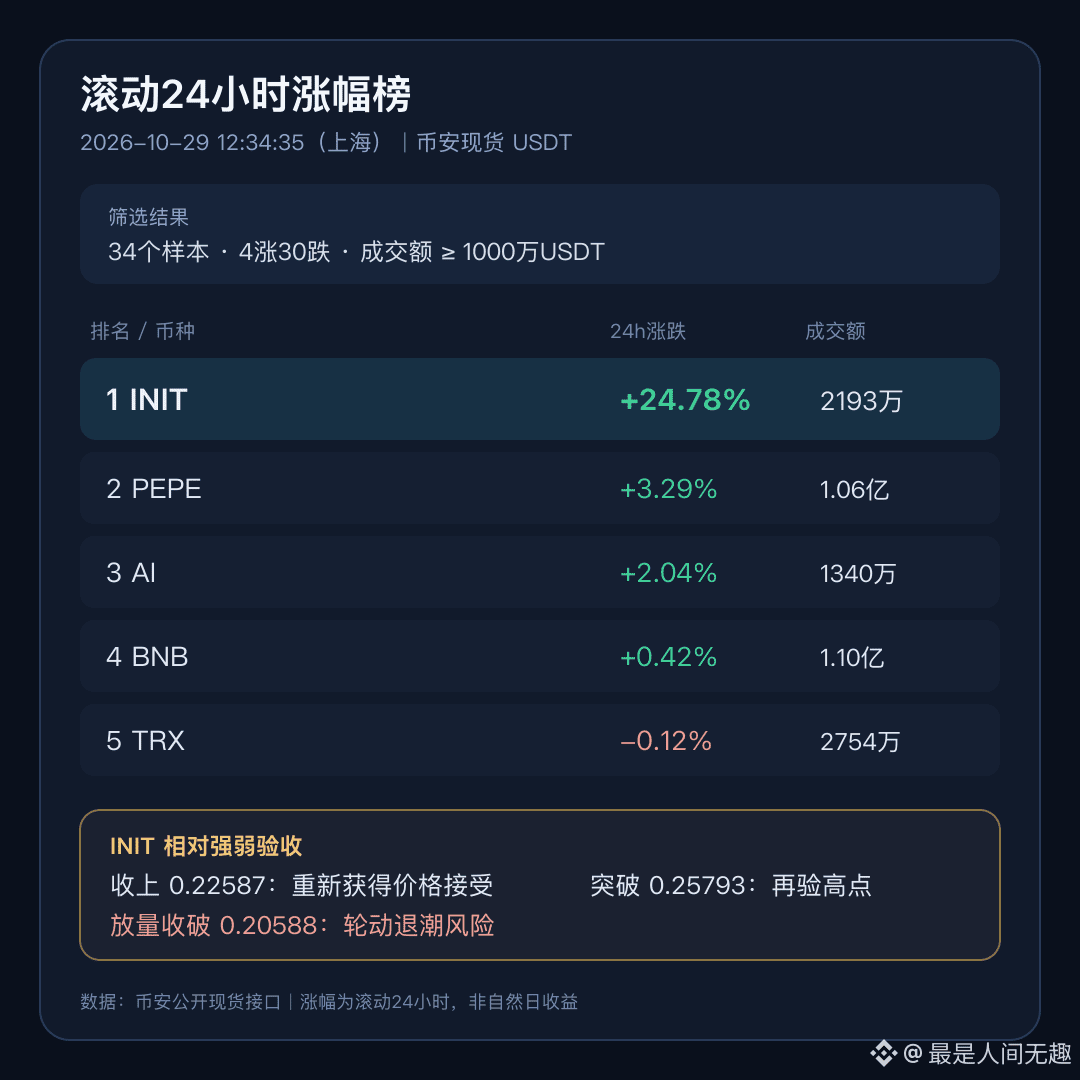
In the rolling 24-hour rankings at 12:34 (Shanghai time), INIT led at +24.78%, more than 21 percentage points ahead of runner-up PEPE at +3.29%. Yet among the same 34 USDT spot pairs, 30 were down, with BTC at -1.38%. This is not a broad-based rally; capital is singling out INIT for trading.
First, the ranking criteria. Using Binance’s official public spot-market data, we filtered for assets marked TRADING, available for spot trading, quoted in USDT, and with 24-hour trading volume of at least 10 million USDT. After excluding stablecoins, fiat currencies, leveraged tokens, tokenized traditional assets, and clearly anomalous assets, the top five were: INIT +24.78% (21.93 million), PEPE +3.29% (106 million), AI +2.04% (13.40 million), BNB +0.42% (110 million), and TRX -0.12% (27.54 million). These are rolling 24-hour returns, not calendar-day returns. The fact that fifth place is still negative also points to weak market breadth.
Why now? The confirmed sequence of events is as follows: On October 23, Initia halted its chain due to a MoveVM script-cache vulnerability. In a statement on October 24, the team said the attacker had moved about $2.7 million in assets, but had not minted any native INIT. On October 27, it said the fix had been drafted and was undergoing a security audit. On October 28, the foundation approved restoring 1:1 backing for affected Noble USDC, WETH, and AUSD0, capped at 1.08 million USDC, 105 ETH, and 1.4 million AUSD0, respectively. The market is pricing in “technical fixes + asset backstopping.”
But the process is not complete. The foundation explicitly stated that fund transfers still require reconciliation and final approval, and gave no timeline for the network’s recovery. A commitment, funds arriving, an audit passing, and an orderly restart are four distinct milestones; the first should not be treated as if everything is already complete.
On price and volume, INIT’s trading volume over its latest 24 complete one-hour periods was 21.67 million USDT, 3.63 times the 5.96 million recorded in the preceding 24 hours, supporting its independent strength with volume. The counterevidence: the snapshot price of 0.21714 is already 15.81% below the 24-hour high of 0.25793. The latest complete hourly candle also closed at 0.21059, down from 0.22353, on volume of 767,100—1.57 times the median for the preceding 24 hours. Selling pressure after the spike is significant.
From here, watch for just three outcomes:
Continuation confirmed: A complete one-hour candle closes back above 0.22587, with volume remaining above roughly 490,000 USDT. Then, a break above 0.25793 followed by a successful retest would show that the recovery narrative has translated into new price acceptance.
Consolidation at elevated levels: Price holds between 0.20588 and 0.22587 as volume gradually declines. Relative strength would remain, but it would be more appropriate to wait for the audit, funds arriving, or a restart announcement to provide confirmation, rather than treating the top-ranked gain as a guarantee of continued upside.
Rotation fades: A complete hourly candle closes below 0.20588 on rising volume, signaling that the independent buying is starting to fade. If price then falls back toward the 24-hour opening price of 0.17402, the structure of this “recovery repricing” move is broken.
The main risks are that the network has not yet recovered, the audit or reconciliation is delayed, the actual shortfall exceeds what has been disclosed, the attacker’s funds are disposed of, and low liquidity causes slippage. Open $INIT and first check which side—0.22587 or 0.20588—gets confirmed by volume on a complete hourly candle. Then assess whether this is a continuation of the recovery rally, consolidation at elevated levels, or a fading event-driven rotation.