

BNB Standard rings the Nasdaq opening bell: What exactly is its relationship with Binance? And what is BNCB?
Deep Dive · Digital Asset Treasury (DAT) × Tokenized Stocks
The short answer: This is not “Binance going public.” It’s a closed-loop experiment in which a U.S.-listed shell company holds BNB as its sole core asset, is operated by Binance-affiliated capital, and then has its shares tokenized by Binance and sold back to crypto users. The bell-ringing is just a promotional milestone for this experiment, not an IPO.
Project details | Data as of: Morning of 2026-10-29 (Beijing time) | Assets: BNC (Nasdaq) · BNCB (Binance bStocks) · BNB (BNB Chain) | Price/market cap reference: U.S. market close on 2026-10-28 (16:00 ET / 04:00 on 10-29 Beijing time); BNCB: latest Binance spot trade price | Financials: FY2027 Q1 (ended 2026-07-31)
5 Key Takeaways
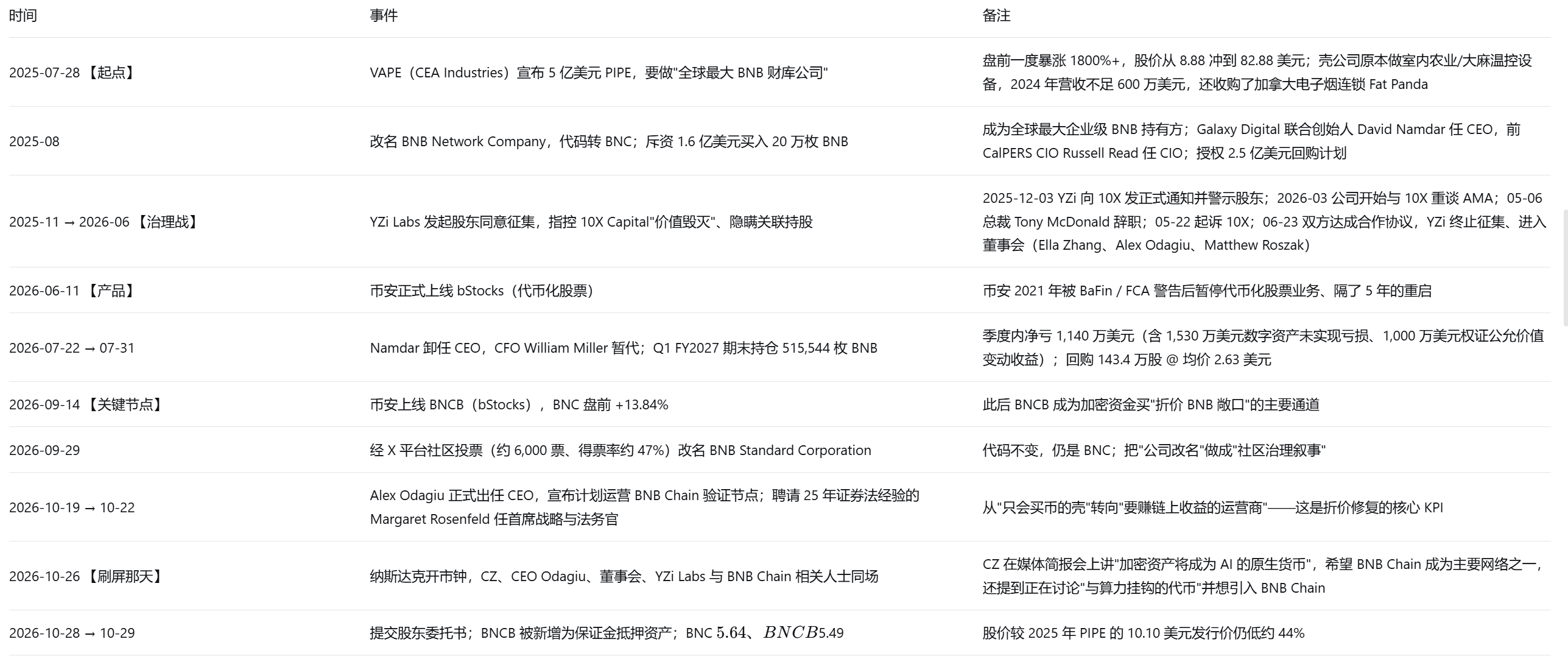
It wasn’t an IPO, but a celebratory “name change + change of leadership.” BNC had already gone public via a reverse merger in July 2025 (as CEA Industries, ticker VAPE, a small indoor agriculture climate-control equipment company). In August 2025, it changed its name to BNB Network Company and its ticker to BNC. On 2026-09-29, it changed its name again to BNB Standard Corporation following a community vote, and rang the opening bell on 10-26.
Its relationship with Binance runs along three lines—“assets + people + channels”—not through corporate ownership. The asset is BNB (the native token of BNB Chain); the people are YZi Labs (formerly part of the Binance Labs organization), which led the $500 million PIPE, placed directors, and provided the CEO; the channel is Binance listing BNC as the bStocks token BNCB for 24/7 trading on its own platform, and accepting it as collateral. Legally, BNC is an independent U.S.-listed company, and Binance does not consolidate it.
BNC’s business is “holding BNB.” It holds 515,544 BNB, accounting for 93.1% of its total assets. At current prices, that’s about $385 million, while the company’s market cap is only $232 million—the market values it at 0.60 times net asset value, or buying BNB at a 40% discount.
**BNCB is a “tokenized BNC stock” in Binance’s bStocks product line**, backed 1:1 by underlying BNC shares and convertible to and from directly held shares. It tracks the BNC share price ($5.49 vs. $5.64), not the price of BNB; buying BNCB is roughly equivalent to buying BNB exposure at 0.59x, at the cost of taking on corporate governance, litigation, dilution, liquidity, and regulatory risks.
Its real significance for the industry: DATs are expanding from BTC/ETH to “platform tokens,” and for the first time there is a complete loop in which “an exchange’s own ecosystem creates a treasury company, then tokenizes its stock and sells it to its own users.” The flywheel spins forward at a premium (issue shares to buy coins) and reverses at a discount (issuing shares destroys value). It is now stuck at 0.6x and can only rely on buybacks, validator yield, and a restored narrative.
Key figures at a glance
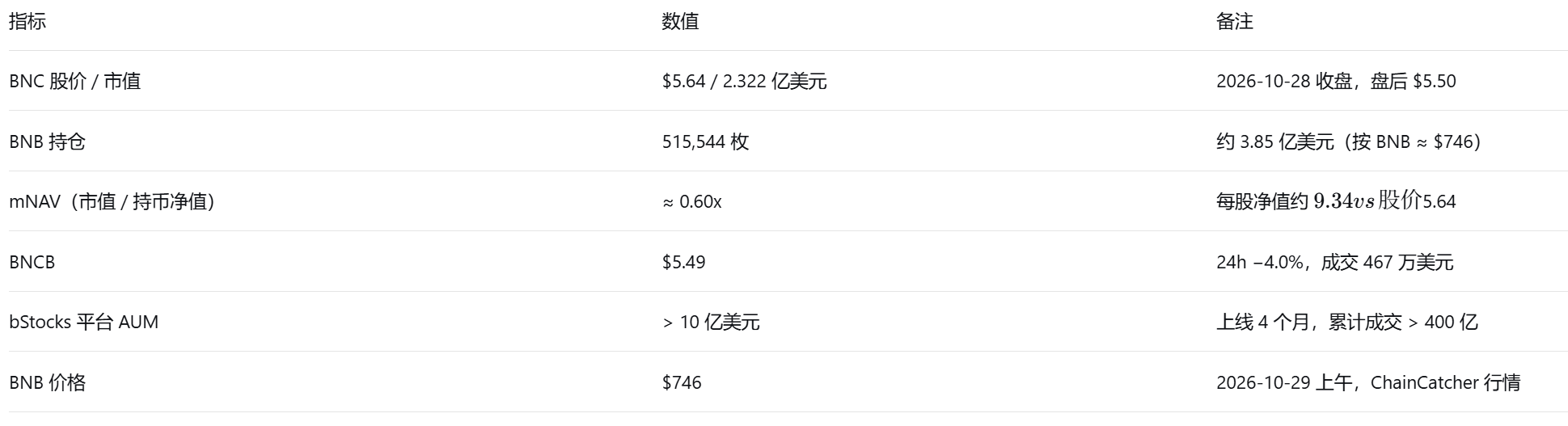
01 First, dispel three misconceptions

⚠️ An easy-to-miss question of identity: CZ is no longer Binance CEO (he stepped down after a settlement at the end of 2023, retaining only his founder status). His attendance at the bell-ringing ceremony as the founder does not amount to an official endorsement by Binance. For compliance purposes, Binance will certainly emphasize that BNC is an independent listed company—this is the standard separation structure for this type of transaction.
02 Relationship map: Three interconnected strands
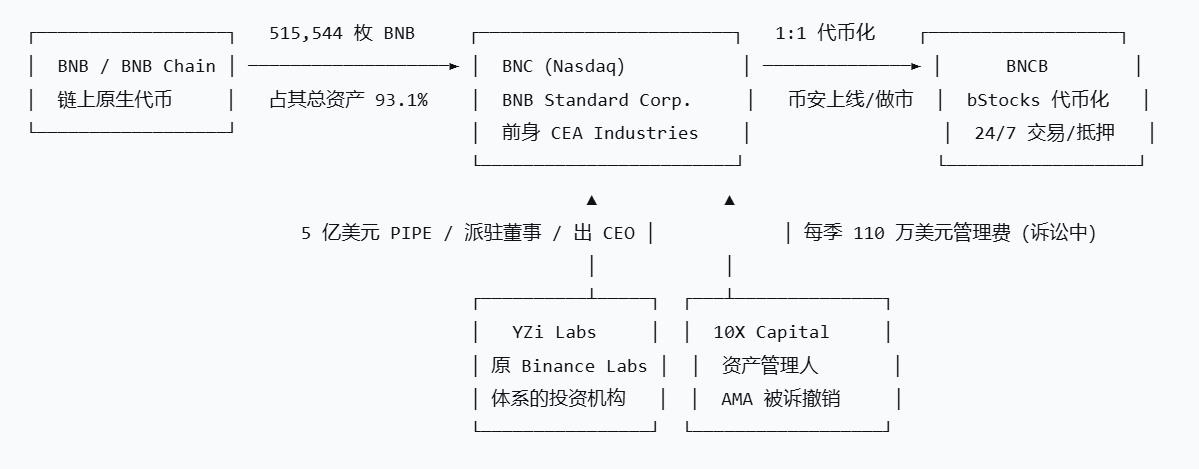
Strand one · The asset link (the most concrete)
BNC’s balance sheet is essentially “BNB + a little retail business.” As of 2026-07-31, the fair value of its digital assets was $304.5 million, or 93.1% of its $327.2 million in total assets; of this, 471,346 BNB were unencumbered and 44,198 were collateral for a $15 million USDC loan. The company calls itself “the world’s largest corporate BNB treasury”; the second-largest holder, Nano Labs, has about 128,000 tokens—roughly a fourfold difference.
Strand two · Capital and people
On 2025-07-28, the company announced a $500 million PIPE ($400 million in cash + $100 million in crypto asset subscriptions). 10X Capital structured the deal, while YZi Labs led the investment and provided strategic backing. More than 140 institutions participated, and full exercise of the warrants could bring the total to $1.25 billion. In 2025-11, YZi Labs launched a shareholder consent solicitation and moved against 10X; on 2026-06-23, the parties settled, and three YZi representatives joined the board. In October, the CEO role went to a former YZi investment partner. This is a path **from “financier” to “controller.”**
Strand three · Channels and products
On 2026-06-11, Binance launched bStocks; on 09-14, it listed BNCB for spot trading and Convert (BNC rose 13.84% pre-market that day); from 09-18 onward, BNCB holdings grew rapidly; and on 10-28, BNCB was added to the list of margin collateral assets alongside AppLovin, GE Vernova, and others. Binance is using its exchange traffic to direct users to “a treasury company built by its own people.”
Behind the scenes · Litigation
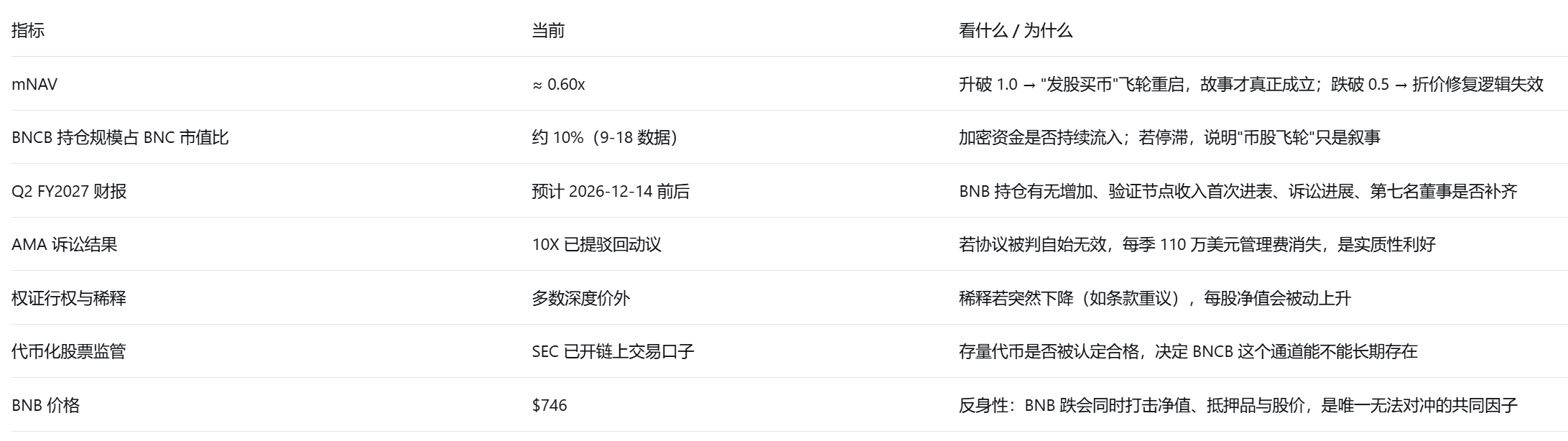
On 2026-05-22, BNC sued its asset manager, 10X Capital, in federal court in Delaware, seeking to rescind the asset management agreement (AMA) from its inception, or, in the alternative, arguing that its liquidated damages clause is an “unenforceable penalty.” 10X filed a motion to dismiss on 07-28, and the company filed its opposition on 08-14. The agreement has not been terminated, and the lawsuit remains unresolved.
03 Timeline: From a Vape Shell to “Wall Street’s BNB”
04 What kind of business is BNC, really?
It’s easy to misread it as “the U.S. stock market’s BNB ETF.” In reality, it’s a vehicle holding BNB that comes with leverage, fees, litigation, and a vape retail business. It should be valued using a DAT (Digital Asset Treasury) framework, not PE/PB:
mNAV methodology notes ① Using only the market value of BNB holdings ÷ market cap = 384.7 / 232.2 ≈ 0.60x; ② Using book shareholders’ equity as of 7-31 ($289.4 million) and revaluing BNB at the current price gives approximately $371 million; market cap / revalued net assets ≈ 0.63x; ③ Using the reported value in the 7-31 financial statements (BNB was approximately $586 at the time) gives 0.80x. All three methods point to a “significant discount”; the differences depend on whether net debt is included and whether BNB is revalued at current prices. Metrics such as 2.9x PE and $105 million in net income are meaningless for a DAT stock—net profit is mainly driven by changes in the fair value of BNB, so the company reports a profit when BNB rises and a loss when it falls, irrespective of its operating performance.
Why it stays at a discount: Six sources of the 40% discount
Fee leakage: Asset manager 10X charges management fees under the agreement ($1.1 million in one quarter), while the company is suing the manager to rescind that agreement—the money is flowing out, and to a counterparty it is currently litigating against.
Governance discount: The CEO has changed three times (Namdar → interim CFO → Odagiu), the board is short one of its seven members, there are material weaknesses in internal controls, and there was a $1.4 million bill for shareholder activism.
Overhang from dilution: PIPE warrants make up a large proportion of the package (the disclosed Nano Labs portion has a $15.15 exercise price, deep out of the money). This means limited near-term dilution pressure, but also that the “issue shares at a premium to buy coins” channel is closed.
Poor liquidity: With a market cap of just $230 million and daily trading volume of approximately $6 million, it is excluded from major indexes and difficult for institutions to invest in.
A mixed business: It also owns Canadian vape retail chain Fat Panda (34 stores, quarterly revenue of $7.2 million), so it is neither a pure-play DAT nor a pure consumer stock—and neither valuation approach fits.
Reflexivity: A DAT premium depends on the positive feedback loop of “issue shares to buy coins → increase coin holdings per share.” At a discount, this loop reverses. The company can only buy back shares (with just $7.1 million in cash and debt covenants to comply with), so its growth engine stalls.
Net asset value per share vs. two market prices (USD)

05 But the discount has actually started to narrow
This is the easiest fact to overlook, and also the most important: Over the past three months, BNC has risen not because BNB went up, but because the discount narrowed.
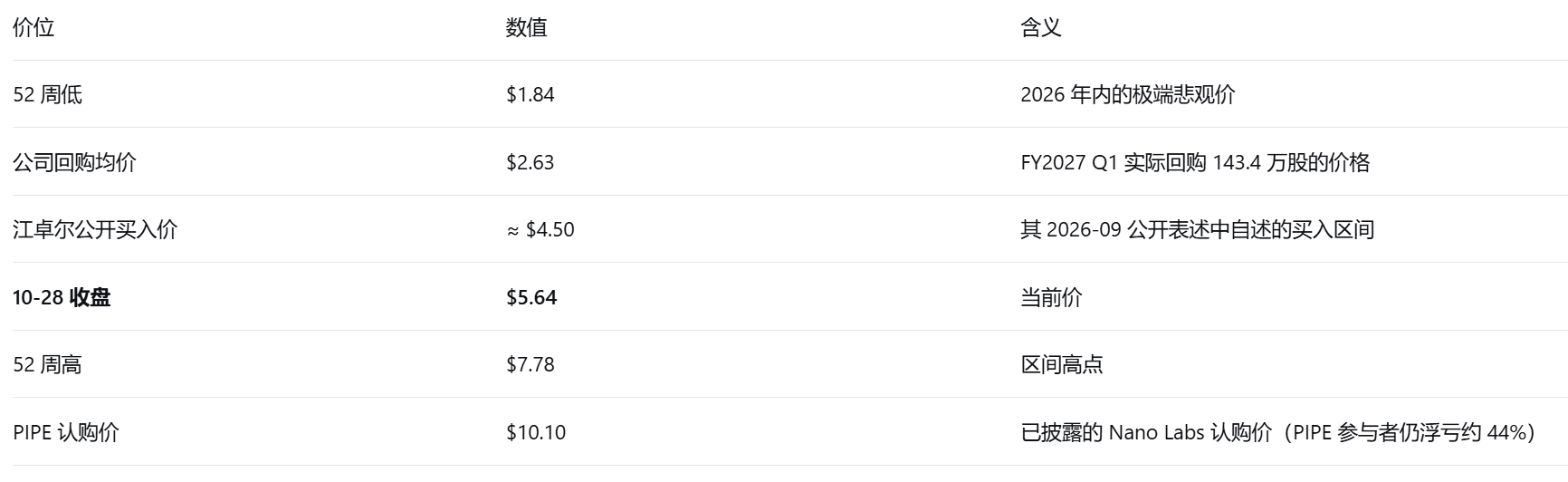
On July 31, BNB was approximately $586, and the company’s average share buyback price that quarter was $2.63 (using the average price as a rough proxy for the share price at the time) → mNAV was approximately 0.36x (a 64% discount) then.
BNB is now approximately $746 (+27%), and the share price is $5.64 (+114% from the average buyback price) → mNAV is approximately 0.60x.
In other words, people who bought BNC over the past three months profited from a “double boost”: BNB’s rise plus the discount narrowing from 0.36x to 0.60x. Meanwhile, institutions that participated in the PIPE at $10.10 in July 2025 are still down approximately 44%.
So the real meaning of “ringing the bell” is not a celebration of going public, but a marketing move aimed at narrowing the discount: building “BNB Standard” into a brand Wall Street understands (echoing the “Bitcoin Standard” / MSTR narrative), turning CZ’s personal attention into institutional attention, and replacing the market’s image of a “shell with governance chaos” with one of “a company with a legitimate management team, on-chain yield, and a Nasdaq listing.” The announcements of operating a BNB Chain validator on 10-19 and hiring a securities law executive on 10-22 were both moves supporting this narrative.
BNC current price and key levels (USD/share)
06 What exactly is BNCB? How is it different from BNB?
Definition: BNCB is an asset in Binance’s bStocks product line—a “tokenized share of BNB Standard Corporation.” According to Binance, it is backed 1:1 by the underlying U.S. stock, can be converted 1:1 to and from direct shareholdings, trades 24/7, settles on-chain, can be transferred between wallets, and may be used as collateral in eligible cases. The “B” in the name is the bStocks suffix, **not “the B in BNB.”**
⚠️ Note on methodology: Binance provides full details of the underlying shares’ specific custody arrangements, issuer, and regional restrictions only in its official FAQs / announcements. This report has not obtained the original wording; please refer to Binance’s official FAQ for matters concerning the legal structure (to be verified).
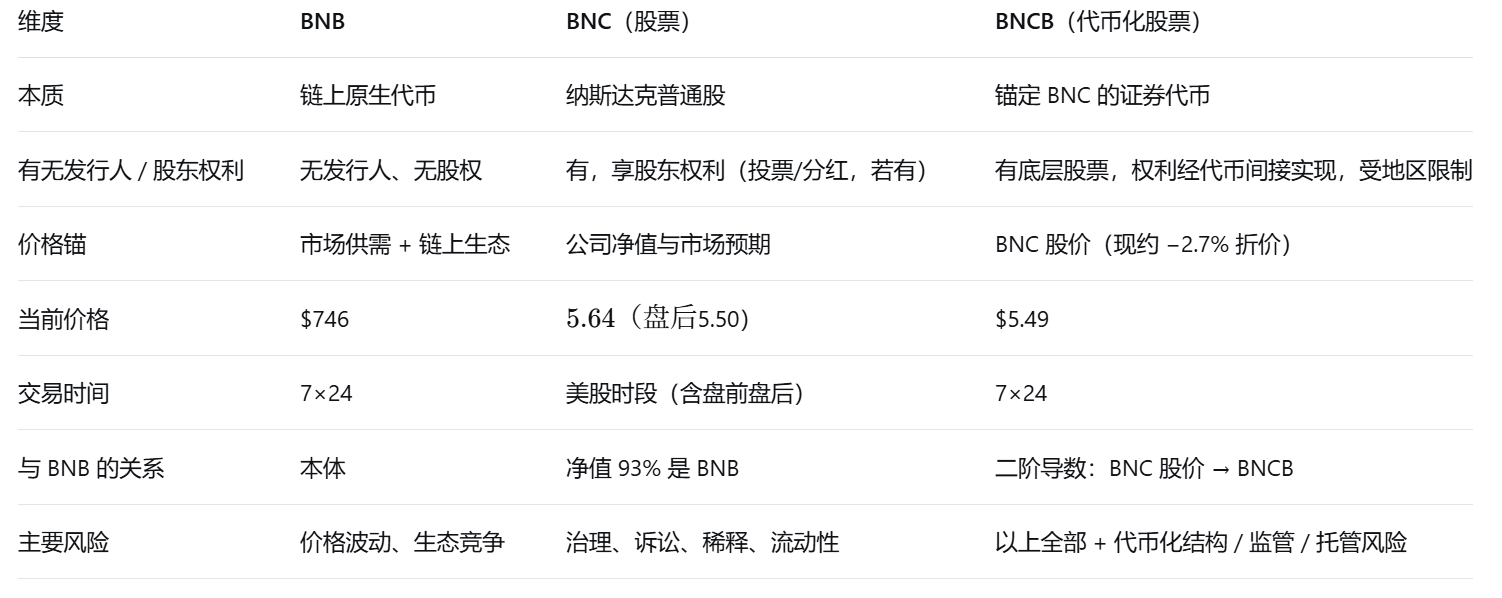
In a nutshell: Buying BNB means buying an asset; buying BNC means buying “a company that holds BNB”; buying BNCB means buying “a tokenized certificate representing a company that holds BNB.” Risks compound at each of the three levels, and prices get discounted at each level.
Two real forms of “arbitrage,” with completely different characteristics
BNCB ↔ BNC price spread (arbitrageable, largely closed): Because there is a 1:1 conversion channel, the price spread between the two has narrowed to under 3%. This is “conversion-channel arbitrage,” which profits from conversion friction and timing differences, with very little room for gains.
BNC share price ↔ BNB net asset value per share (not arbitrageable, 40% discount): This discount cannot be eliminated through arbitrage—you can’t redeem the company’s BNB. It can only narrow through better governance, improved liquidity, a restored narrative, or share buybacks and cancellations. The public comments made on 2026-09-18 by Jiang Zhuoer, founder of BTC.TOP, essentially amount to a bet on this outcome (he said he bought BNC around $4.50 and viewed $5.50–$5.76 as a good entry point, reasoning that “at $5.76, mNAV is 61%; any further decline means buying BNB at half price”).
07 What does this mean for Binance?
✅ What it gains
It has secured a long-term BNB buyer without spending money: The $500 million PIPE was funded by more than 140 outside institutions, and BNC used the funds to buy 515,000 BNB (estimated at about 0.4% of BNB’s total market cap, assuming a BNB market cap in the region of $100 billion). Selling BNB would undermine the company’s own narrative, making it naturally a “locked-up institutional holder.”
A permanent Wall Street billboard: A Nasdaq ticker, the opening bell, a Times Square billboard, and a media briefing in New York—exposure that BNB couldn’t buy even with a marketing budget.
It adds a “homegrown story” to bStocks: Four months after launch, bStocks surpassed $1 billion in AUM, with over $40 billion in cumulative trading volume, more than $300 million in average daily volume, nearly 100 assets, and $6 billion in 1:1 stock-token conversions. BNCB is one of its most compelling stories.
It elevates BNB’s story: from “an exchange platform token” to an asset that “a listed company can hold as a reserve asset, that can be securitized, and that can serve as an AI payments and settlement layer.” CZ’s speech on the day of the bell-ringing ceremony (AI-native currency, computing-power tokens on BNB Chain) was the script for this upgrade.
⚠️ What it has to give up / Where the risks lie
Reputational association: The market already sees it as “a treasury company controlled by Binance” (Jiang Zhuoer’s own words). If BNC falls from $10.10 to $5.64 and BNCB holders lose money, Binance and CZ will be held responsible.
Conflicts of interest across three roles: The exchange is both the token issuer and trading venue, the target company is governed primarily by the exchange’s own investment arm, and custody of the underlying shares is still “within the Binance ecosystem” (as stated in the company’s own risk factors). This is a structure the crypto industry has not seen before.
Risk of a regulatory repeat: In 2021, Binance’s tokenized stock business was shut down after BaFin and the FCA said it “may involve unregistered securities trading.” Although the SEC opened the door to on-chain stock trading in 2026, existing tokens may not comply with the new framework. Turning U.S. stocks into tokens, selling them, and accepting them as collateral could face new regulatory limits at any time.
Correlated reflexivity risk: BNB falls → the company’s net asset value falls + the value of the 44,000 BNB pledged as collateral falls + the share price falls + BNCB falls. The same risk factor runs through all four layers, with no diversification.
08 What does this mean for the crypto industry?
The fourth wave of DAT expansion: from BTC → ETH → SOL → platform tokens. The first three waves involved outside institutions copying MSTR’s playbook; this time, the exchange ecosystem itself is doing it, creating for the first time a complete loop of “exchange — treasury company — tokenized stock.” The BNB camp is mainly backed by Asian capital (Nano Labs with 128,000 tokens, Huaxing Capital’s $100 million proprietary allocation, and Bhutan’s GMC including it in its reserves), while the SOL camp is mainly backed by Wall Street—the divide between the two approaches is becoming increasingly clear.
Tokenized stocks are evolving from “broker / issuer products” into “exchange products.” The pace—$1 billion in AUM and $40 billion in cumulative trading volume in four months—is incomparable to the 2021 wave. The industry’s focus is shifting from “who can list more coins” to “who can bring U.S. stocks on-chain and make them usable as collateral.” BNCB’s inclusion on the margin collateral list shows that the destination for this approach is “stocks as on-chain collateral.”
The stock-crypto link (reflexivity) is becoming a new source of systemic risk. When the same asset exists at four levels—“on-chain token, U.S.-listed company, tokenized stock, collateral”—a forced liquidation or discount at any level can spread back through the narrative and collateral ratios. This risk took an early form in the GBTC/3AC era of 2022; now it has become institutionalized.
Governance turned into narrative. A community vote on X (around 6,000 votes, 47% of the vote) determined the name change—turning “corporate governance” into “community engagement.” This is a marketing innovation, but also a sign of hollowed-out governance: at the same time, the company still has material weaknesses in internal controls, an unresolved lawsuit over the asset management agreement, and a vacant seventh board seat.
09 The opposing view: Four weakest assumptions
“The discount must narrow” is an assumption, not a mathematical certainty. A number of small U.S.-listed DAT stocks stay at 0.5–0.8x for years. Narrowing the discount requires a catalyst (index inclusion, a thorough governance overhaul, or real cash flow generation); without one, the discount may persist indefinitely.
“A 1% shift in BNB buying toward BNC would erase the discount” overestimates how efficiently demand flows through. Buying BNCB does not automatically mean net buying of BNC (Binance could meet demand using inventory or hedging). In addition, crypto funds already hold about $17.28 million in BNCB + $5.29 million in BNC4, together about 10% of BNC’s market cap—this is buying demand, but also raises the future question of “who will take the other side?”
“CZ’s appearance = endorsement” confuses narrative with cash flow. His appearance boosts credibility, but it does not change the $11.4 million quarterly loss, resolve the lawsuit, or fix internal controls. The real value realization point is whether “the validator can generate meaningful on-chain yield”—something only announced on October 19.
The MSTR comparison does not hold up structurally. MSTR has cash flow from its software business, index inclusion, highly liquid options, and a premium flywheel built over many years. BNC has a market cap of $230 million, daily trading volume of $6 million, turbulent governance, and a vape retail business. Valuing the two using the same premium model is the biggest cognitive bias in this narrative.
10 What to watch next (verifiable leading indicators)
11 The bottom line: What are you really buying when you buy BNC / BNCB?
You’re not buying “a Binance listing,” “a substitute for BNB,” or “the next MSTR.” Essentially, you’re buying a bet: Can a BNB vehicle valued at 0.6x net asset value, burdened by governance turmoil and litigation, but which has just shown over the past three months that its discount can narrow, bring that discount to 0.8–1.0x within 12 months?
The odds are attractive (with a 40% net asset value cushion on the downside), but the probability of success depends on three things unrelated to the price of BNB: whether governance truly stabilizes, whether the litigation and management fees are resolved, and whether the validator can generate real cash flow. Ringing the bell solved only the “attention” problem—not any of these three.
Disclaimer: The content above is based on public data and quantitative analysis, is for reference only, and does not constitute investment advice. Markets involve risk; invest with caution. All investment decisions should be made independently in light of your personal risk tolerance, financial situation, and investment objectives. Consult a licensed professional firm if necessary. Past performance is not indicative of future returns.
Main sources
① Company primary disclosures
CEA Industries / BNB Standard Corporation, “First Quarter Fiscal 2027 Financial Results” press release (2026-09-11, including BNB holdings of 515,544 tokens, net assets, debt, buybacks, etc.)
Company 10-Q / 10-K risk factors
Nasdaq event page, “BNB Standard Corporation Rings the Opening Bell”
② Market and financial data
StockAnalysis: BNC closing price, market cap, shares outstanding, 52-week range (2026-10-28)
Binance public market data API: latest BNCBUSDT price and trading volume (morning of 2026-10-29)
ChainCatcher market data: BNB at $746 (2026-10-29)
③ Events and trading details (media, original sources should be verified)
ChainCatcher (“Changpeng Zhao attends BNB Standard Nasdaq listing bell-ringing ceremony”) 2026-10-26
ChainCatcher (“BNB Standard Corporation rings the opening bell at Nasdaq”) 2026-10-26
ChainCatcher (“Changpeng Zhao says crypto assets will become AI-native currency”) 2026-10-27
ChainCatcher (“Binance bStocks becomes the world’s fastest tokenized stock product to surpass $1 billion in user holdings”) 2026-10-15
ChainCatcher (“Binance adds five bStocks tokenized securities as collateral assets”) 2026-10-28
PANews (“BNB treasury company CEA Industries to rename itself BNB Standard”) 2026-09-29
PANews / Wu Blockchain (“Comparison of BNB and SOL treasury companies: Asian capital and U.S. Wall Street take sides”)
BlockBeats (“BNC appoints former YZi Labs investment partner Alex Odagiu as new CEO”) 2026-10-20
BlockBeats (“BNC spends $160 million to buy BNB”) 2025-08-10
BlockBeats (“BNB treasury controlled by Chinese billionaire: Can it rise further after surging 600%?”) 2025-07-29
Bitpush (“Jiang Zhuoer: BNCB is equivalent to gaining BNB exposure at a discount”)
④ Historical and regulatory background
DigitalToday citing Cointelegraph (“Binance plans to relaunch its tokenized stock business”) 2026-01-24 (including the background to the 2021 shutdown by BaFin / FCA)
FinanceMagnates on the SEC opening up on-chain stock trading and existing tokens potentially not meeting eligibility requirements (original source should be verified)
⑤ Data timestamp note: All prices in this report are as of the 2026-10-28 close / morning of 2026-10-29, not real-time. mNAV, net asset value per share, and discount rates are estimates based on public data; the methodology is noted in the text.