🔐 For months, I experimented with different parts of Web3:
🌐 networks
💧 liquidity pools
🌉 bridges
🖼️ NFT
🧪 quests and airdrops
📊 staking
🔗 different dApps
That stage served its purpose: learning by doing.
But closing a position or stopping using a network doesn't necessarily mean that everything related to that experience disappears.
Each interaction may have left on-chain permissions authorizing certain contracts to interact with tokens or NFTs.
And disconnecting from a dApp doesn’t necessarily remove those authorizations.
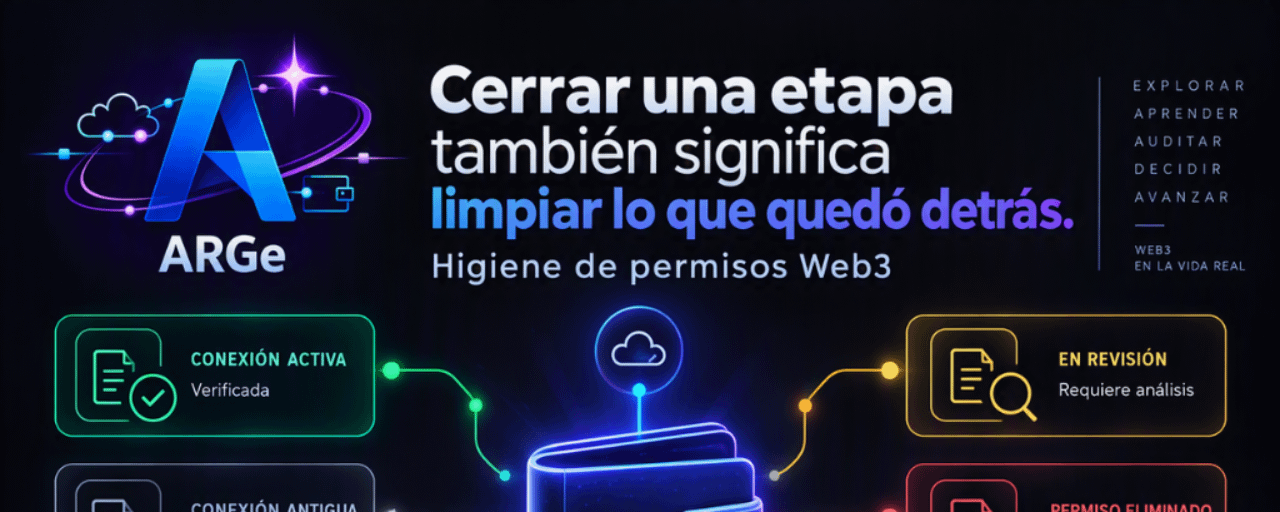
That’s why I decided to wrap up this stage by reviewing my wallet’s active permissions.
I used Revoke.cash to audit each network one by one.
On networks that are no longer part of my regular activity, such as Optimism, Linea, BNB Chain, and Polygon, I removed old permissions that no longer served a purpose.
Among other things, I found:
🔹 old allowances;
🔹 authorizations linked to protocols I no longer use;
🔹 permissions for NFTs I wanted to keep but no longer needed to have authorized to third parties.
But an even more important lesson emerged:
revoking everything can also be a bad idea.
I still have active positions on Arbitrum, Base, and zkSync.
There, the process was different:
identify → investigate → understand → only then decide.
A contract that may initially look like an unknown address could serve a necessary function for a position that’s still active.
So my goal isn’t to get a screen that says:
“0 permissions.”
My goal is something much more useful:
to be able to explain why each permission I chose to keep exists.
The new rule I’m taking away is:
🧹 Abandoned network → review unnecessary permissions.
🔍 Unknown contract → investigate before taking action.
⚙️ Active position → understand which permission it needs.
❌ Old permission with no purpose → consider revoking it.
And there’s another reason to do this periodically.
A wallet may have little capital today and seem irrelevant.
But the permission may still exist.
Months later, you might use that network again or deposit tokens again and have forgotten which contracts were still authorized.
Wallet hygiene is also part of wealth management.
Stage 0 was about learning by doing.
The next stage will be more selective:
fewer permanent experiments → more intention → more traceability → more security.
👇Do you periodically review the permissions that remain active in your wallets, or only when you stop using a dApp?
ℹ️ This documents my personal Web3 security process. I don’t recommend revoking contracts indiscriminately: first, you need to understand what each permission does.
Assets involved $USDT $ARB $ETH
#Web3 #CryptoSecurity #WalletSecurity #DeFi #RiskManagement