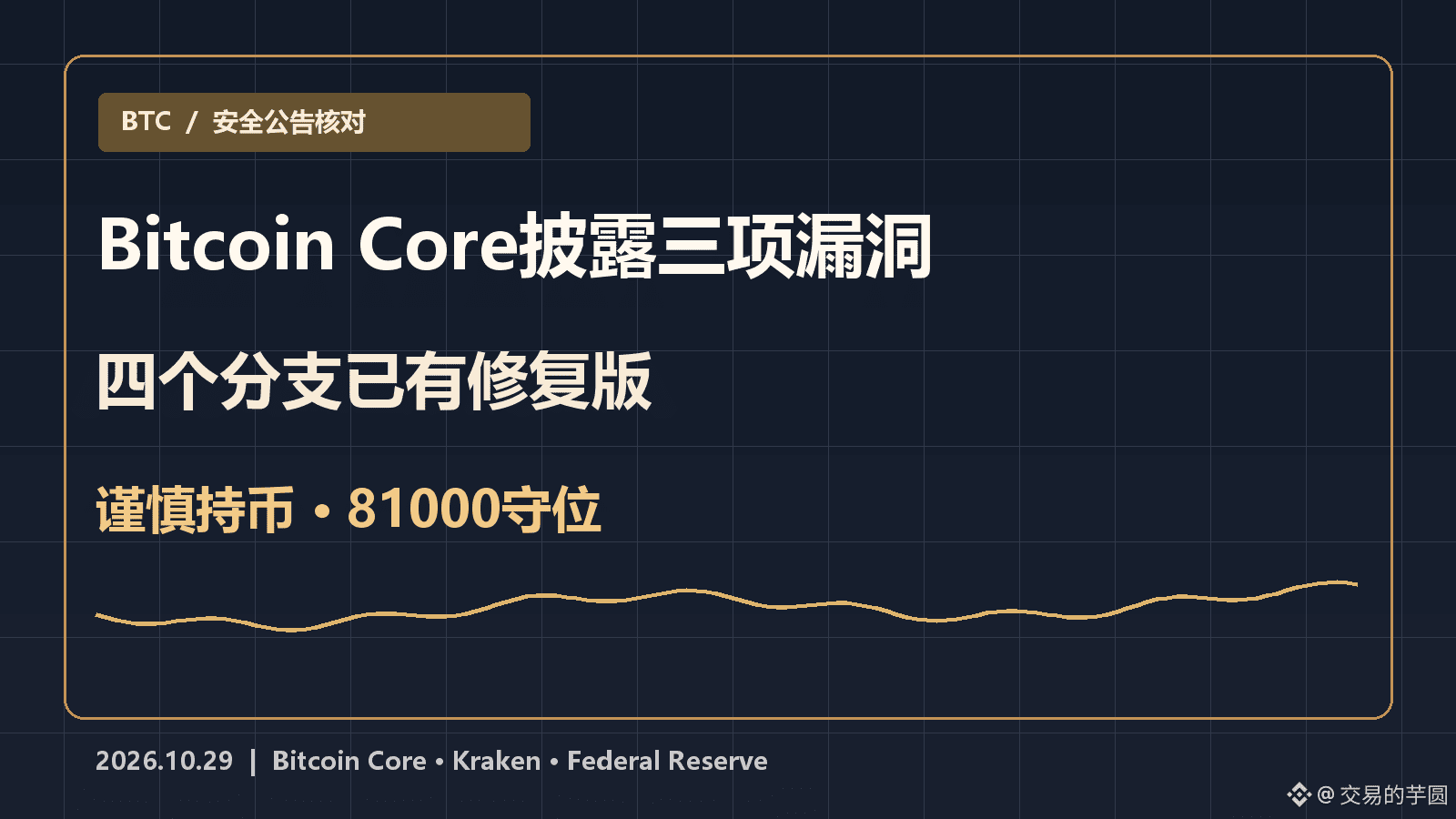
Bitcoin Core discloses three vulnerabilities | Patched versions released | Above $81,000, watch the risk boundaries first
My stance is to hold Bitcoin cautiously: don’t panic-sell because of the word “vulnerability,” and don’t interpret a patch announcement as an immediate bullish signal. Bitcoin Core published three security advisories on October 28, and the official Binance News account also reported the news. Comparing the two, the facts are that the three issues affect node stability, and patches have been released in versions 29.5, 30.4, 31.2, and 32.1. These are not vulnerabilities only discovered today that remain unresolved, nor do they indicate an ongoing attack on the entire network. Node operators should check their versions against the official guidance, while traders should distinguish the risk of node failures from a breach of the Bitcoin protocol.
The most notable issue affects non-Linux systems: a malicious peer can exploit TCP urgent data to bypass read-pausing mechanisms, causing memory usage on Windows, macOS, or BSD nodes to grow continuously and potentially leading to a crash. The official severity rating is moderate, and Linux is explicitly unaffected by this attack path. Another issue allows the send queue to grow slowly and without bounds when using an old peer protocol; this is also rated moderate. The third issue is an overflow in the revocation data file position under extreme conditions. It is rated low severity and difficult to exploit in practice. Its fix is effective on 64-bit systems, but nodes on 32-bit systems and those storing block files on FAT32 still face residual limitations. Describing all three as “all BTC nodes can be easily compromised” would greatly exaggerate the risk.
In practical terms, node software vulnerabilities can reduce the availability of some participants, affecting operating costs and the short-term spread of information. But that is not the same as private keys being exposed, coins being created out of thin air, or a network-wide shutdown having occurred. Patches have been released across four branches, showing that the maintenance work has been completed. More useful things to watch next are the pace of node upgrades and whether any reports of real-world exploitation emerge. Discussion of “Bitcoin breaking above $81,000” has picked up on Binance Square’s trending list. When I checked Kraken BTC/USD, it was trading around $81,027—still above the $81,000 level, but below the day’s high of $81,709. The intraday low was around $80,282. The price did not immediately crash in response to these disclosures, but that does not prove the market has fully priced in the security risk.
Meanwhile, on October 28, the Federal Reserve held rates at 3.75% to 4% in a 10-to-2 vote, with two members supporting a 25-basis-point hike. Farside showed about $176 million in net inflows to BTC ETFs on October 27, while the October 28 entry was still blank. Neither the disagreement over rates nor outdated fund-flow data should be used to force an explanation for every candle at this moment. There are two things that would invalidate my view: if the official team publishes a new, unpatched high-severity advisory, the risk assessment should be raised; if BTC falls below $80,282 and remains unable to recover, the short-term support thesis should be withdrawn.
If I were trading this myself, I would not add to my position right now. I would hold my existing small spot position, with 0% allocated to new positions. Only if the price gets back above $81,709 and holds that level on a retest would I consider a long position using 2% of my total capital. The first target would be $82,500, where I would sell half; I would hold the rest for $83,200. After entry, I would set a stop-loss if the price falls back to $80,800. If it breaks below $80,282, or if the official team reports an actual large-scale attack, I would close the position immediately. If none of these conditions are met, I would not trade, avoiding impulsive leverage prompted by security headlines and trending tags.
Sources: Bitcoin Core’s three official security advisories dated October 28, Binance News, Kraken BTC/USD, the Federal Reserve statement, Farside’s BTC ETF table, and Binance Square’s trending list. #BitcoinBreaksAbove81000
This is solely my personal market observation and does not constitute investment advice.