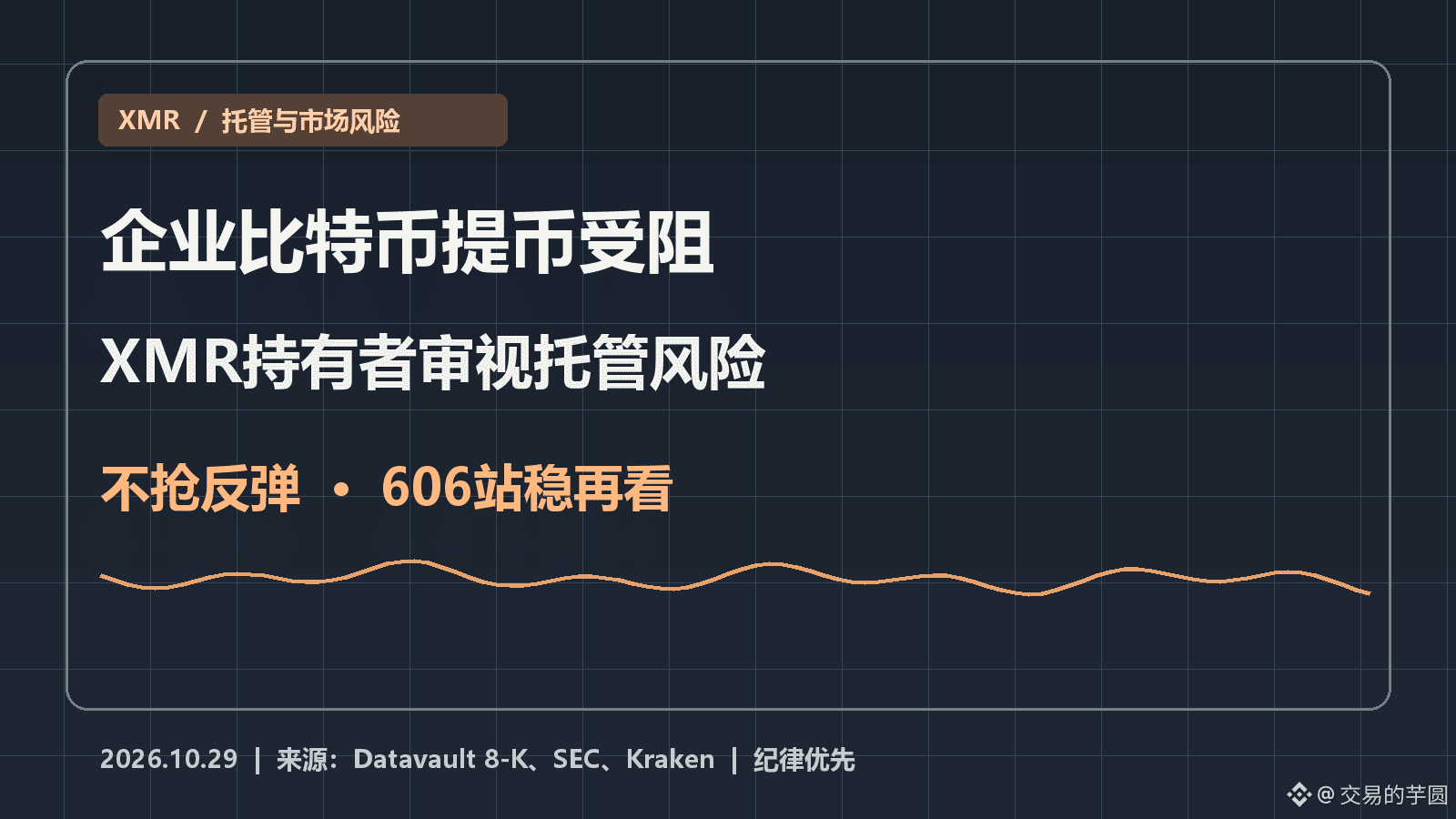
Corporate Bitcoin withdrawals blocked | XMR holders should also reassess custody risks | Don’t chase a bounce near $600
My view is to manage counterparty risk first, then discuss XMR’s short-term direction. Binance Square’s trending topics included the exact headline “#DatavaultAI discloses it cannot withdraw Bitcoin from Biconomy.” I checked Datavault AI’s Form 8-K filed on October 26: the company said it requested in June this year to transfer Bitcoin from its Biconomy account to an external address, but the transfer had still not been completed as of the filing date. The filing also explained that Bitcoin previously acquired through the platform’s internal ledger did not meet the company’s requirements for recognizing it as its own digital asset, and that the relevant financial statements would need to be restated. CoinDesk’s report on the filing also confirmed that the withdrawal remained incomplete.
It’s important to be clear about the limits of what this tells us: the filing concerns this company, this trading arrangement, and BTC. There is no evidence that the XMR network has malfunctioned, nor can we infer that all exchanges are unable to process withdrawals. The filing does not establish who is ultimately responsible for the blocked withdrawal, so we cannot claim on the company’s behalf that it was caused by a hack, theft, or the platform’s insolvency. What it really reminds me is that there can be a gap between “the balance shown in my account” and “my ability to transfer the coins to an address I control.” For XMR holders who value privacy and self-custody, this distinction is especially practical: exchange accounts are useful for trading, while long-term storage calls for consideration of key control, address verification, and small withdrawal tests. On-chain fees, wallet backups, and the risk of user error should also be factored in.
The market has not priced XMR independently on the basis of this corporate BTC filing. When I checked Kraken’s public order book, XMR/USD was around $600.3, below the day’s open of $606.1, with an intraday high of $618.6 and low of $591. BTC was around $80,553, also below its open of $80,801. XMR’s rebound from the intraday low to around $600 is a price snapshot, not confirmation of a reversal. Meanwhile, the Federal Reserve’s October meeting statement has not yet been officially released, so macro expectations may still drive synchronized moves across tokens. If BTC breaks below the $80,280 area again, thinner liquidity in smaller tokens like XMR could amplify the downside. Don’t try to catch a falling knife just because of the “self-custody narrative.”
If I were trading this myself, I would stay out for now and only consider a low-risk spot long. The conditions would be for XMR to reclaim $606 and hold above it for an hour, then break through $612, while BTC returns above $81,000. Only if all three conditions are met would I enter with a position equal to 2% of total capital, without leverage. The first target is $618, where I would take half off; the second is $628, with a trailing stop on the remainder based on the one-hour low. I would stop out if the price fell below $590 after entry. I would also close the remaining position if the Fed statement triggered a spike followed by a reversal, XMR fell back below $606, or BTC lost $80,280 again. If the price first breaks decisively below $591, the original plan is invalidated. I won’t present past observations as trades that have already been executed.
Going forward, I’ll watch for Datavault’s restatement and any progress on the withdrawal, as well as XMR’s own order book and official project announcements. The lessons about custody risk can inform risk management, but price conclusions cannot be transferred mechanically. Only when the trading conditions are met is it worth committing limited capital.
#DatavaultAI披露无法从Biconomy提取比特币 #XMR #BTC
The above is solely my personal market observation and does not constitute investment advice.