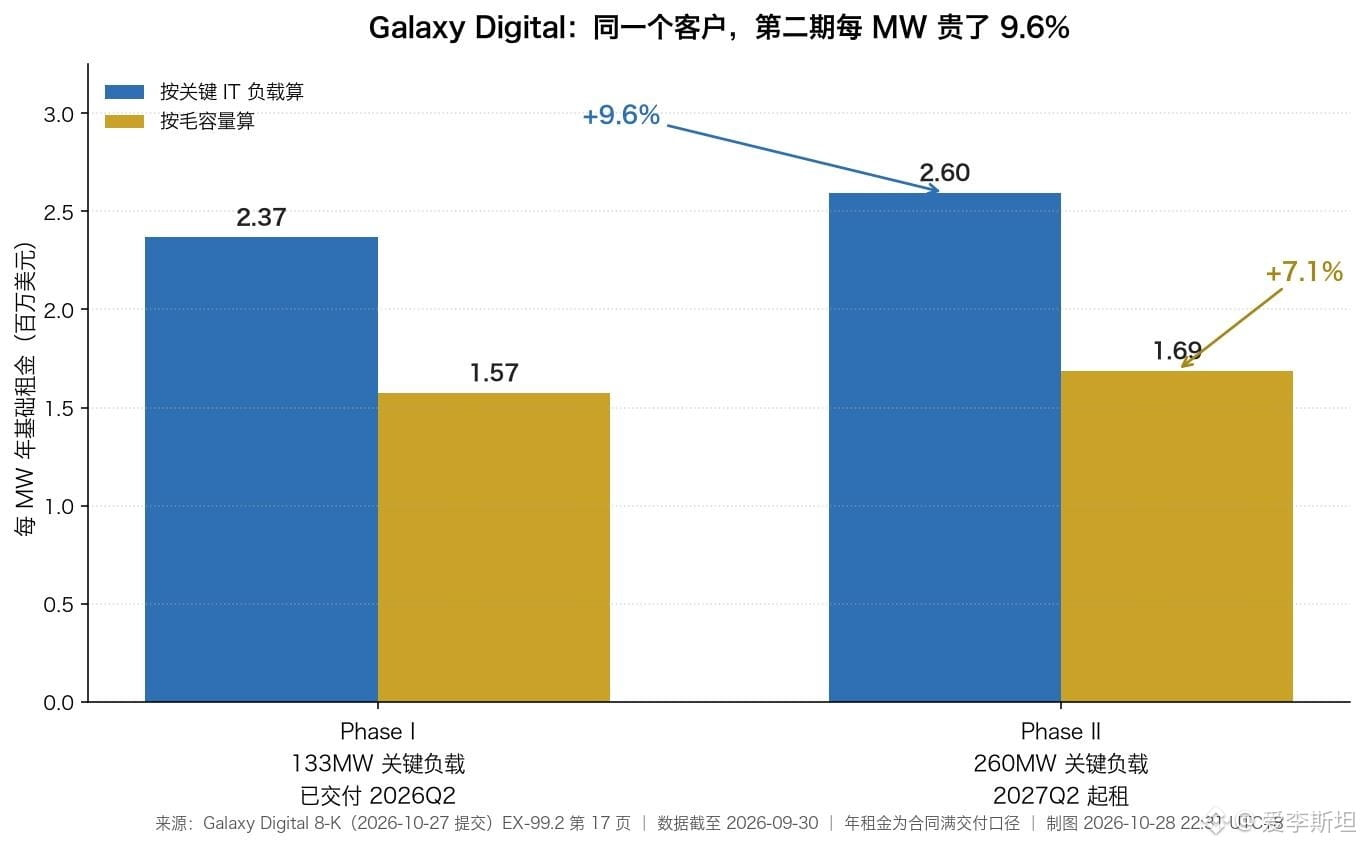
In the 8-K Galaxy Digital filed yesterday, it lays out a three-phase lease of a 2,200-acre data center site in Texas to CoreWeave. Same customer, same site, same contract template—and the annual rent per MW in Phase 2 comes out 9.6% higher than in Phase 1.
When people look through this filing, they often start with crypto trading revenue. But the most solid piece is actually in the lease.
It’s spelled out clearly on page 17. Phase 1, 133 MW, was delivered in the second quarter of this year, with annual base rent of $315 million and construction costs of $1.8 billion.
Phase 2, 260 MW, is scheduled to start leasing in the second quarter of next year, with annual rent of $675 million and estimated construction costs of $4 billion.
What’s the difference? Divide to get the unit price. Phase 1 comes to $2.368 million per MW; Phase 2, $2.596 million. The price increase is real.
There are two ways to measure capacity here, and this is the detail people are most likely to overlook.
The 133 MW is critical IT load delivered to the customer, corresponding to 200 MW of gross capacity; Phase 2’s 260 MW corresponds to 400 MW.
Using gross capacity as the denominator, the unit price rises from $1.575 million to $1.6875 million, narrowing the increase to 7.1%.
Both measures point to a price increase; the difference is just 2.5 percentage points. If you’re asking how much power the data center can handle, use gross capacity. If you’re asking how much computing power the customer can run, use critical load. The filing puts both figures side by side without saying which one is more appropriate.
The money hasn’t come in yet. The filing says revenue is recognized on a full-delivery basis, only after each data hall is powered up. Phase 2 won’t get there until the second quarter of 2027. The risk section of the same filing also acknowledges that Helios recorded impairment charges during its transition from mining to AI, and that adjusted EBITDA has been negative in recent quarters.
The payback period isn’t short either. $1.8 billion in construction costs against $315 million in annual rent works out to 5.7 years; $4 billion against $675 million works out to 5.9 years. Neither figure includes operating expenses. This investment will take time to pay back.
What I’m not sure about is whether this 9.6% can be considered a trend. Phase 3, at 133 MW, is scheduled for 2028, but the filing gives no rent figure—only that it will follow the annual escalation clause. The contract has an annual rent escalator, and Phase 3 hasn’t reached a repricing point yet. So this 9.6% looks more like a difference based on when the leases were signed. It’s plausible, but there’s no way to verify it.
The structure is what’s really worth remembering. Galaxy’s valuation anchor is shifting away from trading fees and toward a 15-year data center lease: 800 MW has already been leased, 1,630 MW has received approval, 3,600 MW is still only potential, and 4,930 MW of the 5,730 MW pipeline remains unsigned.
Any company that stakes its cash flow on a long-term contract with a single customer will ultimately be driven by that contract’s delivery schedule.
Because capacity can be drawn on a chart, but revenue has to wait until the data hall is powered up.
As I write this, $BTC is trading at $80,546, and the coins Galaxy holds are valued accordingly.
Source: Galaxy Digital 8-K, filed 2026-10-27.
https://www.sec.gov/Archives/edgar/data/1859392/000185939226000108/exhibit992-glxyq32026ove.htm
When people look through this filing, they often start with crypto trading revenue. But the most solid piece is actually in the lease.
It’s spelled out clearly on page 17. Phase 1, 133 MW, was delivered in the second quarter of this year, with annual base rent of $315 million and construction costs of $1.8 billion.
Phase 2, 260 MW, is scheduled to start leasing in the second quarter of next year, with annual rent of $675 million and estimated construction costs of $4 billion.
What’s the difference? Divide to get the unit price. Phase 1 comes to $2.368 million per MW; Phase 2, $2.596 million. The price increase is real.
There are two ways to measure capacity here, and this is the detail people are most likely to overlook.
The 133 MW is critical IT load delivered to the customer, corresponding to 200 MW of gross capacity; Phase 2’s 260 MW corresponds to 400 MW.
Using gross capacity as the denominator, the unit price rises from $1.575 million to $1.6875 million, narrowing the increase to 7.1%.
Both measures point to a price increase; the difference is just 2.5 percentage points. If you’re asking how much power the data center can handle, use gross capacity. If you’re asking how much computing power the customer can run, use critical load. The filing puts both figures side by side without saying which one is more appropriate.
The money hasn’t come in yet. The filing says revenue is recognized on a full-delivery basis, only after each data hall is powered up. Phase 2 won’t get there until the second quarter of 2027. The risk section of the same filing also acknowledges that Helios recorded impairment charges during its transition from mining to AI, and that adjusted EBITDA has been negative in recent quarters.
The payback period isn’t short either. $1.8 billion in construction costs against $315 million in annual rent works out to 5.7 years; $4 billion against $675 million works out to 5.9 years. Neither figure includes operating expenses. This investment will take time to pay back.
What I’m not sure about is whether this 9.6% can be considered a trend. Phase 3, at 133 MW, is scheduled for 2028, but the filing gives no rent figure—only that it will follow the annual escalation clause. The contract has an annual rent escalator, and Phase 3 hasn’t reached a repricing point yet. So this 9.6% looks more like a difference based on when the leases were signed. It’s plausible, but there’s no way to verify it.
The structure is what’s really worth remembering. Galaxy’s valuation anchor is shifting away from trading fees and toward a 15-year data center lease: 800 MW has already been leased, 1,630 MW has received approval, 3,600 MW is still only potential, and 4,930 MW of the 5,730 MW pipeline remains unsigned.
Any company that stakes its cash flow on a long-term contract with a single customer will ultimately be driven by that contract’s delivery schedule.
Because capacity can be drawn on a chart, but revenue has to wait until the data hall is powered up.
As I write this, $BTC is trading at $80,546, and the coins Galaxy holds are valued accordingly.
Source: Galaxy Digital 8-K, filed 2026-10-27.
https://www.sec.gov/Archives/edgar/data/1859392/000185939226000108/exhibit992-glxyq32026ove.htm