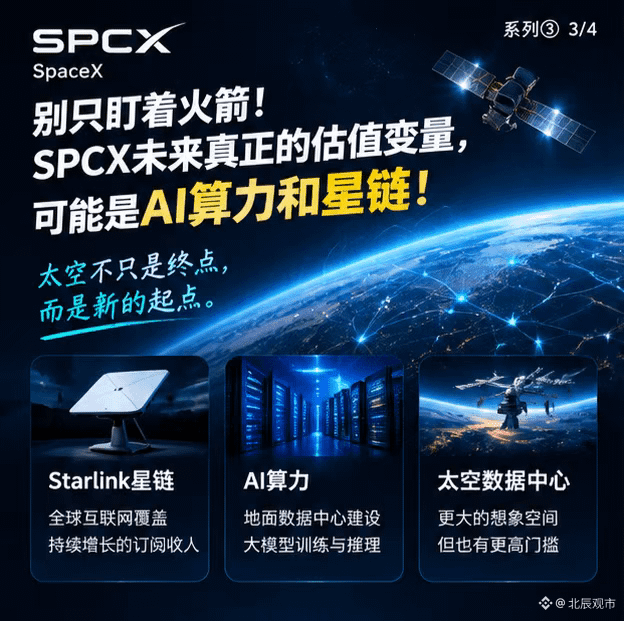
Don’t focus only on the mainstream! The real drivers of $SPCX ’s future valuation may be AI computing power and Starlink
If you think SpaceX’s value lies solely in launching rockets, you may be underestimating the direction of its future business expansion. I’m more focused on three growth engines.
The first is Starlink. The value of satellite internet isn’t just in selling connectivity services; it can also provide connections to remote areas, mobile users, and specific industries. As long as its user base, service revenue, and commercial applications continue to grow, this business could become a more stable source of income.
The second is AI computing power. SpaceX is expanding its ground-based computing infrastructure. If demand for AI model training and inference continues to grow, this infrastructure could become a new growth driver. However, investing in computing power is extremely capital-intensive. It’s not enough to look at the scale of construction—you also need to consider customer contracts, utilization rates, and returns on investment.
The third is space-based data centers. This concept has enormous potential, but the engineering, energy, cooling, launch costs, and maintenance challenges are all substantial. Actual progress will need to validate whether it can be commercialized.
That’s why I’m willing to put SPCX on my watchlist for the next 2–3 years: it could benefit from the growth of satellite communications, AI infrastructure, and commercial spaceflight at the same time, rather than relying on just one business.
Of course, a large addressable market doesn’t guarantee that the stock price will rise. Even if the company performs well, the stock could still experience a deep pullback if its current valuation already reflects a lot of future expectations.
In my next post, I’ll discuss a question many people would rather avoid: Will Musk’s political views give SPCX a boost, or become one of its biggest future risks?
#EarningsSeason