$SKHYNIX
SK hynix’s “most explosive ever” quarterly report: profit is 7 times what it was a year ago, yet management says the shortage is “only just beginning”
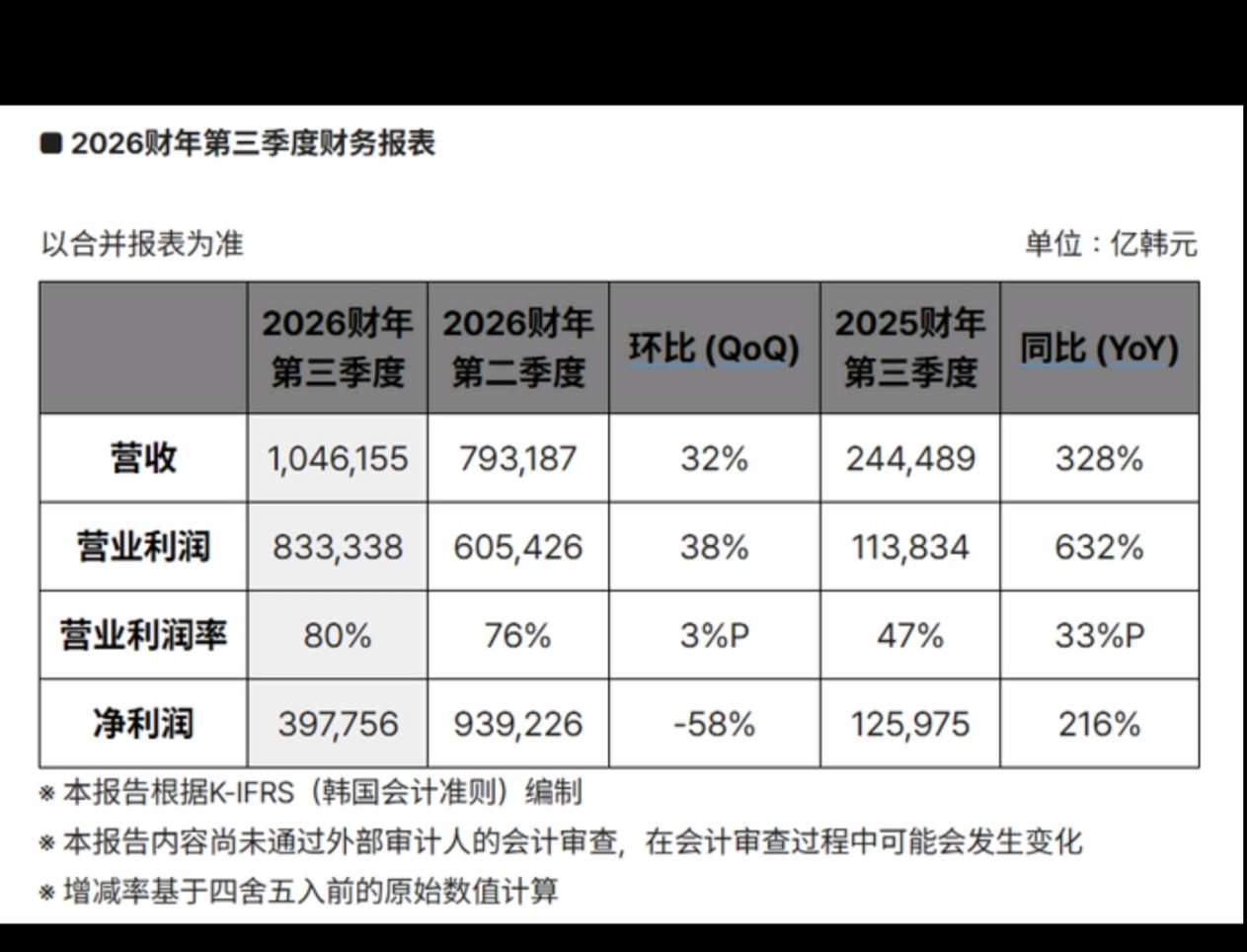
Quarterly revenue topped 100 trillion won for the first time, and the operating margin hit 80%. SK hynix’s third-quarter 2026 results: revenue of 104.62 trillion won, up 328% year over year; operating profit of 83.33 trillion won, up 632% and roughly 7 times the figure a year earlier. For every 100 won in sales, 80 won was operating profit. This isn’t a recovery—it’s pricing power coming through amid an extreme supply-demand imbalance.
More importantly, management said on the earnings call that the supply shortage in memory is expected to last until 2030. The logic is straightforward: advanced manufacturing processes are difficult, new wafer fabs take too long to build, and supply can’t keep up with demand. On the demand side, AI investment is spreading beyond a handful of hyperscalers to businesses and governments. The global AI data center infrastructure market is expected to grow at an average annual rate of about 40% through 2030. Memory is no longer just subject to the ups and downs of consumer electronics replacement cycles.
The order book is even more striking: the company has signed long-term supply agreements with 14 core customers. DRAM and HBM capacity through 2029 is “effectively sold out,” with customer demand exceeding current supply capacity by more than two times. HBM4 began ramping up in the third quarter, and shipments and revenue in the fourth quarter are expected to surpass HBM3E across the board. The market voted with its feet: on the day of the earnings report, SK hynix shares rose 10.89% in Korea, while Samsung Electronics gained 9%.
But a shortage “lasting until 2030” is a projection based on today’s supply-demand structure, not a law of nature. Supply constraints are real, but if the HBM technology roadmap shifts or the pace of AI capital spending slows, long-term contracts may lock in volumes without necessarily protecting pricing flexibility. The company also said it would use a flexible investment pace to manage cyclical risks. The most candid thing about this report is that it doesn’t claim the cycle has disappeared. Rather, it says this cycle’s length and shape may be unlike anything people are used to.#股票财报季