25 people, $20 each, exactly $500 in the pool. This isn’t a giveaway; people are selected based on the quality of their feedback.
On October 27, Binance posted an announcement about collecting feedback on the #DYOR panel.
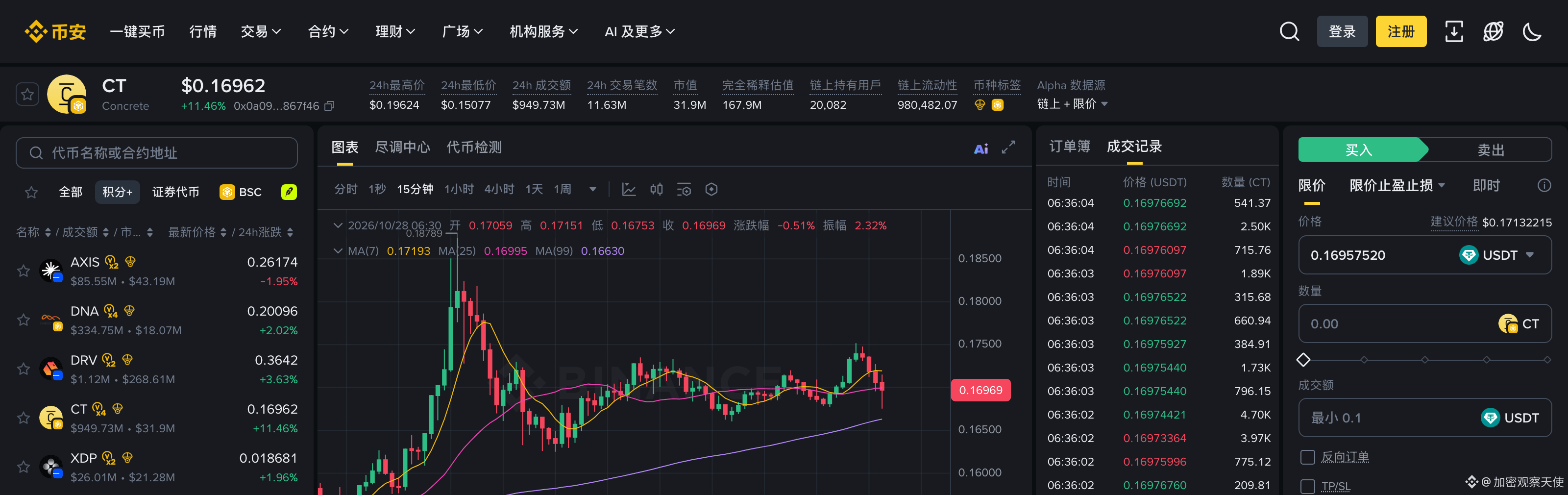
DYOR is the research entry point for the #币安Alpha token.
The campaign runs until 23:59 UTC on November 1.
In Beijing time, that’s 7:59 a.m. on November 2.
There are four steps to participate, and you must complete all of them.
First, complete KYC.
Then follow Binance Angels’ X account.
Next, repost the original post and answer with: “I used DYOR for…”
Finally, fill out a user feedback survey.
Two of the four steps require posting on X.
The $20 is a token voucher, not cash.
You have to claim it yourself in the Rewards Hub. It expires if you don’t use it within 30 days.
The distribution deadline is November 30.
The campaign window is only five and a half days.
The announcement doesn’t say how many submissions the 25 people will be chosen from.
It doesn’t say what the survey will ask, either.
The one thing you can control is how specifically you describe your use case.
What’s really valuable isn’t the $20—it’s the five panels it prompts you to open.
The announcement lists five types of data.
Top 10 holders, DEX liquidity, CEX wallet buying activity, project fundamentals, and Binance open interest and funding rates.
Each of these answers a different question.
Top 10 holders answers who holds the tokens.
DEX liquidity answers how much you can sell without crashing the price.
CEX wallet buying activity answers whether funds on exchanges are flowing out or coming in.
Open interest and funding rates answer which side the leverage is building up on.
Project fundamentals answer whether the first four are worth paying attention to.
Together, the five form a sequence: look at the structure first, then the price.
Most people do the opposite: look at the price first, then find a reason for it.
Get the sequence backwards, and the five panels are just five charts.
The regional restrictions are longer than the campaign rules.
Submissions from the United States, the United Kingdom, the European Economic Area, Hong Kong, China, and Singapore will not be counted.
The announcement also states that Binance may verify participants’ jurisdictions at its discretion.
The definitions of the fields in these five panels are in the app; the announcement only lists their names.
Refer to the in-product descriptions for the definitions.
The announcement itself adds a disclaimer for DYOR: data is provided “as is” and does not constitute investment advice.
That means the same as the disclaimer in this article.
What I’m unsure about is how feedback quality will be ranked.
The announcement says selections will be based on depth and quality, but provides no scoring rubric.
Which Alpha token panel do you use the most?
Figures are based on the original announcement dated 2026-10-27. The campaign period is stated in UTC; Beijing time is a conversion. Campaign rules may change; please refer to the official page.
The above compares details against the original announcement and does not constitute investment advice. The announcement provides no guidance on how to fill out the survey.