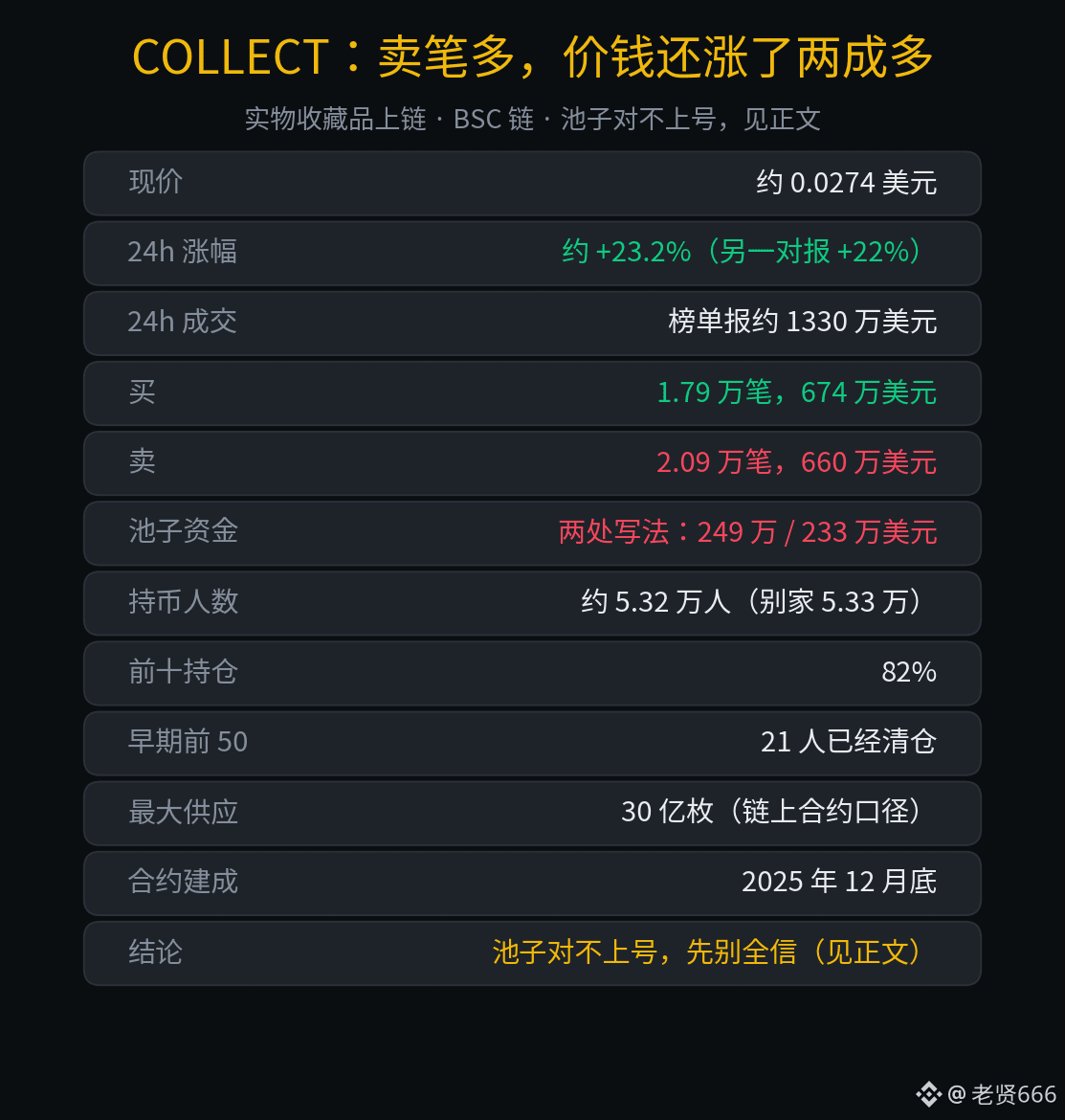
There are 3,000 more sell transactions than buys, the dollar amounts are nearly even, and the price has jumped more than 20% in a day—this chart for $COLLECT looks contradictory at first glance.
Let’s start with the figures that match across both sources. The current price is about $0.0274. One listing shows a 24-hour gain of about 23.2%, while another trading pair shows about 22.3%—the direction and magnitude line up. One source reports around 53,200 holders, the other 53,300, which also checks out. Breaking down trades: 17,900 buys worth $6.74 million, and 20,900 sells worth $6.60 million. That’s 3,000 more sell transactions, but the amounts differ by only around $140,000, while the price still rose more than 20%. There was no shortage of sellers, and no shortage of money either. That’s what makes the price rise—and that’s what makes it odd.
The inconsistency is in the liquidity pool. The listing reports about $13.3 million in 24-hour volume. On the same page, it gives two figures for the pool’s funds: $2.49 million at the top, and $2.33 million in the pool section—a difference of more than $100,000. Stranger still, searching the other source turns up two pools named WBNB: one has only $6 left, the other less than $1, and together they recorded just 8 buy and sell transactions in 24 hours. The pool shown on the listing holds 50.3 million tokens and more than 1,570 WBNB. That’s nearly five times the 10.1 million tokens in the pool when it was first created. I couldn’t find a pool that large on the other source. I’m not saying it doesn’t exist; the two sources just don’t seem to be referring to the same pool, and the address in the pool section doesn’t make it clear which pool it means. For now, I’d put a question mark next to that $13.3 million volume figure. It’s too early to treat it as confirmed.
The project itself is focused on real-world assets: physical items such as Pokémon cards, comics, and sports cards are authenticated, locked in a vault, and represented by tradable on-chain certificates, according to the official website. The contract was created at the end of December last year, and the contract page on-chain lists a maximum supply of 3 billion tokens. The top 10 holders control 82%. Of the 50 earliest buyer addresses, 21 have already sold out. We’ll have to keep watching to see whether the rest are still holding.
What to watch next: whether the pool’s identity can be matched across sources, whether volume and price figures for the same pool line up for two consecutive days, and whether the top 10’s 82% share starts to fall. What would make me walk away: the pools still don’t match, the holder count turns downward, or the top 10 keep accumulating. If you already hold some, check one thing first: is the pool you traded through the same one the listing refers to? Can you handle the slippage, and is the pool deep enough for your trade?
I’ll log this for now and report back once the pool checks out. Alpha tokens are volatile and could go to zero. This is a review, not investment advice. If the pool can’t be matched, how much faith do you put in a 20% gain—check the pool first, or look at the price first?
#BinanceAlpha #COLLECT #OnChainAccounting