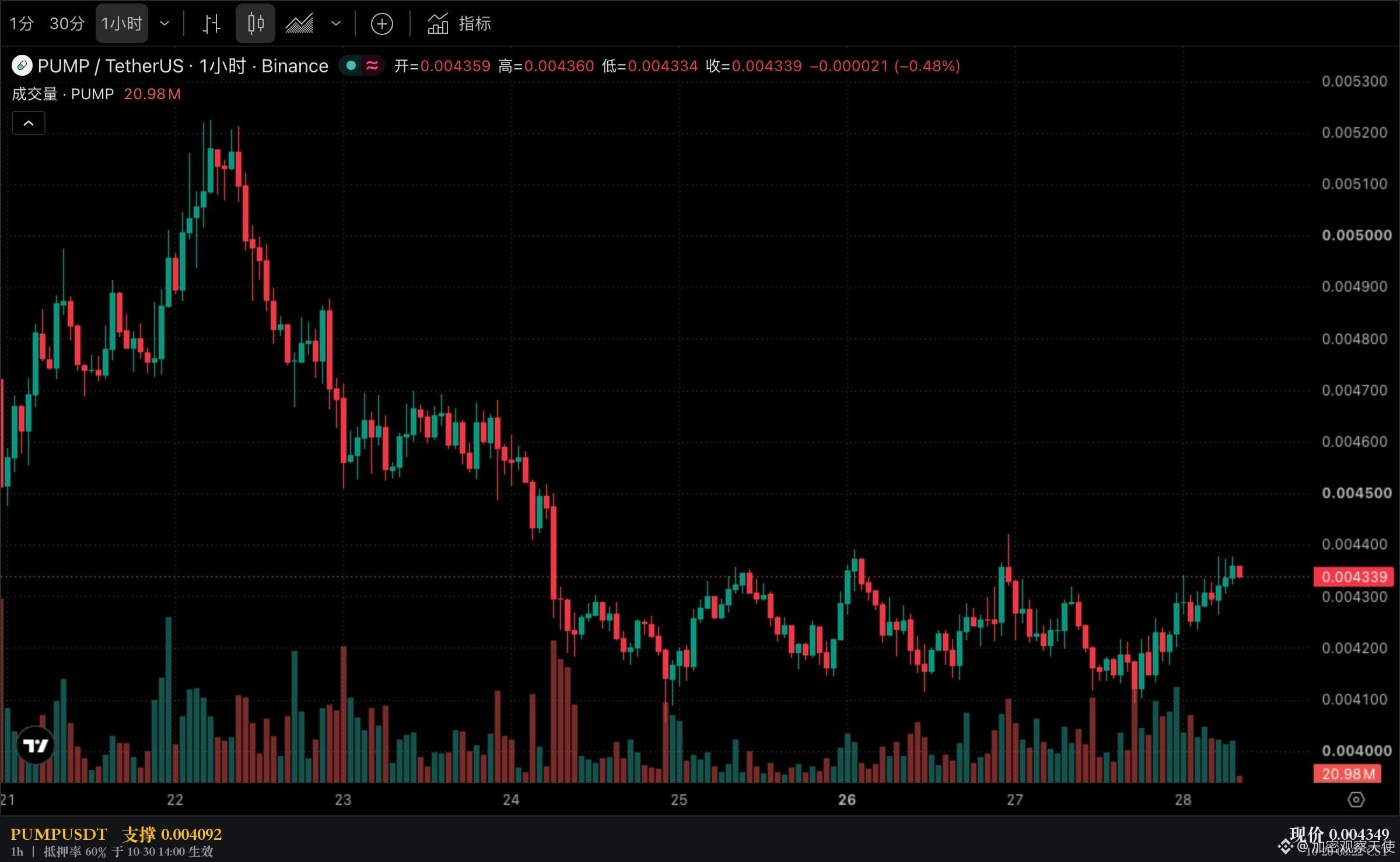
Binance raised the collateral ratio for $PUMP from 50% to 60%, effective Friday at 2 p.m. The same amount of PUMP can now borrow 20% more. Whether that extra borrowing capacity is a buffer or a position—you can only choose one.
The collateral ratio is about “how much your coins are worth.” When you put coins into your account, this percentage determines how much of their value counts as available margin.
Here’s a simple example. With $10,000 worth of PUMP, you can borrow $5,000 at 50%, or $6,000 at 60%. That extra $1,000 is both new borrowing capacity and a new buffer.
But it’s only a buffer if you don’t touch it.
In Portfolio Margin mode, liquidation is based on the unified maintenance margin ratio, or uniMMR. The collateral ratio only changes the portion of the numerator derived from the converted value of your collateral; it doesn’t change the maintenance margin requirement. A bigger numerator means a higher uniMMR for the same position, putting you further from liquidation.
The announcement itself says: “The collateral ratio and leverage affect the unified maintenance margin ratio. Users should closely monitor their uniMMR to avoid liquidation due to changes in the collateral ratio.”
So here’s the fork in the road. If you don’t add to your position, the extra $1,000 is a buffer, and the liquidation threshold moves further away. If you borrow that $1,000, the buffer goes back to where it was; your position is simply 20% larger.
The same announcement also covers two other assets. POLYX and ONG go from 10% to 30%—a relative increase 10 times greater than PUMP’s. The exchange hasn’t explained why the difference is so large.
$PUMP was quoted at 0.004349 this morning, trading between 0.004092 and 0.004378 over the past 24 hours, with $19.55 million in volume.
Looking at the week as a whole, it closed at 0.004551 on October 22, down 4.4% by this morning.
That trading volume isn’t small compared with the rest of the platform, but it isn’t deep enough either. If people actually use it as collateral to add leverage, open interest in the futures market will react before spot trading does.
After 2 p.m. Friday, watch to see whether PUMP futures open interest increases. If it does, that means people are using this rule; if it doesn’t, it’s just an adjustment on paper.
What I can’t pin down is how they arrived at 60%. Reassessing based on liquidity would make sense, and applying a discount based on volatility would make sense too, but the announcement doesn’t mention either.
This rule gives you a choice about how to use the extra capacity.
Keep it, and it’s a buffer; use it, and it becomes a position. The same money can’t be both at once.
The announcement tells you how much capacity you have, but not how to use it.
$PUMP 0.004349. #保证金 This rule changes both your ability to borrow and your ability to withstand losses; only those who don’t add to their positions get the latter.
After 10-30, will you use that extra 20% capacity, or keep it as a buffer?
Data: Binance announcement, “Update on the Collateral Ratio Under Cross Margin and Portfolio Margin,” published 10-27.
Effective 10-30 at 06:00 UTC; rollout to be completed within approximately 30 minutes.
Market data is a Binance spot snapshot from 10-28 at 08:20 CST.
This is an analysis of publicly available rules and does not constitute investment advice.