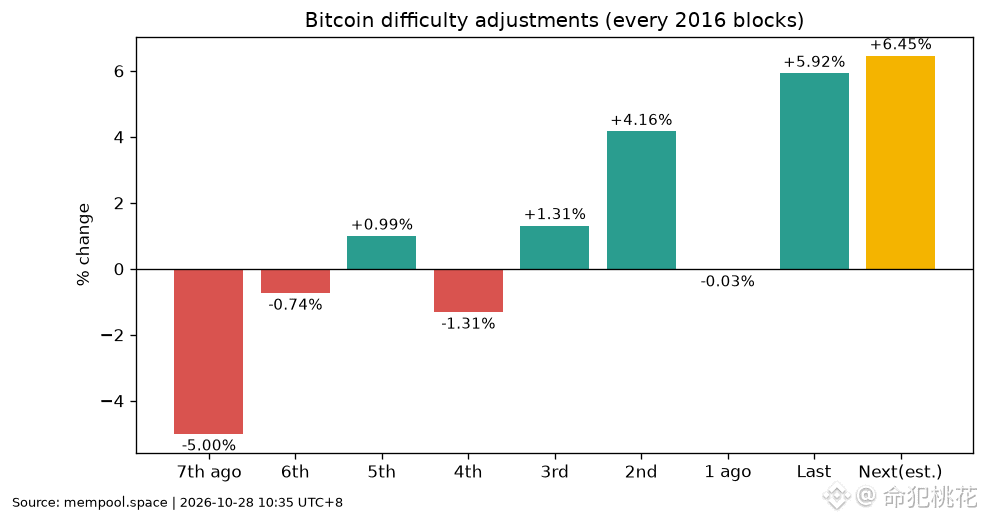
Why does Bitcoin always produce “about one block every ten minutes”? It’s all down to difficulty adjustments. Let’s take a look using the latest data.
The rule is simple: every 2,016 blocks (about two weeks), the network resets mining difficulty based on how quickly blocks were actually produced during that period. If hash rate rises and blocks are produced faster, difficulty goes up; if hash rate falls and blocks take longer, difficulty goes down.
I just checked mempool.space: the current period is about 88% complete, with 242 blocks remaining. The next adjustment is estimated to be a 6.45% increase, expected to take effect in the early hours of October 30. The previous adjustment, on October 16, was +5.92%. Over the past 30 days, the network’s hash rate has gone from about 1.09 ZH/s to around 1.11 ZH/s, and currently stands at about 1.07 ZH/s.
How should you interpret this number? An increase in difficulty means miners are continuing to commit hash power, and the network’s security budget is growing. But for miners, the block reward earned per unit of hash power decreases, putting more pressure on costs. Difficulty offers a window into miner sentiment, but it doesn’t directly determine which way the price will move.
One more thing: the estimate can change depending on how quickly the remaining blocks are produced. It won’t be final until the very last moment.
Do you usually keep an eye on hash rate and difficulty, or do you pay more attention to fees?
#比特币 #链上数据 #BeginnerEducation
This is not investment advice.