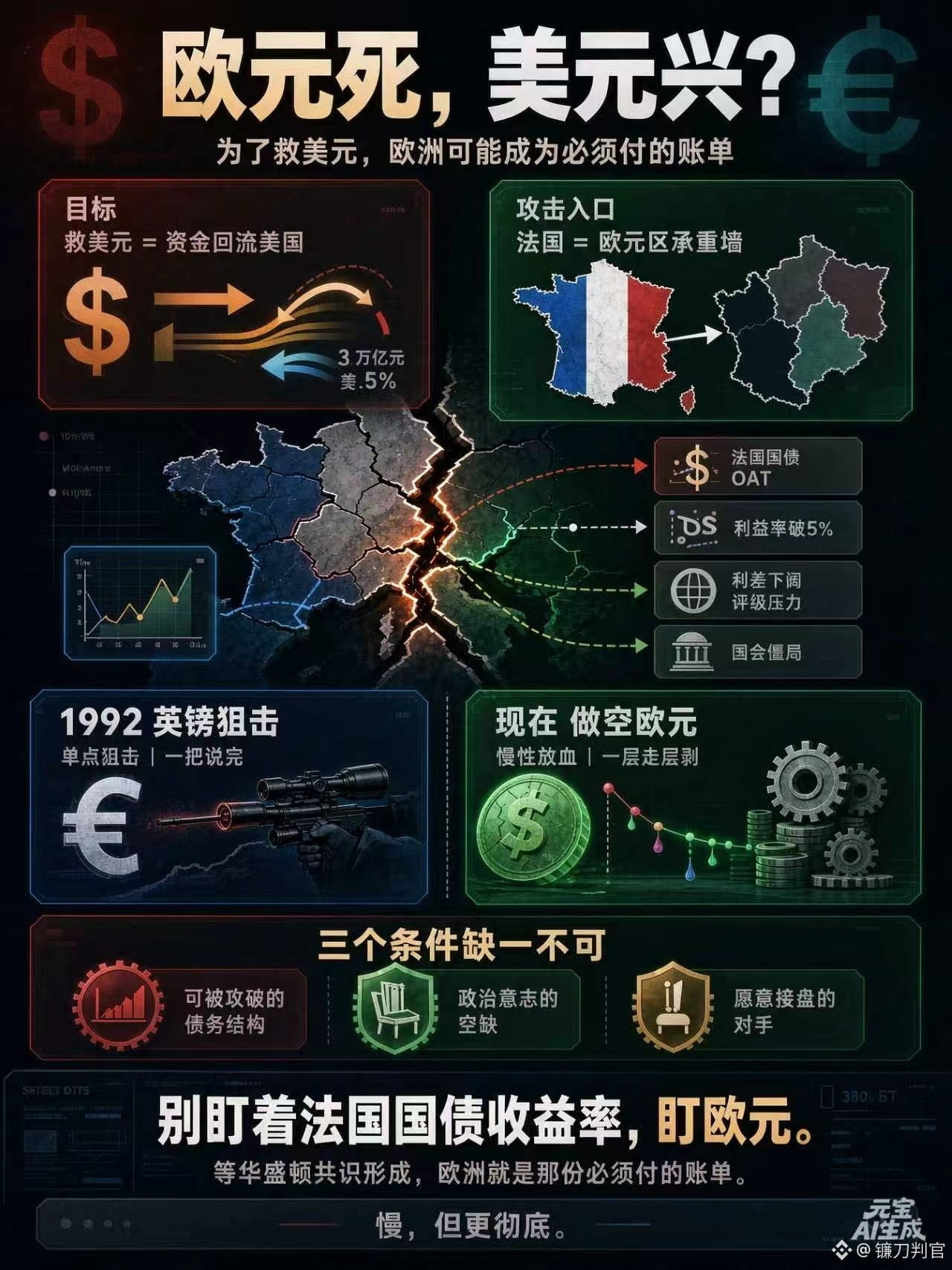

The euro dies, the dollar thrives!
When Bessent took office, some were already saying he was a protégé of the Soros school.
Once in office, he’d surely short a country—because that’s the only way to save the dollar!
At the time, people guessed Japan, given the yen carry trade and U.S. Treasury basis trades. But Japan now seems unlikely—it’s one of the pillars of the dollar system, and attacking it would be like attacking yourself.
Japan holds over a trillion dollars in U.S. Treasuries.
Squeeze the yen, and the first domino to fall would be the Treasuries themselves.
No one would be that stupid.
But there has to be a target.
After eliminating the alternatives, only Europe is left.
More precisely: not a particular European country, but the euro.
The logic is simple.
To save the dollar, money has to flow back to the United States;
for money to flow back, a sufficiently large market has to collapse first.
The only market in the world big enough is the eurozone.
China keeps its doors closed.
The yen is a pillar and can’t be touched.
That leaves only the euro.
So where do you strike first? France.
Going after France means dismantling a load-bearing wall.
France is the eurozone’s second-largest bond market, with more than €2.5 trillion in outstanding OATs. It’s not an outer wall; it’s the foundation.
Once the foundation cracks, the French-German spread widens, money flees into German government bonds, and the eurozone splits in two on the spot.
One half becomes a safe haven; the other, a fire zone.
One half can still be called a currency; the other is just bad debt.
Look at where things stand now.
French bond yields have topped 5%. Paris is burning. The budget plan can’t get through parliament. The European Central Bank can neither raise nor cut rates.
This time, the strategy is also different from 1992.
In 1992, it was a pinpoint attack, over in one fell swoop.
This time, it’s a slow bleed. Spreads, CDS, ratings, a political vacuum—peeling back the layers one by one.
Slower, but more thorough.
Look back at history.
In 1992, the pound was attacked to force Britain out of the Exchange Rate Mechanism.
This time, France is being targeted to ensure the euro never gets the second seat at the reserve-currency table.
Three conditions are essential to short a country.
A debt structure that can be breached
A lack of political will
An opponent willing to take the other side
Europe has already met the first condition
The second is taking shape
The third is not yet in place
So I’m not saying it’ll collapse tomorrow
I’m saying this: when “saving the dollar” becomes a consensus in Washington, Europe will be the bill that has to be paid
When that happens, don’t keep your eyes on French bond yields
Watch the euro.
$NVDA