

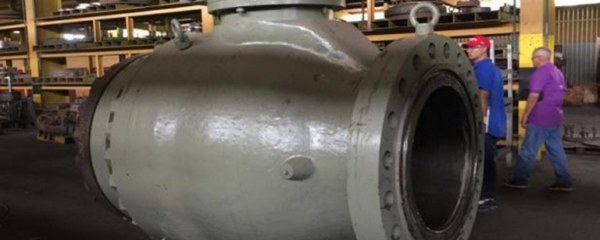

This proposal calls for a “comprehensive concession for the use, management, modernization and industrial operation” of the facilities, to restore the operating capacity of those originally acquired by PDVSA.
A consortium comprising U.S. firm Sunergon Oil Operating, LLC and Venezuelan company Empresa de Servicios Industriales Alloys, C.A. (Empreservinca) formally asked the Government of Venezuela for a 15-year concession to operate eight state-owned pipe and valve manufacturing plants that are completely shut down. The goal is to reactivate them through private investment and supply the country’s oil and water industries.
According to documents submitted to the International Center for Productive Investment (CIIP), the proposal calls for a “comprehensive concession for the use, management, modernization and industrial operation” of the facilities, enabling the recovery of their operational capacity. The state-owned Petróleos de Venezuela (PDVSA) originally acquired them to supply both the hydrocarbon industry and the state water company Hidroven.
The industrial complex proposed for concession comprises eight strategic facilities spread across five states in the country:
– Carabobo State: Industria Mecánica Orión, S.A. (IMOSA), in Puerto Cabello, and Invetubos, C.A., in Valencia.
– Lara State: Tuberías Helicoidales, C.A. (Tubhelca), located in Barquisimeto.
– Anzoátegui State: Helisold de Venezuela, S.A. (Helvesa), in Barcelona, and Empresa Nacional de Válvulas (Enaval), in Anaco.
Zulia State: The Atlántida Socotherm, S.A. and Zaramella & Pavan Construction Company, S.A. (ZYP) coating plants, located on the eastern shore of Lake Maracaibo.
– Guayana Region: Empresa de Producción Social (EPS) Tubos Sin Costura, affiliated with Corporación Venezolana de Guayana (CVG).
Proposal to end the operational standstill
According to the technical background report attached to the application, the Venezuelan state took control of these factories between 2009 and 2012 under the “Economic Sovereignty” policy promoted by the late President Hugo Chávez. In 2013, PDVSA Industrial brought the main manufacturing and coating plants together under its subsidiary Empresa Nacional de Tubos (Enatub).
Investment and import substitution plan
The proposal, signed by Alejandro Terán on behalf of Sunergon Oil (registered in Texas, USA) and by Edgar Alexander Gómez Ramírez on behalf of the domestic company (Empreservinca), calls for a strategic partnership involving PDVSA Industrial and the Ministry of Attention to Water.
The financial and operational plan includes locating and making use of raw materials previously purchased by Bariven—PDVSA’s procurement subsidiary—as well as upgrading submerged arc welding (SAW) lines and metrology testing benches.
The consortium’s main objective is to ensure domestic production of carbon steel pipes (seamless, longitudinally welded and helical-welded, meeting international API 5L and AWWA standards), drill rods, coatings, and industrial gate, ball and check valves with diameters greater than 16 inches.
“It would allow us to substitute imports and ensure domestic production of tubular supplies, drill rods and valves, reducing dependence on foreign currency in PDVSA’s value chain,” the letter submitted to the CIIP states.
If the concession is granted, the supplies would be prioritized for drilling and rehabilitation work in the Orinoco Oil Belt (FPO), major shutdowns in the Punta de Mata District, and the supply of major hydrocarbon transportation projects, such as the 42-inch San Tomé-Jose and Morichal-San Tomé oil pipelines, the Falcón-Zulia fuel system, the Jusepín-Veladero diluent pipeline, and the EPA N30 and Dragón-Patao gas pipelines.
Likewise, restarting the pipeline production line to the AWWA standard would make it possible to resume supplies for aqueduct and national water infrastructure projects.