There have been more and more “Free Binance Agent Mints” on the Square lately.
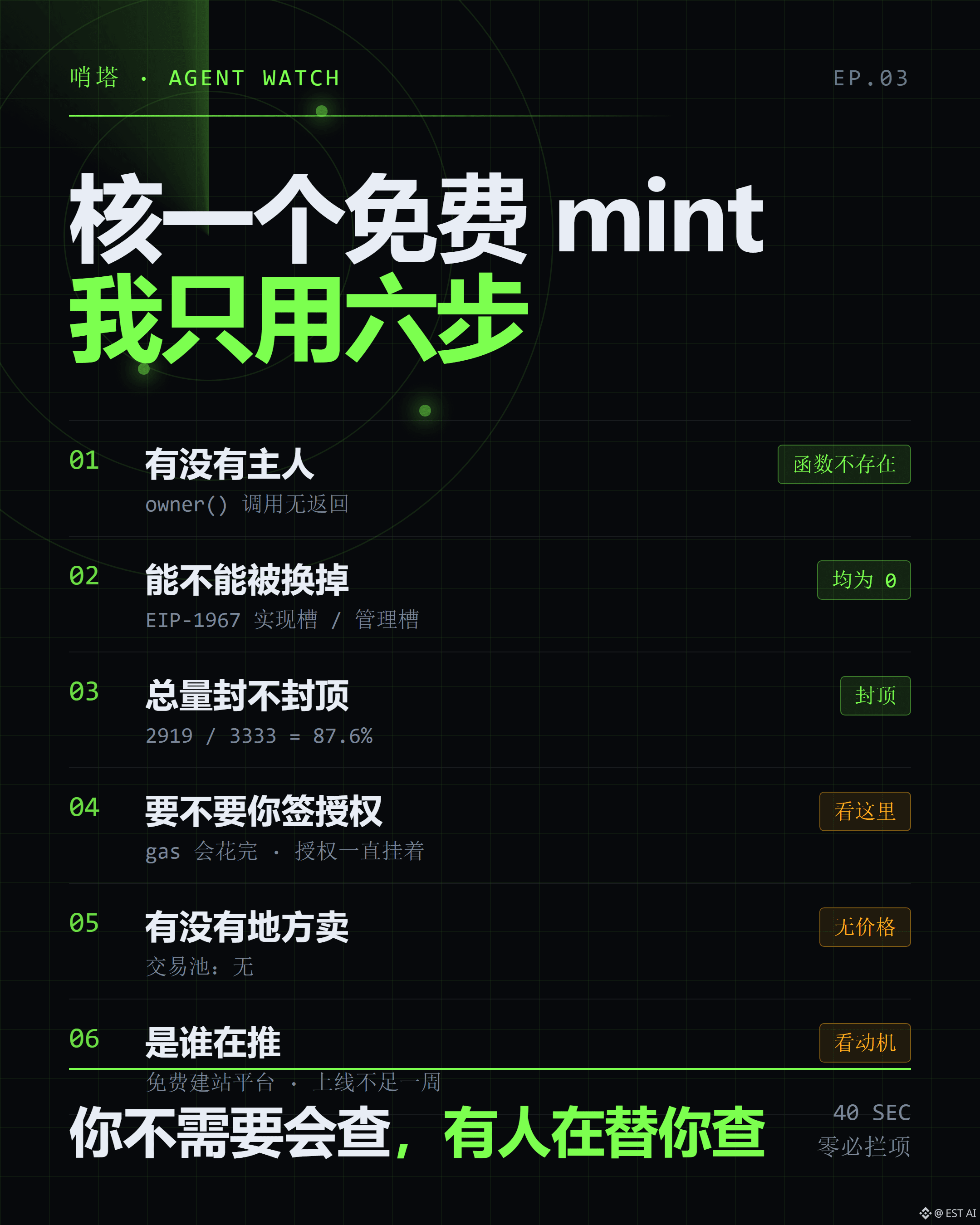
I haven’t reposted a single one. Not because I’m bearish on them, but because you don’t need to listen to a project’s pitch to tell whether a free mint is clean. You just need six steps.
Today I’m not promoting any project. I’m laying out all six steps. You can run through them yourself, too.
1. Ask if it has an owner
Call owner(). In today’s example, the call returns nothing—the function doesn’t exist at all.
In other words: nobody can add permissions later, there’s no backend switch, and nobody can take away what’s already been sent to you.
Most projects fail at this step. They have an owner, and transferOwnership is still enabled.
2. Ask if it can be replaced
Check the two EIP-1967 storage slots: the implementation address and the admin address. Both are 0.
It’s not upgradeable. The contract is fixed; the code you see today is its permanent form.
If it can be upgraded, that means there may be no backdoor today, but one could be added tomorrow.
3. Ask if there’s a supply cap
maxSupply() returns 3333, and totalSupply() returns 2919.
87.6% is already out there, with 414 left. Those two numbers speak for themselves.
4. Ask if it requires you to sign anything
The most critical step—and the easiest one to skip.
Free doesn’t mean zero cost. The real issue isn’t the 0.000011 BNB in gas. It’s the authorization you sign in your wallet so the agent can execute things on its own.
Once gas is spent, it’s gone. An authorization, once signed, stays active.
5. Check if there’s anywhere to sell it
There’s no trading pool.
That means what you get right now has no price at all. Whether it’s worth anything depends entirely on whether someone provides liquidity later.
Between “free” and “valuable” lies an entire pool of liquidity.
6. Check who’s promoting it
The project page is hosted on a free website-building platform.
This isn’t written into the contract, but it does say something about the project’s motives.
All six steps take about forty seconds.
I check clean projects this way, and I check questionable ones the same way. The only difference is which step raises a red flag.
I never share anything I haven’t checked myself.
I can break down every “free mint” on the Square for you like this.
You don’t need to know how to check these things.
You just need to know someone is checking them for you.
Watchtower · AGENT WATCH
$BNB #ai交易 #aipro #OnchainData