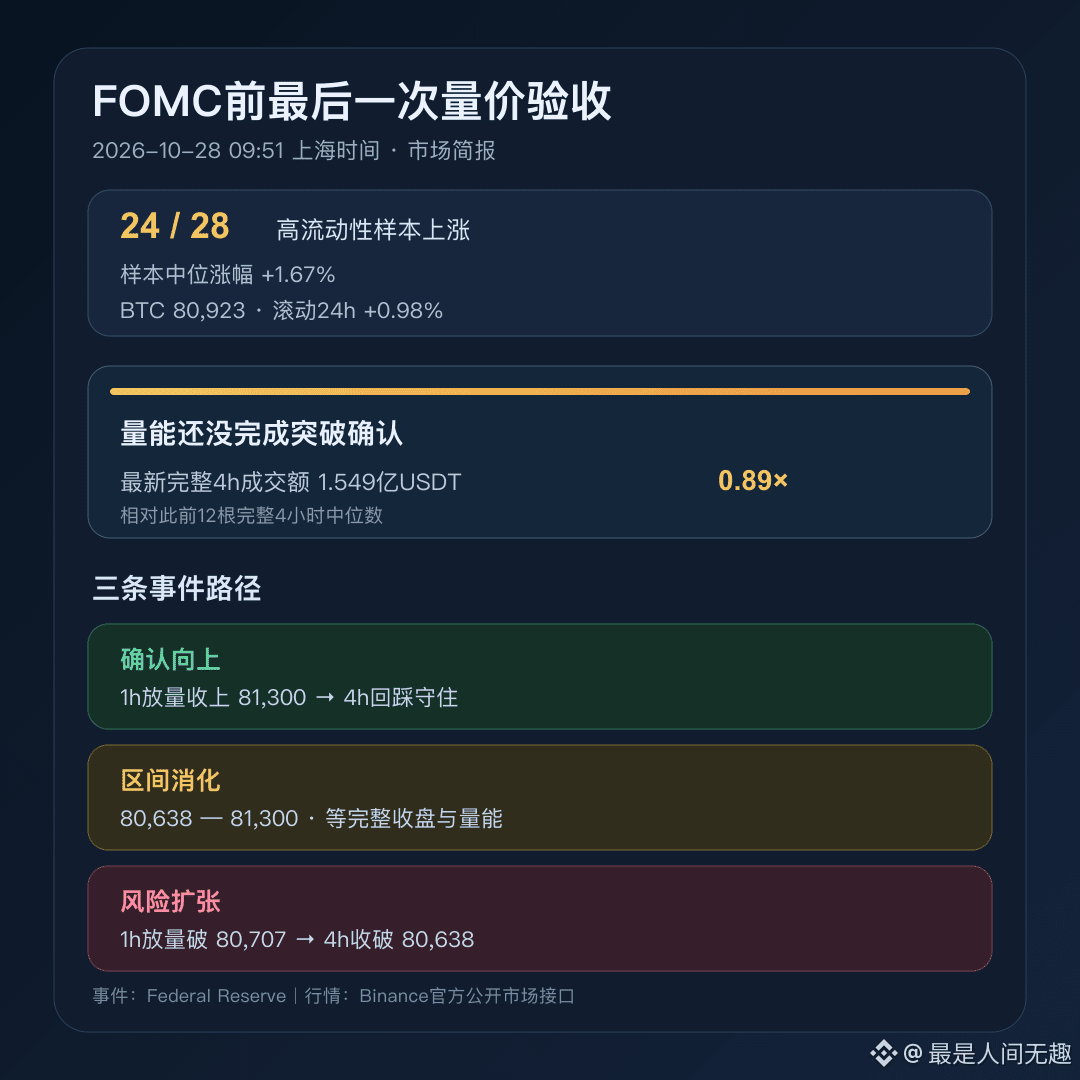
24 samples are up, but it’s still too early to call it a breakout ahead of FOMC
$BTC was quoted at 80,923 at 09:51 Shanghai time, up 0.98% over the rolling 24 hours. More encouraging is market breadth: among 28 USDT spot samples meeting the 10 million USDT turnover threshold, 24 rose and 4 fell, with a median gain of 1.67%. Both price and breadth are improving, but the one thing still missing before the decision is sustained acceptance confirmed by full-period volume.
Why now? The Fed’s official calendar confirms that the October FOMC meeting will take place on the 27th–28th, with a press conference scheduled. There is no asterisk next to this meeting, meaning it is not one at which economic projections will be released. The absence of a new dot plot does not mean less volatility: the market will focus more closely on the wording of the policy statement and the subsequent press conference, and those two information releases could send the initial and secondary reactions in opposite directions.
First, let’s assess the market structure ahead of the decision. BTC’s latest completed 4-hour candle closed at 80,909.77, up from 80,817.75, with a high of 81,300 and turnover of 154.9 million USDT—just 0.89 times the median of the previous 12 completed 4-hour candles. Price is holding near the highs, but this is not yet a volume-backed acceptance. The latest completed 1-hour candle then pulled back from 80,909.77 to 80,747.14, with turnover of 41.76 million, or exactly 1.01 times the median of the previous 24 candles. This shows that short-term selling pressure is backed by real trading, rather than the market being uniformly optimistic.
No guessing at a single line this time—just prepare for three paths
Upside confirmation: After the policy information is released, a completed 1-hour candle posts turnover above roughly 41.17 million USDT and closes above 81,300. A subsequent 4-hour pullback must continue to hold that level, while more than half of the high-liquidity samples remain up. Only then should the current breadth advantage be upgraded to a confirmed breakout.
Range digestion: Price stays between 80,638 and 81,300, with turnover not consistently above the median. In this case, neither the first sharp rise nor the first sharp drop is enough on its own to determine direction; waiting for a completed close after the press conference matters more.
Risk expansion: A completed 1-hour candle breaks below 80,707 on rising volume, and the share of advancing samples falls below half. If a 4-hour candle then also closes below 80,638, the current bullish breadth assessment is invalidated, and the 24-hour low of 79,506 becomes the next structural level to watch.
The reversal conditions should also be clear: even if price first pushes above 81,300, a subsequent high-volume close back below 80,638 should be treated as a false breakout. Conversely, even if price first breaks below 80,707, a rapid, high-volume recovery above 81,300 would warrant caution about a false breakdown caused by event-driven liquidity.
The main risks are the policy statement and press conference releasing information in stages, changes in market depth during the event, and rolling 24-hour breadth shifting rapidly as the window moves. These price levels are tools for assessment, not promises about the outcome.
Open $BTC first to check whether full-period turnover confirms either 81,300 or 80,638, then see whether advancing samples remain above half. That will help determine whether this FOMC reaction is a confirmed breakout, range digestion, or a renewed expansion of risk.