Let’s make the conclusion clear upfront: The final approval granted by the U.S. OCC on October 26 gives Ripple’s stablecoin business a federal charter; it is not an endorsement of $XRP . Directly translating a bank charter into a rising coin price is the easiest trap to fall into in this discussion.
1. The approval itself: On October 26, the U.S. Office of the Comptroller of the Currency gave final approval to establish Ripple National Trust Bank. Ripple had previously received conditional approval in December 2025. According to Ripple’s announcement, the bank will manage RLUSD’s segregated reserves, act as trustee for the reserves, and provide institutional digital asset custody. RLUSD will still be issued by its New York State-regulated trust company; the charter covers stablecoin reserve and custody services.
2. On-chain concentration: Santiment data from October 26 shows that wallets holding at least 10 million tokens collectively held about 46.87 billion tokens, or approximately 68.5% of the supply—the highest level since November 2022. The observable data shows concentration rising, but the same dataset also contains countervailing details: The number of wallets holding between 10 million and 100 million tokens recently fell from 351 to 339, while exchange-related balances increased by about 47 million tokens. Rising concentration does not mean all large holders are uniformly adding to their positions.
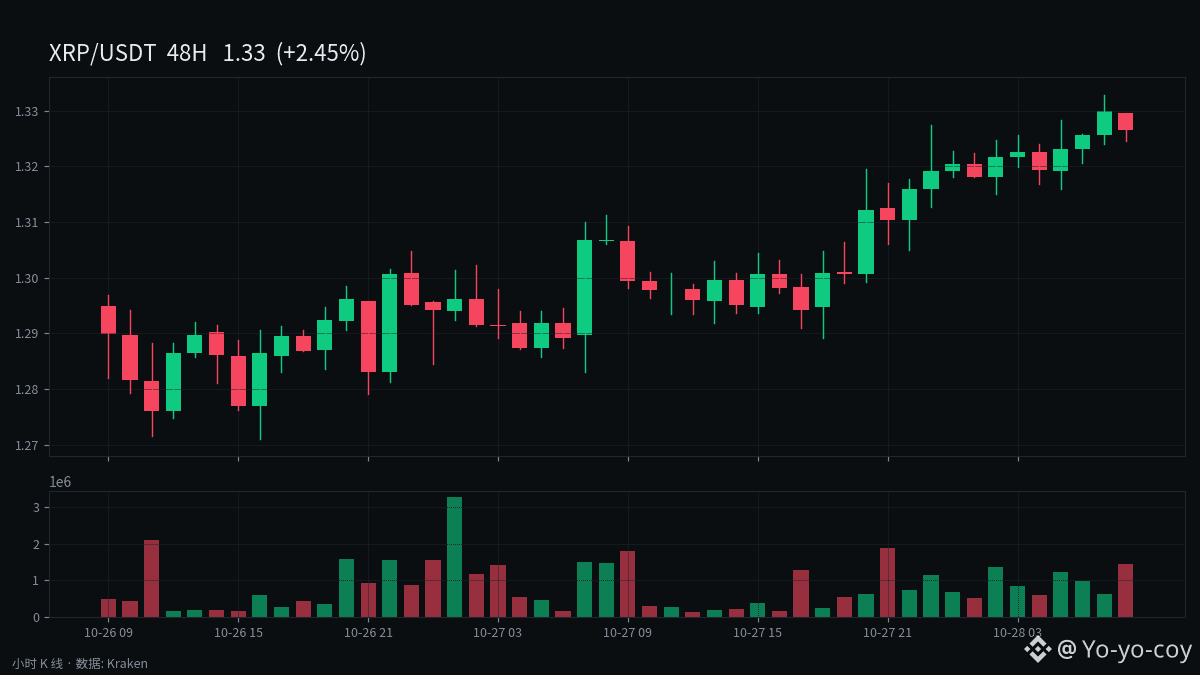
3. Price action: The closing price on October 27 was about $1.33, up roughly 1.6% on the day and 2.6% over seven days, with an intraday range of about $1.29 to $1.33. The price is still hovering around the $1.30 level; the approval did not trigger a breakout from the range on the day it was finalized.
Assessment: The regulatory charter strengthens the credibility of Ripple’s ability to conduct institutional business. In the short term, price action still hinges on whether it holds above or falls below the $1.30 level. The charter news itself is not evidence of a particular price direction.
#XRP #Ripple
Just my personal opinion; this does not constitute investment advice.