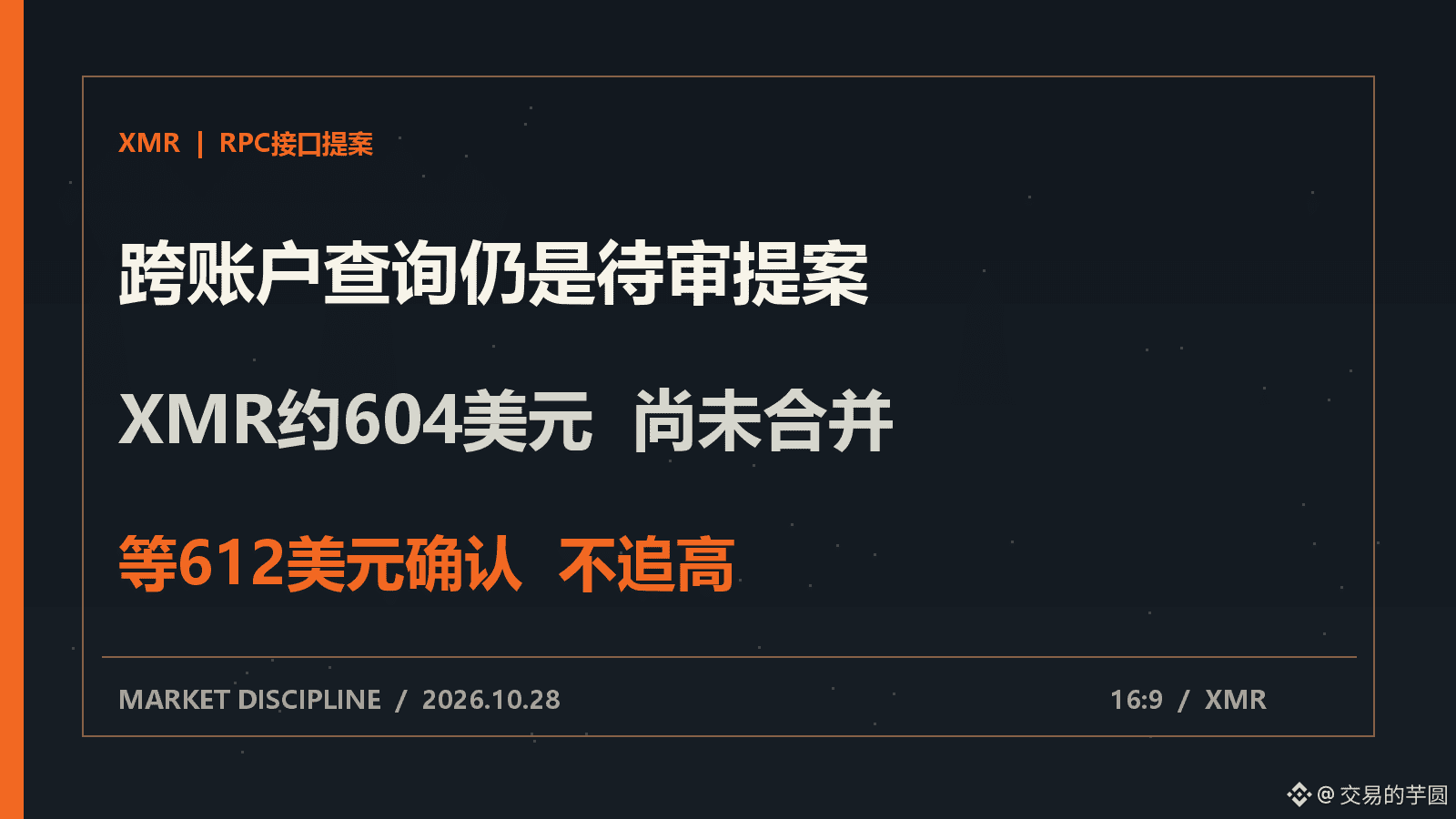
I’m keeping XMR on watch and won’t chase the rally yet | Monero wallet RPC cross-account query remains a proposal under review | Above $600, wait for confirmation
This cycle, I’m watching a project update that could easily be misread as “already upgraded.” On October 26, a pull request, #11626, appeared in Monero’s official code repository, proposing to add an all_accounts parameter to get_address and incoming_transfers. According to the submitter, with the current approach you have to make a separate request for each account to retrieve addresses and incoming transfer details across accounts. The new parameter is intended to allow a single cross-account query while preserving the default behavior of querying one account at a time. The page is currently clearly marked Open and awaiting review; the code has not been merged, let alone released as part of a wallet version. The GUI 0.18.5.4 release published by the project on the 16th is a separate, already-completed past event and cannot be cited as proof that this new interface is live.
Why am I paying attention to this kind of detail? For merchants or self-custody tools managing addresses across multiple subaccounts, a simpler query path could theoretically reduce the number of calls and the risk of missing data. But any real improvement in user experience would require code review, merging, testing, a release, and users upgrading. This is not a consensus-layer change, nor does it alter XMR’s supply or privacy transaction rules, so I won’t dress it up as news that will immediately boost demand. If compatibility issues emerge or the review leads to the proposal being sent back, the market narrative should cool accordingly. What matters more for traders is recognizing the time lag between a “proposal” and “delivery.”
How has the market reacted so far? At the time of writing, XMR/USD on Kraken was around $604, with a 24-hour low of $584.8 and a high of $611.77; the opening price was about $597. Compared with the same public market data from roughly an hour earlier, which also showed about $604, the price is still moving sideways around $600. This sideways action cannot be attributed to an RPC change that has not yet been merged. On the macro front, the Federal Reserve’s October 27–28 meeting has yet to produce a final decision; risk assets can see false breakouts as the announcement approaches. I’m using $611–$612 as the upside confirmation zone, $600 as the short-term dividing line, and $584–$585 as the bottom of the range. If the price spikes and then falls back below $600, that invalidates my cautiously bullish outlook; if it breaks below $584, I’ll exit rather than try to call the bottom.
If I were trading this myself, I wouldn’t chase the rally at this stage. I’d only prepare a spot long plan, using no more than 4% of my total capital for a single trade. I’d wait for the price to hold above $612 for an hour, then pull back to $610–$612 without breaking below, with confirmation that trading volume has not contracted significantly, before entering in two tranches. The first target is $625; I’d take half off there. The second target is $640, where I’d close the remaining position in stages. I’d set the initial stop-loss below $600; if the price falls back to $608 after entry and fails to recover within an hour, I’d close early. If the order book suddenly becomes volatile or spreads widen in response to the Fed decision, I’d cancel the plan and keep watching. No trigger means no trade; a plan should not be written up as if it has already been executed.
Sources: Monero’s official code repository PR #11626; project GUI release notes; public Kraken XMR/USD market data; Federal Reserve meeting schedule. #XMR
The above is solely my personal market observation and does not constitute investment advice.