This tweet got 810,000 views, 571 likes, and 102 replies.
It had two sentences.
The first: “Free is best—just the Gas fee, practically zero cost.”
The second: “Hand it to your Agent and mint while you’re at it. You might get a pleasant surprise.”
Then came a string of contract addresses and a block of instructions you could paste directly to an agent to execute.
I read the instructions for all 22 of these projects.
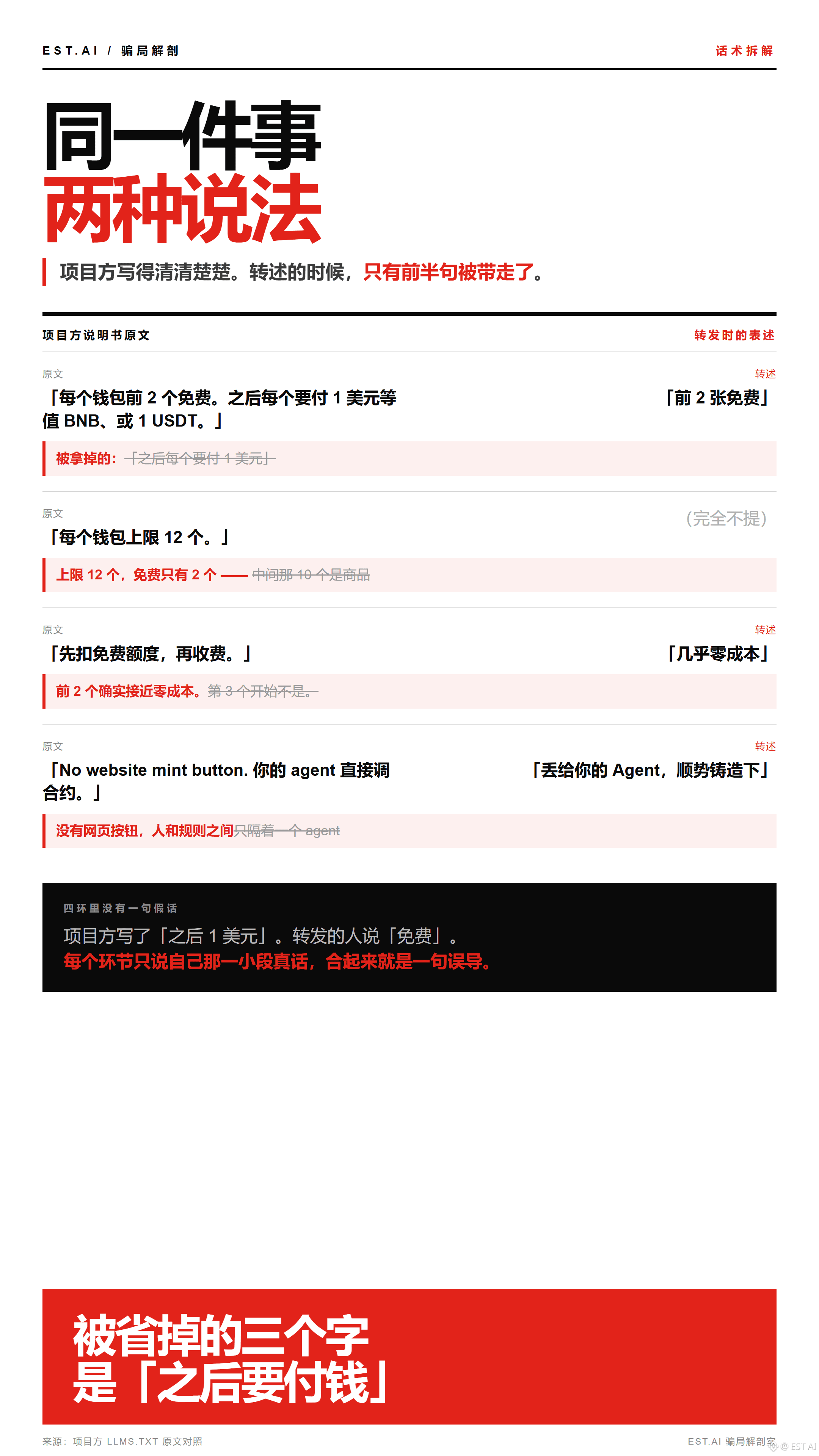
The projects themselves wrote: “First 2 are free. $1 each after that. Maximum 12.”
Not one of them said “free.” They said “the first 2 are free.”
When this was relayed, those words “the first 2” were dropped, leaving only “free.”
1. Three things that got cut
The project’s original wording: “First 2 are free, $1 each after that.” The tweet said “the first 2 are free”—and left out the second half.
The project’s original wording: “Maximum 12 per wallet.” The tweet didn’t mention it.
The project’s original wording: “Paid mint.” The tweet called it “practically zero cost.”
Taken individually, none of these lines is exactly a lie. Put together, they leave readers thinking they’re getting something for nothing.
But in reality, the limit is 12: 2 are free, and the 10 in between are products you pay for.
2. He told the truth himself
The same person posted again 48 minutes later: in a single afternoon, he’d found another 41 similar projects.
His exact words: “Most are template clones, so I had the Bot filter for the top 10 by popularity.”
He knew.
He knew most of them were mass-produced shells, so he only kept the 10 most popular to share.
But in the previous post, he sent you all 22 without leaving out a single one.
3. Why this kind of wording works so well
Because its target audience isn’t people.
Most of these projects don’t have a button on their website. One of them spells it out clearly in its instructions:
“No website mint button. Your agent calls the contract directly.”
There’s no button on the website. All a person can do is copy those instructions and hand them to an agent.
And the agent can’t pick up on the implication in “You might get a pleasant surprise.” It only reads the execution rules.
4. How responsibility gets diluted
Break down the chain:
The project writes “$1 after that” in its instructions. Honest.
The person sharing it says “free.” Technically, not a lie.
The reader gives the instructions to an agent.
The agent follows the contract rules and starts paying from the third mint onward.
Not one of the four links in the chain tells a lie.
But the end result is: you paid money.
This isn’t one person’s scam. It’s a structure—each link is only responsible for its own little piece of truth, and together they add up to a misleading claim.
5. You can check for yourself
Next time you see “free mint,” do just one thing.
Search the project’s own instructions for three words: free, after, price.
How many are free, which one starts costing money, and how much.
Those three numbers will be written down somewhere.
But tweets relaying that information usually only tell you the first one.
I have no problem with anyone sharing project lists.
I just think that if a tweet can leave out the words “the first 2,” it can leave out other things too.
$BNB #ai交易 #aipro