XMR | Official GUI fixes testnet wallet reopening issue | Security update doesn’t mean a price catalyst
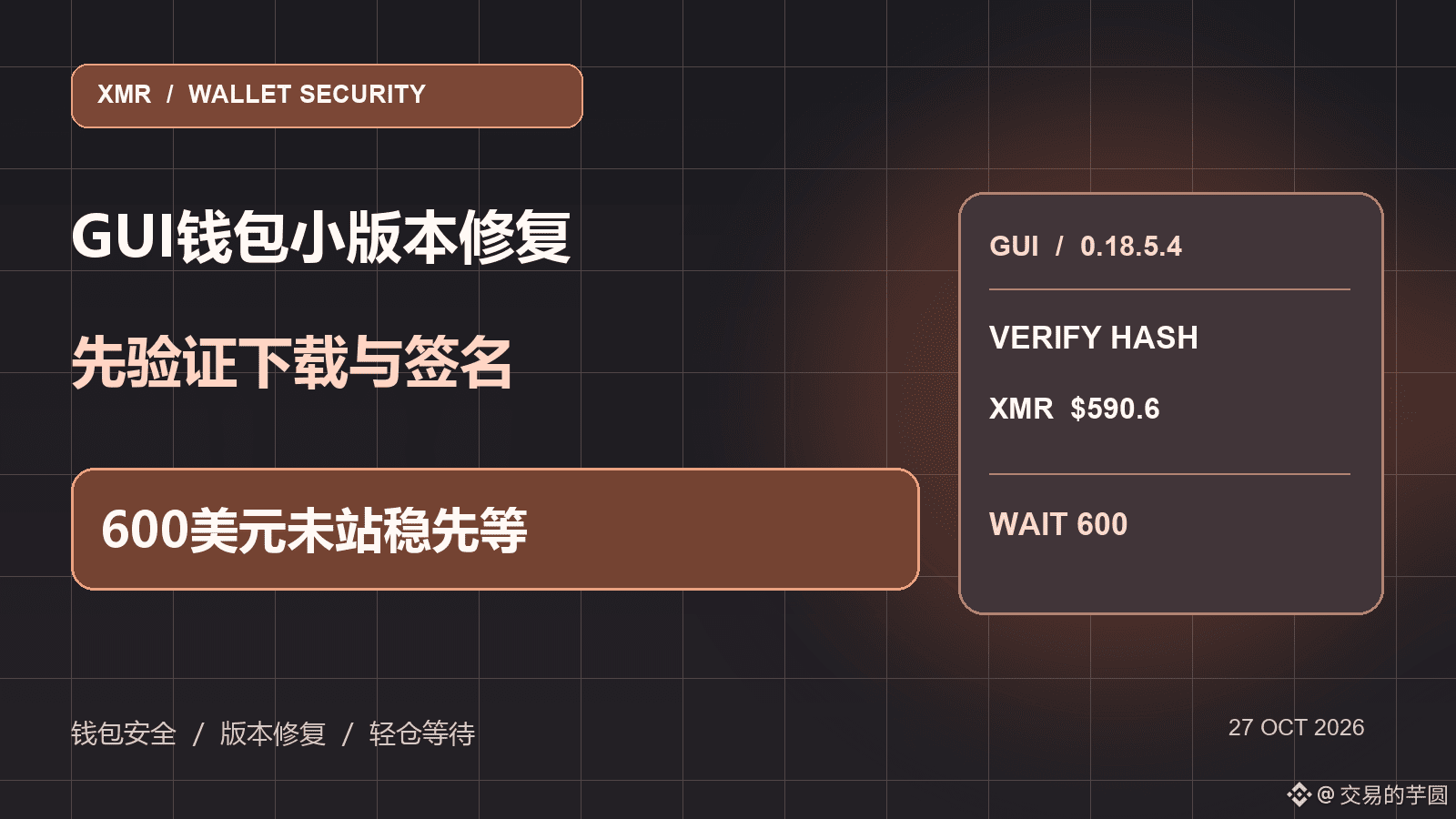
My stance is to prioritize wallet security and software provenance, while remaining on the sidelines for short-term trading. On October 16, Monero’s official website released GUI wallet 0.18.5.4, describing it as a minor bug-fix release. One fix addresses an issue with reopening testnet and stagenet wallets. The website also provides download links, SHA256 values for each platform, and a signed hash manifest. This should be distinguished from the previously discussed command-line node 0.18.5.4: the GUI release fixes an issue in the graphical wallet experience; it is not a new consensus upgrade today, nor does it mean that mainnet privacy or performance has suddenly improved. This round of trending topics on Binance Square leans toward the FOMC, BTC, and ETH, with no relevant trending tag that directly matches this Monero release, so I’m using only #XMR.
For ordinary users, software supply-chain risk is more concrete than a “bullish version update.” Unverified third-party installers may contain malicious code, and once private keys are exposed, no subsequent price movement can make up for the loss. The official instructions say to obtain binaries from its download page, verify the file’s SHA256 hash, and check the GPG signature on the signed manifest. Seeing someone share a download link on social media is not verification. Nor should the testnet and stagenet issue be exaggerated into a claim that all mainnet wallets are broken. From a market-mechanics perspective, reliable software maintenance can support long-term trust and make the software easier to use, but it’s difficult to quantify as a source of short-term XMR buying on its own—especially when volatility in risk assets is rising ahead of macro events.
The market reaction does not currently support chasing a long. At the time of writing, XMR/USD was around $590.6 on Kraken, below the UTC daily open of about $597. The intraday low was around $586.4 and the high around $611.8. These are exchange price ranges and do not prove that the wallet release caused the decline. My key level is $597–$600: I’d only discuss a continuing rebound if price gets back above and holds $600. Below that, $586 is short-term support; if it fails, the next level to watch is $575. If price breaks below $586 and fails to reclaim it, the long thesis is invalidated. If it pushes above $600 but quickly falls back below $597, I’ll treat it as a false breakout. When the market mistakes a software fix for a major protocol catalyst, patience matters more than getting in early.
If I were trading this myself, I’d stay out for now and only consider a small spot long. I’d enter with 2% of total capital only if the one-hour candle closes above $600, price retests $597 and holds, and there are no new security incident announcements. I’d first target $612 and sell half there, then look toward $625 while moving up my stop. My hard stop would be below $585. If, after entering, a one-hour candle closes back below $597, I’d exit proactively. If price first breaks below $586, I’d cancel the long setup and wait for the next price confirmation. Until these conditions are met, there is no trade; I won’t present observation as profit, and I won’t use high leverage just because of a maintenance release.
#XMR
The above is solely my personal market observation and does not constitute investment advice.