
These past few days, posts inviting people to vote for the top 100 creators have been everywhere on the Plaza. Few people know that the event’s sole sponsor is @KITE AI 中文 . I’d like to take this opportunity to share some of my recent thoughts on the Agent economy.
People talk every day about how much money AI can help us make, but few seriously consider one question: when AI actually does the work and earns money, how should that money be split? That’s why I started paying attention to $KITE again.
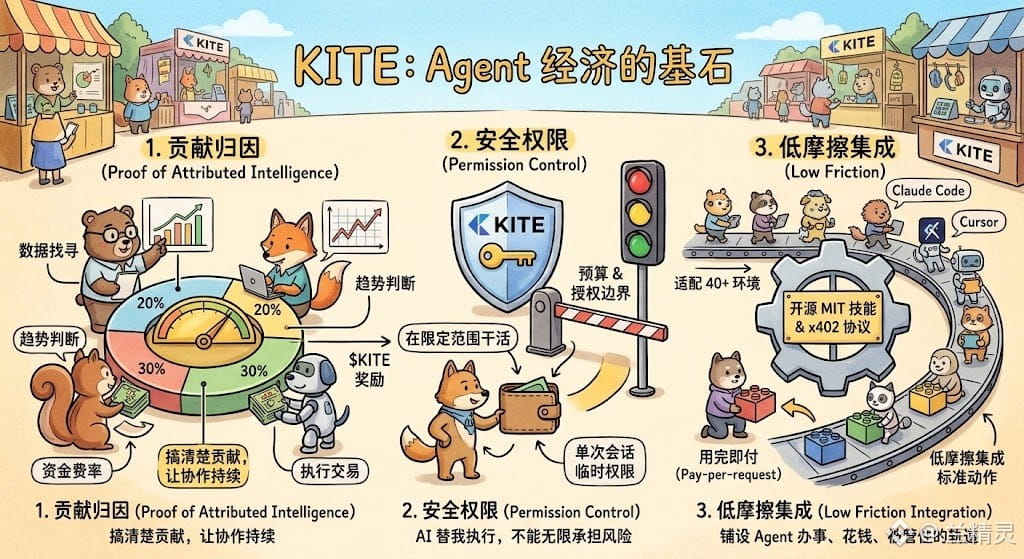
Here’s a simple example. I ask several Agents to research BTC together: one gathers data, one monitors funding rates, one assesses the trend, and the last one executes trades. Once they’re done, who should get paid? The data provider, the model provider, the computing provider, or the Agent that executes the trades? If contributions can’t be distinguished, collaboration can’t continue. Kite’s Proof of Attributed Intelligence is an attempt to clearly record and verify contributions, and attribute value to them.
Permissions are even more important. I’ve used a few AI trading tools before, and what worries me most isn’t whether they can operate, but who’s responsible for their wallet if they make a mistake. Kite’s approach is practical: users set their own budgets and permission boundaries, Agents can only work within those limits, and each session uses temporary permissions. For example, you can set rules for repaying USDC on Aave, and the Agent will act only when the conditions are met—instead of giving it unlimited permissions. AI can execute tasks for me, but it can’t take on unlimited risk on my behalf.
Next, let’s look at real-world implementation. In early October, Kite open-sourced 14 MIT-licensed Agent Passport Skills, compatible out of the box with more than 40 environments, including Claude Code and Cursor. Developers can call on them while building Agents without having to learn an entirely new system. Soon after, Ankr integrated x402 pay-per-request RPC, and the two jointly launched Forge Heat 2. The direction is clear: Kite isn’t building a single product; it’s laying down a set of standard procedures that let other Agents integrate with minimal friction. An Agent can use USDC and complete a transaction in a single request through 402 negotiation.
This isn’t a TVL story; it’s a story about integration density. The denser the toolchain, the harder it is to replace the settlement layer. What the Agent economy lacks isn’t a model that can chat, but the rails that let Agents spend money and get things done while remaining under control. Kite is laying those rails.
There’s still time needed to validate its real-world implementation, but at least the direction is right. #KiteBBW